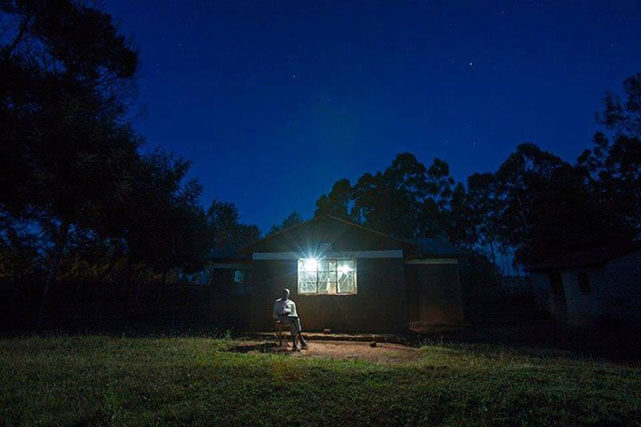
To a first visitor in Ng’ong’a village, South Kanyamkago location of Migori County, the sparkling bright lights illuminating homes during the dark night could be as a result of a well-thought out electrification programme initiated by government in the area.
However, a quick inquiry would inform the visitor that many of the bright lights seen flashing and twinkling within and around the local homes are actually generated from solar kits that have been fixed by majority of the area residents in the recent past.
The trend can be noticed in a number of villages dotting Migori County, where people are fast embracing off-grid lighting in a strategy aimed curbing expensive charges hooked to the official Kenya Power electricity transmission line.
Consequently, in the wake of the presence of many companies diversifying to offer off-grid lighting in Kenya, a huge population of people in Migori is now taking advantage of solar and dynamo-charged lighting approach, deemed to provide cleaner and safer energy options.
Several companies including Sun King, d.light and M-Kopa are now offering good and reliable solar kits that are cheap to handle and pay for the power emitted to light up homes.
The arrival of these companies with this form of power supply obviously justifies Kenya’s decision to go green with the best example remaining the use of geothermal energy in power production.
Caroline Otieno, a widow and mother of five from NyamiluVillage in Central Kanyamkago location, Uriri Sub County, says that she is now using solar 100 per cent to light up her home and even charge phones owned by her family members.
Contrary to the previous years, when Kerosene was the only source of fuel lighting up their small mud house, Otieno notes that their home is now free from the dark soot seen stuck on the family house walls and inside family members’ noses due to the frequent use of kerosene-powered candles made out of old cans.
“I can today confirm here that my family is no longer exposed to the risks of developing respiratory diseases because of the use of clean and cheap energy offered by these solar kits,” she told The Kenya News Agency (KNA) crew during a recent interview with her.
Kerosene was the single most important lighting fuel used by the low-income households before the solar- and dynamo-powered lamps were introduced.
According to a Kenya Integrated Household Budget (KIHB) survey conducted in the year 2013, an estimated three million homes, or 80 per cent of the population living off the electricity grid then, spent an average of Sh70 daily on kerosene and phone charging.
But the entry of more players in the clean and safer energy market today has drastically changed everything, with a huge population, hitherto disadvantaged in Migori, now rushing to fix their homes with solar- and dynamo-powered lamps.
Joel Makotsi, an environmentalist and an expert in clean and safer energy systems, notes that the entry of big players into the market is a welcome incoming tide that has changed the way Kenya protects its environment, while at the same time fixing cheap power to illuminate homes, once plunged in darkness.
“The multinationals’ activities bode well for the overall market development; they have proven experience in creating brands as well as markets to the benefit of solar- and dynamo-powered lamps,” declared Makotsi in Awendo town.
For instance, Safaricom in partnership with M-Kopa is known to have invented the first-ever GSM-enabled pay-as-you-go solar system in the world that customers pay for using mobile money.
By using embedded Safaricom SIM cards, M-Kopa solar allows a customer to enjoy a solar light home system while paying daily instalments of Sh40 via M-Pesa for a period of one year.
This credit-sale model targets low-income households in rural areas currently dependent on kerosene for lighting and local mobile bureaus for phone charging.
“However, the barrier to large-scale adoption of solar lighting still remains the high upfront cost of a home system, which makes it unaffordable to many rural residents. Indeed, the penetration of lighting products in Africa as a whole still remains at less than 2 per cent,” said Makosi.
He added, “M-Kopa Solar has been basically designed to remove this barrier by making solar home systems affordable and accessible to low-income consumers.”
However, though the number of solar lights and dynamo-powered lamps has increased tenfold in Migori County, triggering a mass of sparkling villages everywhere, there is a need to bring on board a huge population of poor people still forced to use the hazardous, polluting kerosene as a lighting source.
Meanwhile, the government’s initiative aimed at connecting rural residents to the national power main grid under the Last Mile Program is yet to bear the envisaged results mainly due to high connection charges.
By George Agimba