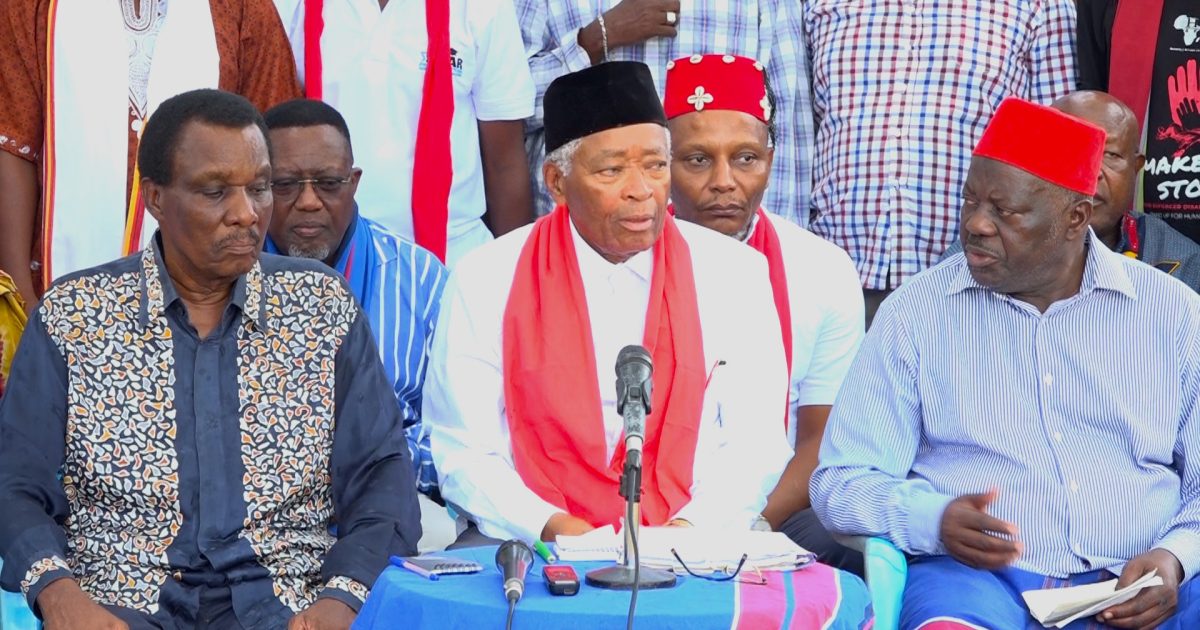
Mijikenda community leaders have urged the government to sustain and intensify the fight against drug and alcohol abuse, warning that the rising wave of juvenile gangs at the Coast is fueled by substance addiction among young people.
Speaking in Kwale County, the Mijikenda leaders attributed the mushrooming of machete-wielding gangs to drug and substance abuse, urging the government to declare an all-out war on drug barons, who they say are destroying the lives of youth, who end up engaging in criminal activities due to addiction.
Mijikenda spokesperson and former minister Amb. Ali Chirau Mwakwere said their analysis shows that most machete-wielding miscreants are boys aged between 13 and 14 years from the community.
He cited the widespread consumption of muguka, a variant of khat retailing at as little as Sh50, as a major contributor to the surge in crime, saying many youths have become addicted to it.
“Ask Kwale residents and primary schools along the highway where muguka is sold during break time. Learners buy Sh50 packets to chew from Msambweni, Kombani and other areas. They are addicted. They must have Sh50 to buy muguka, and when they miss it, they are ready to take machetes and rob,” said Amb. Mwakwere.
He condemned the juvenile gangs for terrorising people and urged the government to introduce stringent measures to control the consumption of muguka, terming it a ticking time bomb that threatens security.
“It depresses us to see our children turn into zombies through chewing,” he added.
The sentiments were echoed by former Kenya National Union of Teachers (KNUT) chairman Mudzo Nzili, who called on the government to tighten the noose to curb the entry of hard drugs such as cocaine and heroin.
He also called for the arrest of drug barons accused of destroying the lives of young people in the community.
“We believe the President, like us, should show love to the Mijikenda by curbing the entry of drugs into the Coast region. The President loves the youth; that is why he initiated the NYOTA programme,” he said, adding that youths addicted to drugs will not benefit from the programme.
Mijikenda youth leader Adnan Juma noted that many young people are drug users and urged the government to sustain the anti-drug campaign in the region.
“Drugs have significantly contributed to machete-wielding crime,” he said, calling for concerted efforts to save youth who are losing their productive years to substance abuse, with many ending up in prison.
On her part, Mariam Bindo urged police to address societal gaps contributing to the surge in crime before resorting to stringent measures. She alleged that some youths are pushed into criminal activities at a tender age due to drug abuse.
The appeal comes as the government declares alcohol and drug abuse a national development and security emergency, rolling out a coordinated, whole-of-government response to curb the production, distribution, and consumption of illicit substances, including bootleg liquor.
The move follows a recent presidential proclamation on alcohol and drug control, which calls for enhanced enforcement, prevention, rehabilitation, and asset recovery through inter-agency collaboration and expanded operational capacity.
In his recent address to the nation, the Head of State described alcohol and drug abuse as a silent but deadly crisis threatening the country’s health, security, and economic future.
To strengthen the fight, the Anti-Narcotics Unit within the Directorate of Criminal Investigations will be enhanced with operational capacity similar to that of the Anti-Terrorism Police Unit.
The unit will be equipped with modern tools for surveillance, intelligence gathering, forensic analysis, and financial investigations.
It will operate as a permanent multi-agency formation, working closely with the National Authority for the Campaign Against Alcohol and Drug Abuse (NACADA), the National Intelligence Service, Border Management Agencies, county governments, and international partners.
The Assets Recovery Agency has also been tasked with tracing, seizing, and forfeiting to the State assets used in or acquired through the narcotics and illicit alcohol trade.
By Sadik Hassan