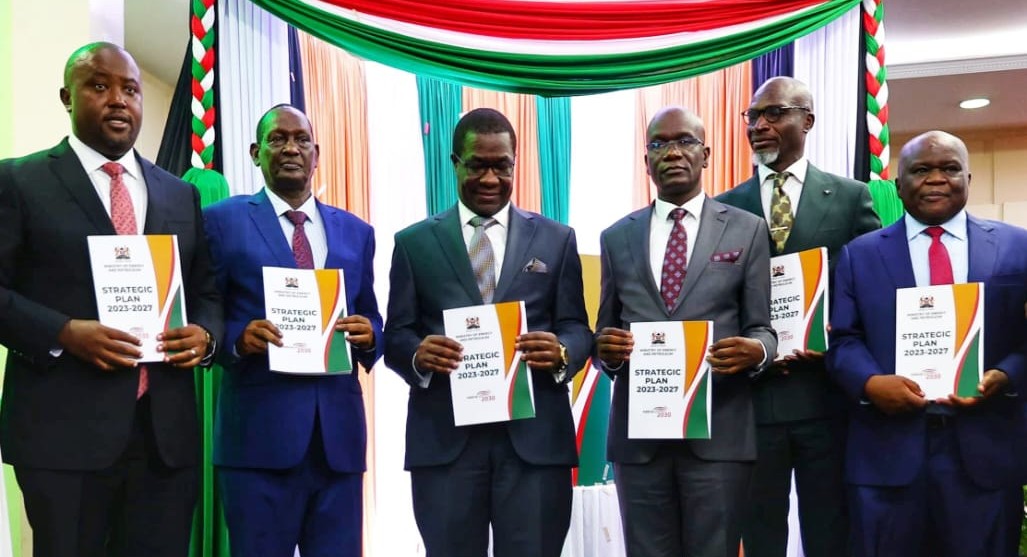
The Ministry of Energy and Petroleum has launched its Strategic Plan for the period 2023–2027 which aims at transforming Kenya’s energy sector through policy reforms, infrastructure development, and the adoption of clean energy technologies.
Speaking during the event held in Nairobi at the Kenyatta International Convention Centre (KICC), Cabinet Secretary (CS) for Energy and Petroleum, Mr. Opiyo Wandayi, noted that the new Strategic Plan reflects the Ministry’s forward-looking agenda to power Kenya’s economic growth and meet global energy targets.
“The energy and petroleum sectors are critical enablers of our development agenda and also a key driver of the nation’s socio-economic transformation,” said the CS.
Wandayi commended the ministry’s achievements under the previous strategic cycle (2018–2022), highlighting the enactment of the Energy Act, 2019 and Petroleum Act, 2019, which he said laid a strong legal foundation for sector reforms.
He also praised the development of major policies, including the Energy Policy 2018 and Petroleum Policy 2018, as well as the Kenya National Energy Efficiency and Conservation Strategy, 2020.
“We acknowledge the efforts of the Energy and Petroleum Regulatory Authority (EPRA) in aligning regulations to these statutes. While we are not yet at the finish line, the progress made is commendable,” said Wandayi.
The CS further disclosed key institutional reforms underway, including the transformation of the National Oil Corporation of Kenya (NOCK) through a new business model supported by strategic partnerships.
“The Kenya Petroleum Refinery Limited is currently undergoing restructuring, and its functions are being transferred to the Kenya Pipeline Company to consolidate petroleum logistics under one entity. Kenya Power has also made significant strides towards achieving commercial sustainability.” Said the CS
CS Wandayi emphasized the Ministry’s resolve to expand access to clean and renewable energy, with renewables currently accounting for 93 per cent of Kenya’s energy mix.
“As a Ministry, we are fully committed to implementing this Strategic Plan. We must act with urgency, maintain transparency, and embrace inclusive stakeholder engagement,” said Wandayi.
Furthermore, he urged sector leaders to uphold the highest standards of governance and accountability.
Principal Secretary (PS) for the State Department for Energy, Eng. Alex Wachira, described the launch of the Strategic Plan as a major achievement for the Ministry.
“The 2023–2027 Strategic Plan addresses longstanding challenges in the energy sector, including affordability, reliability, and sustainability,” noted PS Wachira.
The PS for the State Department for Petroleum, Mr Mohamed Liban, applauded the planning teams from both departments for ensuring inclusive public participation across the country.
Presenting the strategy, Director of Planning Lucy Gaithi noted that the plan aligns with Kenya’s Vision 2030, the Bottom-Up Economic Transformation Agenda (BETA), Africa Agenda 2063, and the Sustainable Development Goals (SDGs).
Gaithi cited a 40.9 percent increase in national grid capacity from 2,351 megawatts to 3,312 megawatts. Additionally, 1,661 kilometres of transmission lines, five high-voltage substations, and over 6,000 kilometres of medium-voltage lines were developed. Electricity access rose to 75 percent with 2.43 million new customer connections.
The new plan also identifies critical challenges such as power losses, infrastructure vandalism, funding shortfalls, land acquisition delays, and emerging issues like AI, e-mobility, and global energy market instability.
She emphasized that the Strategic Plan is a collective vision and a guiding framework for the sector’s future. She called for continued collaboration, innovation, and firm leadership to ensure its successful implementation.
The launch marks a big step in Kenya’s energy transition journey, with stakeholders optimistic about delivering reliable, sustainable, and affordable energy to all Kenyans.
By Fride Amiani and Victor Kiplagat