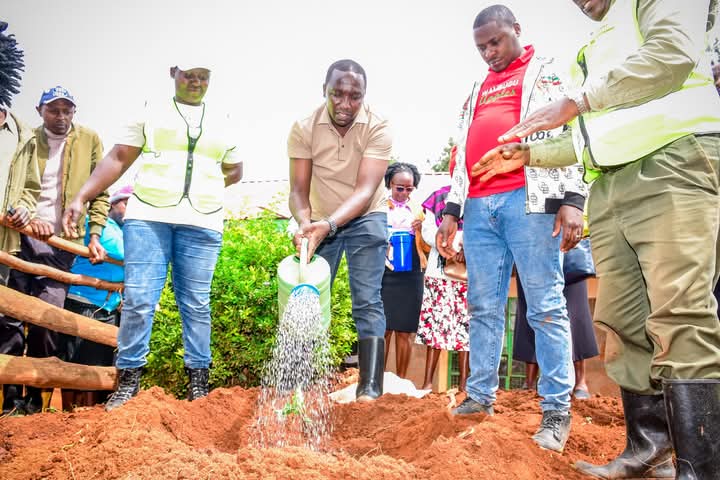
Schools in Murang’a County are continually embracing the growing of fruit-bearing trees, a major shift from the growing of the indigenous and exotic trees.
This shift is significantly solving two major problems, including environmental conservation to mitigate the effects of climate change and offering improved nutritional benefits for the school populations while contributing to a more vibrant ecosystem.
Various stakeholders, including elected leaders, are championing this fruit-bearing tree-growing initiative, which is further contributing largely to the government’s goal to plant 15 billion trees by 2032 as part of a larger plan to increase tree forest cover to 30 percent.
The initiative aims at reducing greenhouse emissions, halting and reversing deforestation, and restoring degraded landscapes.
Speaking during the launch of the fruit trees growing initiative in public institutions under the theme ‘Children and a Greener Planet,’ CEO of Unaitas Sacco Society Limited, Martin Muhoho, observed that the Sacco aims at planting one million fruit trees by the year 2030.
“In this first phase of this initiative, we have planted 70,000 hass avocado trees in 11 public primary schools across Murang’a County”,
“We are looking to inspire the next generation to stir a sense of responsibility for the environment as our source of livelihood and create a connection between happier people and healthier ecosystems,” he said
He emphasized that the impact of time and growth will be realized and experienced by the learners as they witness the young seedlings, they have planted feed generations to come.
In Kangema constituency, the area member of parliament has been championing and supporting the growing of fruit trees in primary public schools in the area.
In a recent drive, 11 schools received over 100 apple tree seedlings each complete with agricultural support for the learners, teachers, parents and the community surrounding the schools.
Kihungi noted that planting fruit trees in learning institutions is a vital step towards a greener, more food-secure, and an economically empowered society.
“This initiative will offer the learners a hands-on learning experience as recommended in the Competency Based Curriculum matters plant biology, sustainable agriculture and the importance of food security as they participate actively in the planting and nurturing the trees and ultimately the harvesting of the fruits,” he said
“Through our NG-CDF we have an environmental kitty whereby last year we planted avocado trees in our 10 schools but this year we have considered the Wambugu apple species which is doing well in this climatic condition and we have done that in 11 schools” the MP stated
Moreover, he noted that using schools as a demo will encourage the farmers around the selected schools to venture into apple farming, which will in turn improve the economy of the area through an empowered society.
“When we planted Hass avocados in our 10 schools, the community surrounding the schools also ventured into the farming, and collectively we are greening Kangema as well as filling the country’s food basket.”
At Mukarara Primary School, the Wambugu apples planted over a month ago continue to thrive with the ongoing rains catalyzing the growth: the high-yielding variety planted is expected to yield its first harvest on the ninth month after planting.
Subsequently, the tree bears fruit three seasons in a year, with each tree producing between 300 and 400 fruits yearly for up to 400 years, benefiting generations, thus making it even more sustainable.
Ruth Maina, the head teacher, lauded the initiative, noting that the fruits will be beneficial to the pupils due to their high nutritional value.
“This is a resource economically and in future we will be able to sell the surplus and generate income to meet some of the institution’s needs” she said
The nearby Muguru Primary School currently boasts 100 apple trees courtesy of the legislators’ initiative and over 100 Hass avocado trees courtesy of the Unaitas Sacco Society Limited.
The fruit-bearing tree planting exercise is set to be achieved in two phases during the major rainy seasons in the country.
By Florence Kinyua