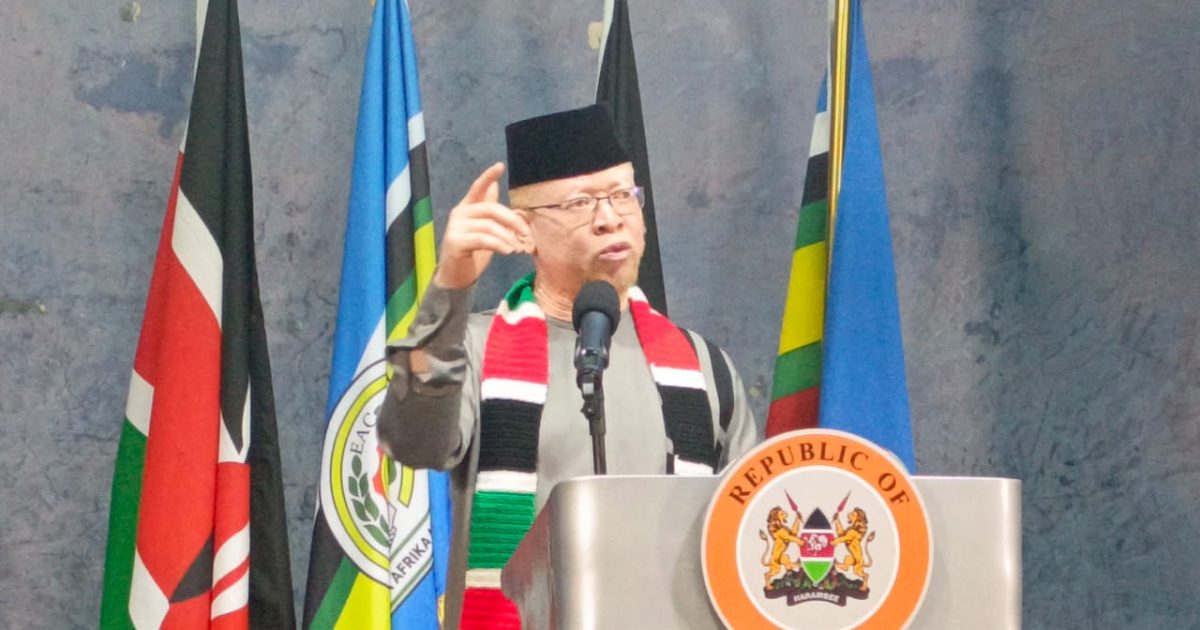
Government spokesperson Isaac Mwaura on Friday delivered his final weekly briefing of the year, highlighting the country’s major economic milestones and progress under the First World Transformation Agenda.
Speaking during the briefing in Nairobi, Mwaura announced that the government has created over two million jobs across multiple sectors, emphasising that the country is transitioning from a third-world economy defined by exclusion to a first-world economy anchored on productivity, economic freedom, and shared opportunity.
“The bottom-up economic transformation agenda has opened access to capital markets, skills, and modern systems for millions of Kenyans previously locked out of formal economic life,” Mwaūra stated, noting that these efforts are reshaping Kenya’s economy and ensuring more citizens can participate meaningfully.
He highlighted stabilisation in macroeconomic indicators, noting that inflation has declined from 9.6 percent to 4.6 percent, while the shilling has stabilised against the U.S. dollar, supported by strong exports and record diaspora remittances exceeding Sh 660 billion.
“Diaspora investment is now a cornerstone of our economic growth strategy, and we have developed a guidebook to facilitate their engagement,” added Mwaura.
According to Mwaura, the government has shifted policy from consumption subsidies to production-led support, resulting in over 7.1 million digitally registered farmers and the distribution of 21 million bags of subsidised fertiliser, reducing costs by Sh 5,000 per bag and saving farmers an estimated Sh 105 billion.
“By supporting our farmers to produce more efficiently, we are securing food, incomes, and the future of rural communities,” he asserted.
Additionally, the government spokesperson observed that agricultural production has seen notable gains, with maize production projected to rise to 67–70 million bags, while tea earnings reached Sh 215 billion and coffee exports increased by 73 percent, boosting rural incomes and improving food security.
Likewise, he reported that the revival of cotton ginneries in counties including Busia, Mugomoa, Kitui, Embu, and Kakamega has created 700 direct jobs, while the distribution of 100 high-volume grain dryers is expected to generate over 10,000 rural jobs.
On the other hand, Mwaura also touched on the Hustler Fund, which has disbursed over Sh 80 billion, helping 26 million Kenyans secure formal credit scores and enabling 3 million MSMEs to access formal banking services.
“Financial inclusion is no longer a promise; it is a reality for millions of Kenyans,” he affirmed, stressing that over 800,000 Kenyans can now access loans up to Sh 150,000 without collateral, benefiting an estimated four million dependents.
Similarly, Mwaura said the NYOTA youth programme targets 820,000 young people, providing financial support, entrepreneurship training, and mentorship to equip them with skills for economic participation.
“Refurbished Constituency Industrial Development Centres are expected to generate 9,000 jobs, while linking enterprises to local and international markets has created an additional 2,001 positions, expanding opportunities for young and small-scale entrepreneurs,” he disclosed.
In the meantime, the government spokesperson maintained that infrastructure development remains a priority under the government’s First World Transformation Agenda.
Mwaura divulged that the National Infrastructure Fund and Sovereign Wealth Fund are mobilising resources from divestments and mineral royalties to finance large-scale development projects across the country.
“Affordable housing initiatives, with 230,000 units currently underway, are supporting over 428,000 jobs, providing homes while stimulating construction and allied sectors,” he revealed.
Concurrently, he mentioned that ongoing educational and health infrastructure expansion continues to improve access and service delivery in underserved areas.
Further, Mwaura pointed out that the government has also prioritised Kenya’s digital economy, with 24,000 km of digital superhighways laid, 1,500 public hospitals brought online, and 22,500 government services digitised, generating over Sh 1 billion daily in efficiency and productivity gains.
“Digital transformation is not just a vision; it is a tool empowering our citizens to earn, learn, and access services seamlessly,” Mwaūra assured.
He outlined that over 300,000 young Kenyans are now earning through online freelancing, e-commerce, and creative industries, opening new income streams and opportunities for innovation.
Equally, Mwaura pronounced that tourism, a major foreign exchange earner, recorded strong performance, with earnings rising to $452 billion and international arrivals increasing to 2.4 million, supporting over three million jobs across the sector.
In addition, the government spokesperson confirmed that Kenya has also signed six bilateral labour agreements, generating 452,000 overseas jobs, expanding opportunities for skilled and semi-skilled workers abroad.
Collectively, Mwaura reaffirmed that the government’s shift from short-term consumption-focused policies to production-led support has created a multiplier effect across sectors, linking job creation, financial inclusion, agriculture, infrastructure, housing, digital transformation, and tourism.
“Our goal is to ensure that every Kenyan, from our farmers to our youth, participates meaningfully in the nation’s transformation,” he assured.
“We are laying the foundation for a Kenya that is prosperous, inclusive, and resilient,” he added.
Ultimately, the government spokesperson emphasised that the bottom-up economic transformation approach ensures equitable access to opportunities and resources. By empowering citizens to participate fully in the economy, Kenya is moving closer to achieving sustainable growth and the broader objectives of the First World Transformation Agenda.
Meanwhile, the figures presented by Mwaura underline the government’s commitment to inclusive growth, noting that job creation, financial inclusion, and agricultural productivity are complementing infrastructure development and digital innovation to enhance livelihoods nationwide.
By Naif Rashid