For decades, the university has been viewed as the gateway to status, stability and professional careers. On the other hand, Technical Vocational Education Training (TVET) institutions carried a stigma of being a fallback.
The above scenario is, however, changing, with a growing number of youth who scored impressive grades in last year’s Kenya Certificate of Secondary Education (KSCE) in Nakuru County challenging the narrative.
Faced with a labour market that rewards practical skills, many students in Nakuru who have qualified to join university have instead opted for shorter, more affordable and industry-aligned TVET programmes.
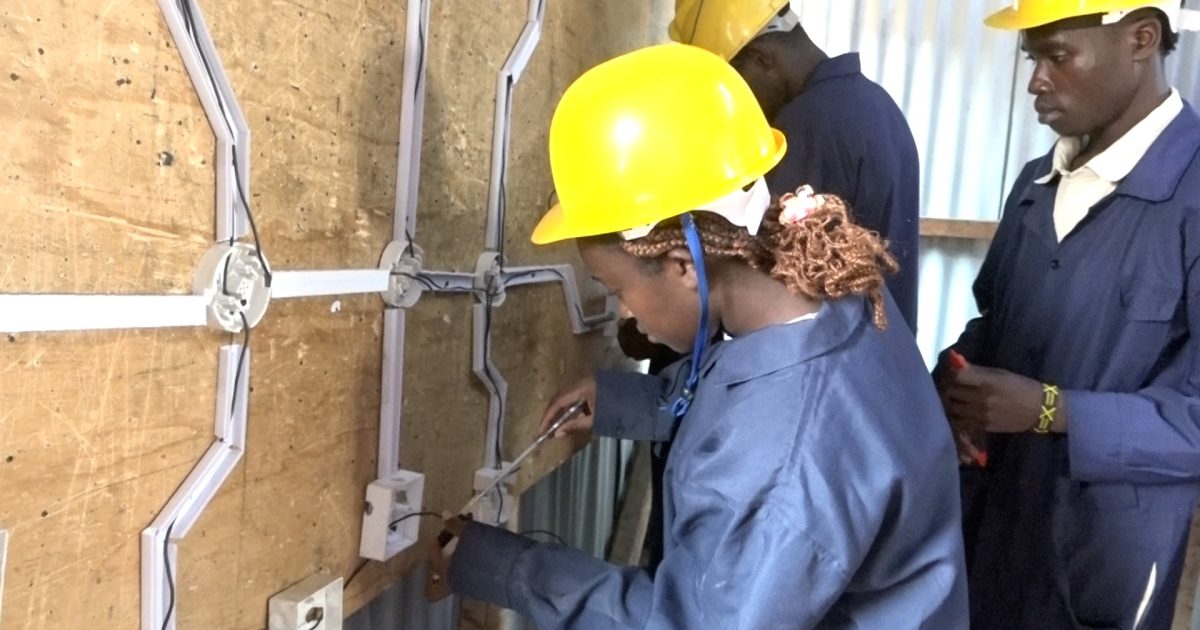
One such student is Mercy Wairimu who after scoring an A- (minus) grade in Kenya Certificate of Secondary Education examination in 2025, vowed to pursue her passion. She wants to be an electrical technician.
Luckily for the 18-year-old, her parents are very supportive of her dream and have allowed her to enrol at a technical vocational education training institute to chase her dream.
“This is a dream come true as I wanted to be an electrical technician all along. My father knew I had a passion for electric wiring and that is why he has supported me to pursue it,” she stated.
Ms Wairimu explained that at a tender age, she would dismantle electric objects such as an iron box, separate the parts and reassemble them successfully with ease.
Ms Wairimu joins more than 50 students at Rift Valley Institute of Business Studies (RVIBS) who have qualified for university admission but have opted to pursue diploma courses at the technical and vocational institution.
Dressed in a navy blue overall, Ms Wairimu is the only female student in a class of 28 pursuing an electrical technician course at the Rift Valley Institute of Business Studies (RVIBS) in Nakuru. She is a trailblazer in a technical field regarded as the preserve of men.
She was happy that with technical skills there were ready jobs and guaranteed incomes. Unfortunately, she said women shunned the practical skills sector because most of them do not want to handle dirty stuff, yet they want money to pay their bills.
Ms Wairimu indicated that national and county governments have good and adequate policies and programmes which, if fully implemented will lift up women in the informal sector.
Official data shows that enrolment in public universities has dipped in recent years leading to the intake at technical colleges offering diploma and certificate courses increasing to 22 percent.
The increasing number of students qualified for university entry that are snubbing university education is a departure from the past when degrees were viewed as a ticket for job placement and promotions in the workplace.
Ms Wairimu attributed the new trend to various initiatives by the government that have made technical education attractive, affordable and accessible to most Kenyan youth.
“The current administration has been reviving technical colleges, a departure from the trend set by previous regimes of converting mid-tier colleges into universities. This led to an increase in mismatch of skills and job market demands,”
She further noted that the government also opened funding from Higher Education Loans Board (HELB) to students joining TVETs, a shift from the past where loans were available only to students admitted to universities.
Rift Valley Institute of Business Studies (RVIBS) Director Mr John Gitau stated that TVET matches well with the competency-based curriculum (CBC) that puts more emphasis on nurturing practical skills among learners as opposed to amassing certificates based on theory learning.
He said in its effort to boost the popularity of technical schools, the National Treasury rolled out tax rebates for employers that offered one-year internships to TVET graduates further boosting the appeal of the institutions.
He observed that the push for 100 percent transition from primary school to secondary school was offering hope for TVET institutions’ increasing enrolment.
He expressed concern that currently, the country was fighting a skills shortage that was hindering the smooth implementation of industrial growth adding that TVETs are centres that produce highly skilled manpower to ensure industrial development, which is still lagging behind in the country.
“We must refocus higher education by promoting technical and vocational training and changing the degree curriculum,” Mr Gitau said.
The director argued that the success of Kenya’s growth ambitions was hinged on an adequate supply of a critical mass of technical skills. He says in countries such as Germany and the Netherlands, the majority of those graduating from secondary school prefer technical colleges to universities.
Technical colleges if well-equipped and managed, he added, were actually the bearing of a nation’s economy, which he said were the hands that do the actual job, conceptualised by professors, engineers, researchers and university scholars.
However, he dismissed the idea that the rise in popularity of technical colleges could be interpreted to mean that university degrees and education were becoming useless. Instead, Mr Gitau noted the need for the two to work together to achieve a greater purpose of economic growth.
“Although there is a perception that getting a job after graduating from university is still difficult, university education is still viewed as important but we should not kill polytechnics and other technical schools by converting them into universities,” he says.
18-year-old John Njoroge who scored a B plain in the 2025 KCSE is elated that the Kenya National Qualifications Authority (KNQA) is now recognising certificates issued to informally trained artisans and professionals who pass practical tests conducted by various authorities.
Under the new arrangement, the Kenya Accountants and Secretaries National Examination Board (KASNEB), Kenya National Examinations Council (KNEC), National Industrial Training Authority (NITA) and Curriculum Development, Assessment and Certification Council (CDACC) issues academic certificates based on practical performance as opposed to written examinations.
This, he said meant that a jua kali-trained tailor, carpenter, mechanic, sculptor or plumber who had never sat in a formal classroom or Technical Educational and Vocational Training Institutes (TVETs) may be issued with a recognised certificate just as his counterparts who have undergone years of formal training.
He indicated that there was a need for youths to embrace blue- as opposed to white-collar jobs through training of artisans because labour was scarce in these fields.
“Artisan jobs are not attractive to many because there is a perception they are for primary and secondary school dropouts. This is what we want to change,” he said.
He said there was a ray of hope after enhanced investments in TVET education by the state which was also giving out incentives to promote artisan businesses.
Phillip Gichohi, an electrical installation instructor, emphasised that an effective Technical and Vocational Education Training (TVET) system will play a key role in achieving Kenya’s leap to industrialisation and Vision 2030.
Mr Gichohi expressed concern that Kenya is grappling with a severe shortage of qualified electrical technicians, plumbers and masons as students avoid technical education in favour of courses leading to perceived glamorous careers, leaving property developers at the mercy of uncertified artisans and compromised standards in the construction sector.
He indicated that there are more quantity surveyors, engineers and architects that universities are churning out than the number of skilled artisans graduating in technical vocational education training institutes (TVETs) and polytechnics leading to a serious labour imbalance in the crucial sector.
“Kenya could be sitting on a labour time bomb in the face of glaring skills shortages in the critical building sub-sector, calling for speedy interventions from both the government and the private sector. The perception that technical jobs pay poorly is partly to blame. There is clearly a mismatch between the job market needs and training,” the instructor said. He noted that the number of carpenters, welders, electricians and painters has also dipped.
In Nakuru, for instance, there are at least 500 architects and engineers, against about 200 trained artisans specializing in masonry, plumbing and painting, a situation that should ordinarily be the other way round, Mr Gichohi noted.
By Esther Mwangi and Dennis Rasto