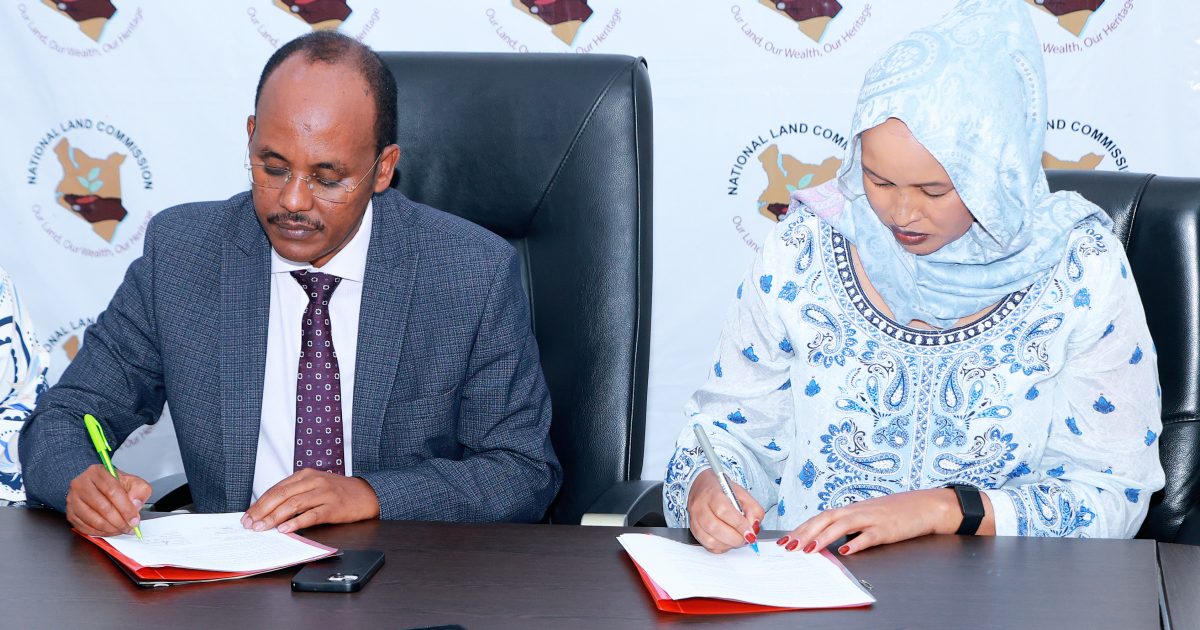
The National Land Commission (NLC) and the Community Land Action Network (CLAN) have renewed their Memorandum of Understanding (MoU), reaffirming a long-standing partnership aimed at strengthening community land tenure, deepening policy dialogue, and addressing historical land injustices across Kenya.
The renewed MoU, which will run until April 2027, builds on an earlier agreement first signed in 2021. It reflects sustained collaboration between the constitutional commission and civil society actors who work closely with indigenous peoples and local communities to safeguard community land rights.
Speaking during the signing ceremony held at the NLC Headquarters in Nairobi, NLC Chief Executive Officer Kabale Tache highlighted the achievements of the previous partnership and underscored the shared vision guiding the renewed agreement.
“Our partnership with CLAN brings the authentic voices of rural communities, indigenous peoples, and grassroots organisations into our constitutional mandate,” “Their work on the ground complements our responsibilities perfectly, and together we are able to translate policy into practical protection for communities.” Tache said.
She explained that the MoU supports the Commission’s constitutional mandate under Article 67 of the Constitution, which includes managing public land, advising the national government on comprehensive land registration programmes, investigating historical land injustices, promoting culturally appropriate dispute resolution mechanisms, and monitoring land use planning across the country.
“The practical implementation of this MoU is not merely symbolic,” Tache noted. “The Commission will convene technical working groups, mobilise resources, provide data, and ensure that all processes feed into relevant national policies.”
Under the renewed partnership, CLAN will organise community resource persons, implement interventions in targeted counties, support community engagement processes, and monitor transitions on the ground to ensure that community land rights are respected and protected.
Acknowledging the central role of communities, Tache assured those present that the Commission remains committed to recognising and protecting customary land rights.
“To the communities represented here today, this partnership affirms that your customary land rights matter to us. Your traditional knowledge in managing natural resources is valued, and your voices will continue to be heard in policy dialogues,” she said.
She further noted that the renewed MoU will serve as a model for how government institutions and community-based networks can work together, demonstrating interdependence while leveraging complementary strengths to achieve shared objectives.
In his remarks, CLAN President Dr Abubakar Lewano described the renewal of the MoU as a major milestone in the ongoing struggle to secure community land rights.
“For indigenous peoples and local communities, land represents identity, livelihood, and heritage,” Dr Lewano said. “Yet community land has long remained the most vulnerable form of land tenure in Kenya.”
He said the partnership reaffirms a shared commitment to giving practical effect to the Constitution and the Community Land Act.
“CLAN brings the voice, trust, and lived realities of communities, while the National Land Commission provides constitutional authority and leadership. Together, we can turn policy commitments into real protection on the ground,” he stated.
Chairperson of the NLC Partnership Committee, Commissioner Tiyah Galgalo, praised CLAN for its role in mobilising communities and providing critical support in areas where government resources are limited.
“We are here to witness the signing of this renewed MoU, and we want to sincerely thank CLAN and its leadership for the support they provide,” Galgalo said. “Your contribution in financing, mobilisation, and community representation is invaluable.”
He added that the partnership has already delivered tangible results, particularly in addressing historical land injustices.
“We have worked together before and achieved significant milestones. Many communities have secured their fair share of land rights thanks to this collaboration, and we believe this renewed partnership will deliver even greater impact,” he said.
NLC Commissioner Esther Murugi also highlighted the practical impact of the partnership and the importance of sustained cooperation between the Commission and community-based organisations.
“On behalf of the National Land Commission, we want to say thank you for this collaboration,” Murugi said. “Our work with the Ogiek community, for example, stands out as a success story.”
She noted that even a single historical land injustice claim requires significant financial, technical, and professional resources.
“Through this renewed MoU, we hope to mobilise and provide these resources so that more Kenyans can access justice and feel fully recognised as citizens of this country,” she said.
Murugi emphasised that formalising the partnership allows for streamlined coordination, shared expertise, and pooled resources, which is especially critical amid increasing pressure on community lands from competing development, conservation, and commercial interests.
On her part, CLAN Steering Committee Chairperson Samante Anne underlined the importance of long-term collaboration between state and non-state actors in protecting communal land rights.
“This being the second renewal of the MoU demonstrates a strong commitment to securing community land rights,” Anne said. “Partnerships like this provide a platform for joint resource mobilisation and amplify our collective voice with development partners.”
She expressed hope that the collaboration would continue beyond 2027, noting that the need to protect community lands remains urgent and ongoing.
Several speakers at the event emphasised that secure community land tenure underpins not only livelihoods but also cultural preservation and environmental protection.
“This partnership is not just about managing land,” Tache reiterated. “It is about protecting communities, safeguarding their knowledge systems, and preserving their heritage for future generations.”
The renewed MoU is expected to strengthen coordination between the National Land Commission, the National Land Secretariat, and community networks across the country. By enhancing collaboration, the partnership seeks to ensure that community land rights remain central to Kenya’s land governance, social justice, and sustainable development agenda.
By Naif Rashid