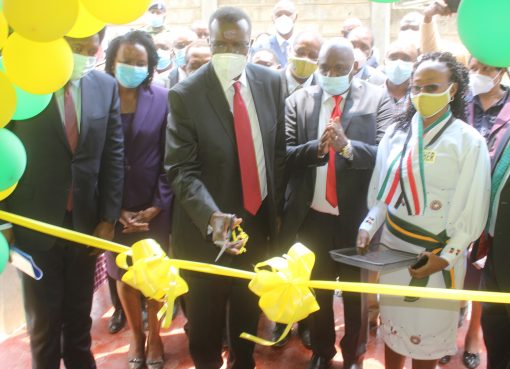
A community-driven peacebuilding forum was convened, Tuesday, in Chesongoch, Elgeyo Marakwet County, bringing together stakeholders from Elgeyo Marakwet, West Pokot and Baringo counties, to deliberate on sustainable strategies to address inter-communal conflict and to enhance security in the North Rift region.
The meeting was facilitated by the National Steering Committee on Peacebuilding and Conflict Management (NSCPCM), domiciled within the Ministry of Interior and National Administration, and attended by peace stakeholders, including county commissioners, local leaders, and security officials from the three counties.
The Committee concurred on the essence of dialogue in resolving long-standing hostilities and sought to understand and share common perspectives on the root causes and impacts of conflict within the communities openly, frankly, courageously and respectfully.
The objective of the consultative forum is to brainstorm on the community-driven solutions that directly address the challenges and to discuss viable peacebuilding mechanisms that can be implemented sustainably, for the long-term benefit of the people in the area.
The forum also enabled the communities to learn from best-practice of peaceful coexistence models adopted in other conflict-affected regions, while serving as a platform to present and validate, a joint community-driven peacebuilding plan, for collective consideration and ownership.
Baringo County Commissioner, Stephen Kutwa, expressed satisfaction with the relative stability experienced across the North Rift.
“We are thankful for the peace that is being realised in the region. Incidents of banditry, cattle rustling, and killings have reduced significantly,” he observed.
Mr. Kutwa emphasised that the NSCPCM had successfully convened the three counties, to chart a collaborative framework with security agencies, aimed at consolidating peace and security gains in the region.
“We are expecting the communities to develop alternative mechanisms and agreements, that they will adhere to, thereby addressing the root causes of insecurity,” he noted.
He acknowledged the efforts by the Interior Cabinet Secretary (CS), Kipchumba Murkomen, particularly through the ‘Jukwaa la Usalama’ initiative, which continues to gather input from stakeholders. A comprehensive report is expected to be released soon.
Kutwa further pointed out that the county security teams have identified and begun addressing micro-level grievances, raised by the public, as part of ongoing follow-up engagements.
He lauded the joint operations of security teams in the North Rift, which he said have enhanced peace and stability.
While noting that security operations remain active in dealing with residual criminal elements in accordance with the law, Mr. Kutwa reported that schools in Kerio Valley have fully reopened, as a result of the prevailing peace and tranquility.
“Education is being prioritised as a soft approach in countering insecurity. When learners are retained in school, they acquire skills that transform their mindset, away from theft and criminality,” he explained.
He also highlighted infrastructural and socio-economic interventions being rolled-out by the government, including, expansion of security roads to guarantee operational mobility for security agencies.
Mobilisation of citizens through the National Government Administrative Officers (NGAOs), to ensure registration under the Social Health Authority (SHA), and integration of youth into the Youth Fund, encouraging group formation for access to credit and alternative livelihoods.
Farmer registration for subsidised fertiliser distribution, is intended to revitalise agricultural productivity and restore income-generating activities, as a pathway to peace and unity of purpose.
Kutwa reiterated the need for community collaboration with security agencies, urging residents to provide intelligence on the few remaining criminal elements, embedded within them.
“The community must continue with their normal lives, attending markets, sending children to school, and freely interacting, so that peace can be consolidated. The ownership of this process lies with the people themselves. They know the local realities, the actors involved, and the solutions required. What they propose will be forwarded to the National Steering Committee and the government, for integration into broader policy responses,” he emphasised.
The Commissioner noted that Tuesday’s session was a follow-up to several similar engagements, including a meeting held on Monday in Kainuk, between the Pokot and Turkana communities, which sought to address cross-border conflict dynamics.
“It is encouraging that this meeting is being held at a time when the region is experiencing relative peace. Communities have seen the tangible benefits of tranquility, and we are optimistic that they will engage candidly and commit to long-term solutions,” Kutwa noted.
By Rennish Okong’o