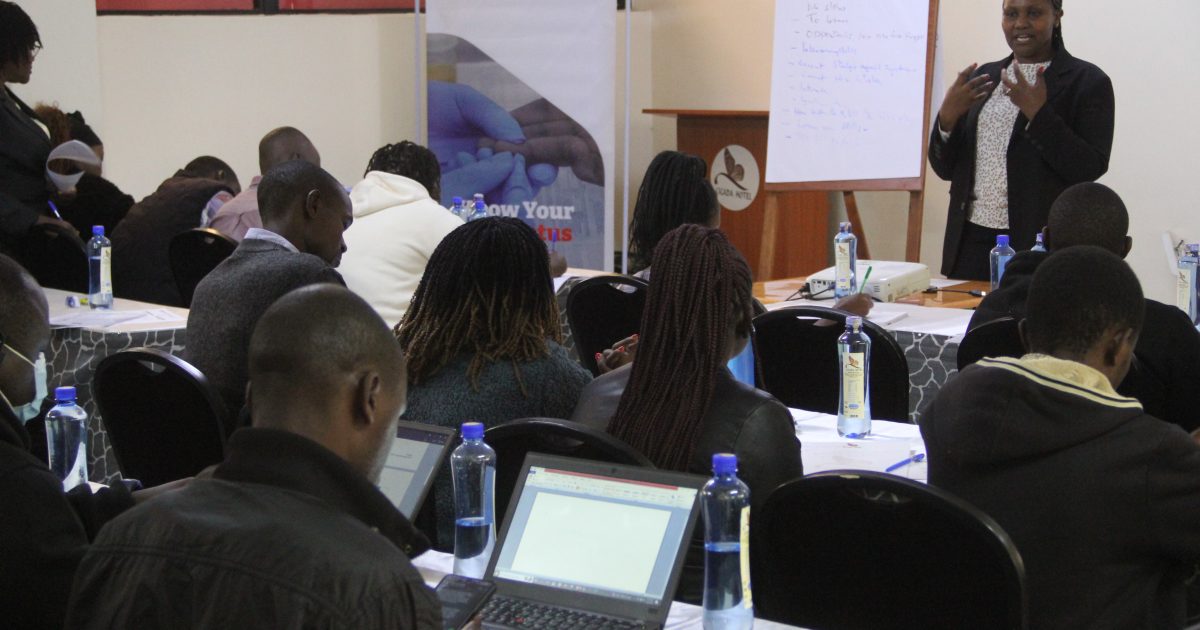
The National Syndemic Disease Control Council (NSDCC), in collaboration with the Media Council of Kenya, conducted sensitization forum for journalists in the North Rift Region to equip them with requisite skills and knowledge to tell and report on health-sensitive stories especially on human immunodeficiency virus (HIV) and tuberculosis.
The journalists were urged to avoid sensationalist headlines and terms that would suffice to disparage the people living with HIV but rather adopt ethical reporting while respecting confidentiality and privacy.
The media practitioners were taken through ethos of journalism and storytelling techniques in health reporting, like adopting AI for data analytics, fact-checking, automated reporting where AI can assist in summarizing medical research, translating complex health data and automating routine reports on disease outbreaks.
The Strategic Media and Communication Advisor, NSDCC, Wanyama Chebusiri underscored the importance of embracing technology like Artificial Intelligence (AI) noting that it is fundamental in transforming personalized health journalism.
He said AI-driven content personalization allows journalists to deliver targeted health information to different demographics.
“The use of AI for multimedia storytelling; AI-powered tools like synthesis allow journalists to create AI-generated video explainers on health topics, making disease reporting more engaging. Journalists can use AI to produce interactive documentaries, podcasts and explainer videos that simplify complex health issues,” explained Chebusiri.
NSDCC Regional HIV Coordinator for North Rift, Faith Kosgei emphasized the key role the members of the fourth estate could play to support the Kenyan “Triple Threat” agenda, which aims to address and eliminate the combined challenges of new HIV infections, gender-based violence (GBV), and adolescent pregnancies.
Kosgei explained that teenage pregnancy was an indicator of heightened risk to HIV infection. Sexual and gender-based violence increases the risk of HIV and pregnancy among adolescent girls is often associated with negative health and societal outcomes for both mother and baby, leading to intergenerational cycles of poverty, poor education and unemployment.
She further decried the alarming rate of the new HIV infections across the counties along the transport corridor noting that Uasin Gishu is among the top 9 counties that contribute up to 51 percent of the new HIV infections in the country.
According to NSDCC Kenya HIV Estimates (2013-2023), 51 percent of the new HIV infections occur in 9 counties: Nairobi, Kisumu, Nakuru, Migori Homabay, Uasin Gishu, Siaya, Mombasa and Kakamega.
The report further reveals that 16,752 new HIV infections were recorded in 2023, females accounting for more than 69 percent of new HIV infections among adults.
Kosgei highlighted that the government through a whole-of-nation approach came up with a Commitment Plan to End the Triple Threat 2023-2030 which has brought on board both state and non-state actors to strengthen the fight against the multifaceted problem that negatively affects adolescent girls and young women, impacting their health, safety, and potential.
“Managing ‘Triple Threat’ requires a layered, multi-stakeholder approach that involves the entire community and promotes investment in education, empowerment and gender equality,” said the NSDCC Regional HIV Coordinator.
NSDCC Regional HIV Coordinator noted that empowering journalists to tell impactful stories will help in achieving commitment number 12 in the Commitment Plan 2023-2030 which aims to increase the proportion of community members sensitized on ending the Triple Threat.
On his part Uasin Gishu County AIDS and STI Coordinating Officer (CASCO), Daniel Bett, emphasized the need to identify sustainable platforms to bridge the knowledge gaps among the young people on HIV prevention methods.
Bett indicated that condom use among women has reduced since 2008 coupled by low condom distribution.
Kenya Medical Supply Authority (KEMSA) report 2023, indicated that Kenya distributed 14.6 condoms per man per year against a global target of 40 condoms per man per year.
According to NSDCC Kenya HIV Estimates 2024, National HIV prevalence in 2023 was 3.3 percent, with a total of 1,378,457 people living with HIV where 71,433 were children between 0-14 years and AIDS related deaths stood at 20,480.
The overall HIV burden ranks Kenya 7th globally in terms of the People Living with HIV (PLHIV).
By Ekuwam Sylvester