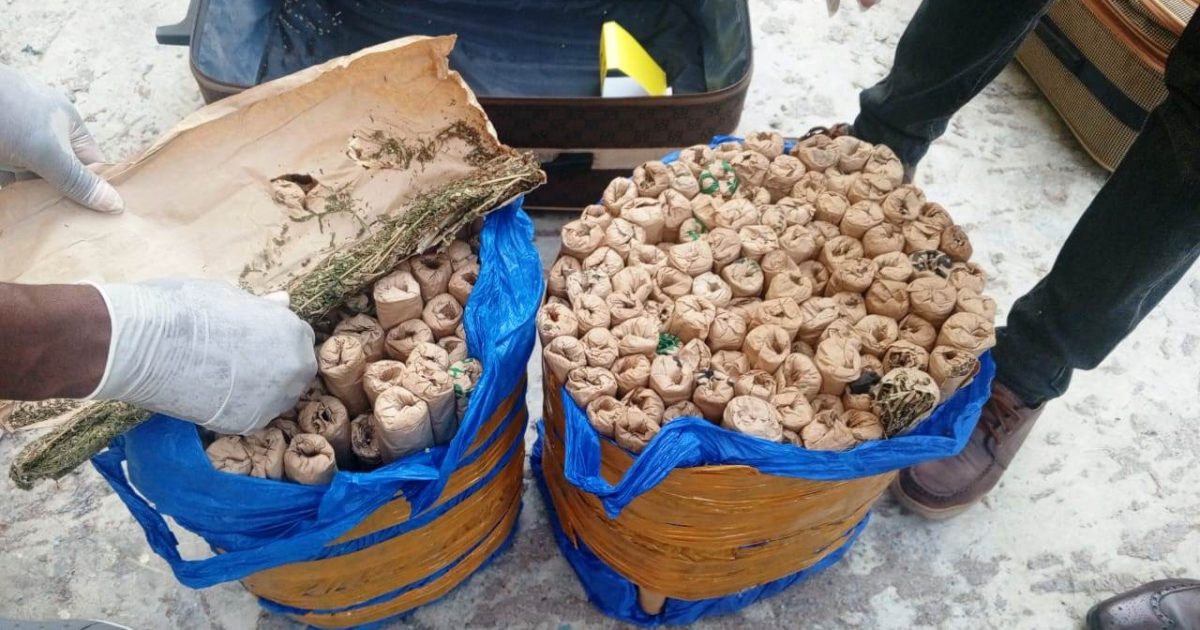
Police in Kisumu East on Thursday evening netted over 65 kilogrammes of bhang (Cannabis Sativa) with a street value of over Sh2 million that was on transit to Mombasa on a bus christened Guardian Angel.
One male suspect has been arrested in connection with the illegal cargo haul and is assisting the police with investigations.
Confirming the incident, Kisumu Central Sub- County Police Commander Mr. Peter Mulai said the bhang, which was in form of stones is believed to have originated from Ugunja in the neighbouring Siaya County and was in the process of to being freighted to Mombasa as a parcel by a night bus.
“Police acting on a tipoff rushed to the Guardian Angel company offices in the Central Business District (CBD) and netted the narcotic that was concealed in two large carton boxes and three suitcases.
Cannabis, locally referred to as bhang, is illegal in Kenya under the Narcotic Drugs and Psychotropic Substances (Control) Act, 1994. But though bhang is an illegal substance in Kenya, it is freely cultivated in some neighbouring countries where most of it that is being trafficked in the country is believed to come from.
The country’s porous borders and weak legal system have made Kenya a safe haven for traffickers oblivious of the health hazard this commodity poses to lives of millions of Kenyans especially young people.
Data from the National Authority for the Campaign against Alcohol and Drug Abuse (NACADA) shows that the most abused drugs in Kenya are alcohol and cannabis sativa (bhang) which is grown in a few isolated parts of the country. But there are reports of somewhat isolated cases of cocaine, heroin, mandrax, hallucinogens, amphetamines and solvents.
A survey by NACADA in 2022 reveals that 600,000 Kenyans aged 15 to 65 are currently using cannabis also known as marijuana, translating to a national prevalence rate of nearly two per cent. The report dubbed ‘Status of Drugs and Substance Use (DSU) in Kenya, 2022’ shows that over 90 per cent of those abusing these psychotropic substances are males.
The Agency has raised alarm over the rise in the use of bhang in Western Kenya, ranking the region as leading in illicit alcohol and drug abuse in the country.
Although marijuana is found with various medical prescription drugs, consuming too much of it results in confusion, dry-mouth, fatigue, and anxiety, changes in mood, increased heart-rate, dizziness and headaches. However, in rare cases this can also develop into hallucinations, paranoia, panic attacks, nausea and vomiting.
In 2024, over 2.8 million litres of illicit and counterfeit alcohol were seized, alongside 6,000 kilogrammes of bhang also known as weed, resulting in nearly 30,000 arrests. The regions most impacted were Nairobi, Central, Rift Valley, Nyanza, and Western.
Kenya has emerged as a central player in East Africa’s expanding illicit drug trafficking, with industrial-scale methamphetamine production and sophisticated cocaine smuggling operations transforming the nation into a continental narcotics powerhouse.
A comprehensive report by the Eastern and Southern Africa Commission on Drugs (ESACD) reveals alarming developments in Kenya’s drug trade, documenting the country’s evolution from a transit point to a major manufacturing and distribution centre for illegal substances across the region.
One of the most striking developments in drug trafficking in Kenya involves the establishment of clandestine methamphetamine laboratories suspected to operate in some hideouts in Nairobi and the coastal region. These facilities form part of a broader East and Southern African manufacturing corridor extending from South Africa to Mozambique and Zimbabwe.
The report further says Methamphetamine, locally known as “crystal”, has infiltrated Kenyan communities as an affordable alternative to crack cocaine. Consumer bases have been identified in informal settlements across major cities including Nairobi, Kisumu, and Mombasa, bringing to the fore, the widespread nature of Kenya’s drug trade.
The ESACD report attributes this expansion to broader socio-economic challenges such as unemployment and urbanization.
By Mabel Keya – Shikuku