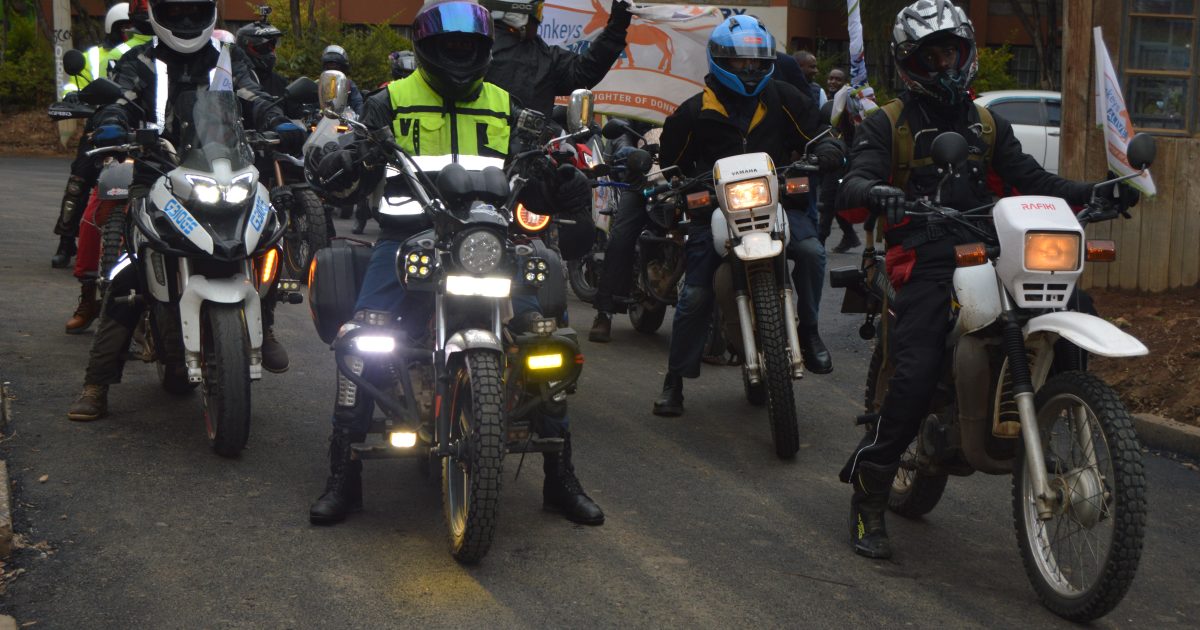
The battle to protect the donkeys from illegal slaughter has gone a notch higher after 13 riders rode for 500 kilometres to sensitise police officers manning roadblocks on the illegal transportation of slaughtered donkeys and their products.
The riders in the company of Farming System Kenya (FSK) and Brooke East Africa officials rode from Ndeiya in Kiambu County, through Narok County, to Bomet County.
Speaking when they stopped at the Narok County Commissioner’s office, the FSK Executive Director, Kenneth Wamuga, underscored the importance of sensitising police officers on the laws protecting donkeys from illegal slaughter and transportation.
“Many police officers don’t understand what to do when they seize donkeys being transported illegally. Today we were sensitising them on the existing laws that protect donkeys and what to do with stolen donkeys,” said the executive director.
At the same time, the locals were sensitised to protecting donkeys by giving any information that would protect the animals from illegal slaughter and transportation.
Narok County Commissioner, Kipkech Lotiatia, lauded the riders for the noble course and called on all stakeholders to join hands to ensure illegal donkey slaughter becomes a thing of the past.
“It is a taboo to eat donkey meat among the Maa community. We should all join hands to ensure that illegal donkey trade and slaughter are finished,” he said.
Dr Yegon Kibet of Brooke East Africa said the donkey cartels have resorted to slaughtering the donkeys in the bushes and selling the meat as beef to unsuspecting buyers, mostly in Nairobi and Kiambu counties.
Dr Kibet warned that the donkey population has been dwindling and if the illegal trade is not contained, there could be no donkeys in the future.
“In the 2009 census, the donkey population in the country was 1.8 million, but the number decreased to 1.1 million in 2019. This is a clear indication that the numbers will continue decreasing if nothing is done now,” he continued.
Dr Kibet reiterated that bush slaughter is dangerous, as it exposes the residents to zoonotic diseases like anthrax and rabies.
On his part, Dr Brian Mwaura, an adventurous veterinary surgeon who led the group of 13 riders, reiterated that they were riding for a cause to sensitise police officers on donkey theft and illegal transportation.
Mwaura reported that they had reached out to police officers in seven roadblocks, where they sensitised two police officers in each roadblock.
“We are riding to sensitise police officers on illegal donkey slaughter. We rode from the Ndeiya area and we intend to stop in Bomet town,” said the rider.
By Ann Salaton