President William Ruto has reaffirmed Kenya’s commitment to strengthening micro, small and medium enterprises (MSMEs) as a key driver of economic transformation and regional integration.
The regional event, marking 25 years since the signing of the EAC Treaty, brought together leaders, entrepreneurs and development partners from across East Africa under the theme of promoting innovation, trade and inclusive growth for MSMEs.
President Ruto said the MSME sector remains the “engine of job creation, innovation and industrial growth,” driving shared prosperity across the continent.
He hailed the visionary leadership of the EAC’s leaders; Presidents Yoweri Museveni, the late Daniel arap Moi and the late Benjamin Mkapa, whose efforts revived the regional bloc in 1999.
“This gathering validates the central role of MSMEs as pillars of our economies. Their resilience, creativity and innovation continue to power industrial growth and employment across East Africa,” the President said.
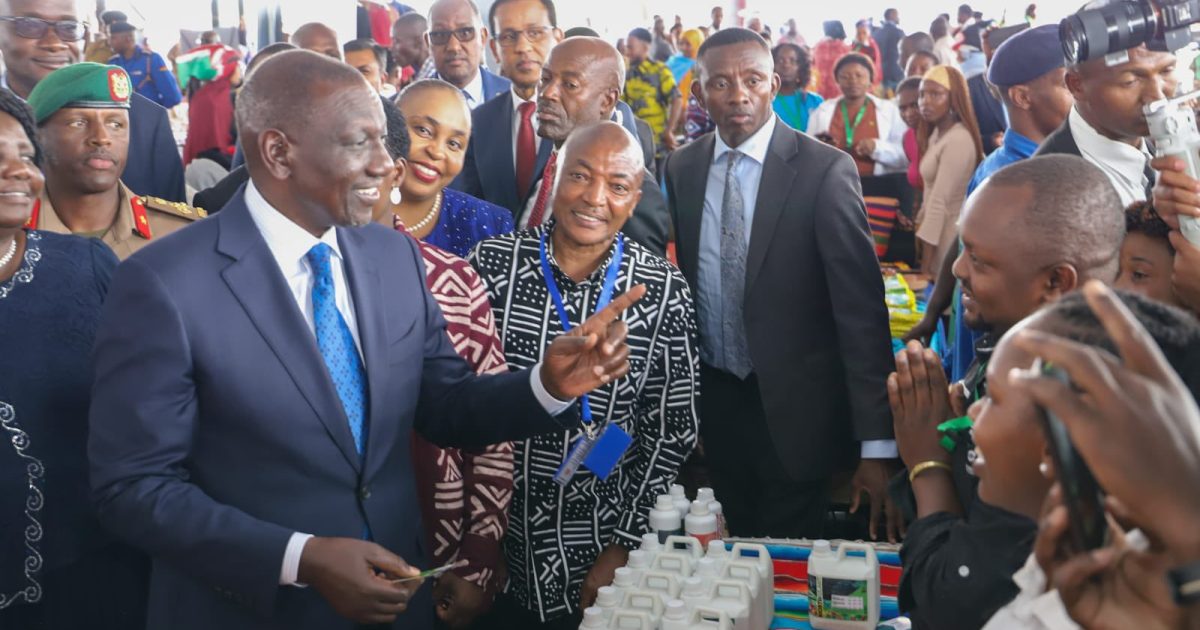
Speaking on Tuesday during the official opening of the 25th East African Community (EAC) MSME Trade Fair at Uhuru Gardens, Nairobi, President Ruto noted that the EAC has grown into a dynamic bloc of eight partner states representing more than 300 million citizens, making it one of the fastest emerging markets globally.
Highlighting Kenya’s reforms under the Bottom-Up Economic Transformation Agenda (BETA), saying that MSMEs sit at the core of national priorities alongside agriculture, affordable housing, healthcare and the digital economy.
“We chose to subsidize production instead of consumption, and the results speak for themselves. Our national yields in key crops have increased significantly,” he said.
Ruto cited the Hustler Fund as a flagship initiative enhancing financial inclusion, revealing that over Sh80 billion has been disbursed since 2022 to millions of Kenyans previously excluded from formal credit systems.
“Today, more than two million Kenyans borrow regularly from the Hustler Fund, some accessing up to Sh150,000 without collateral only their creditworthiness,” he said, adding that the government was working to securitize credit scores as new collateral for youth and women entrepreneurs.
He announced plans to establish County Aggregation and Industrial Parks (CAIPs) in all 47 counties to promote value addition and industrial linkages for small businesses, alongside the Nyota Programme, which will issue grants of Sh50,000 to over 110,000 youth and disability-led enterprises and provide business training to more than 600,000 entrepreneurs.
“Women are outstanding businesspeople, and this programme will ensure that not less than 50 percent of the beneficiaries are women,” he emphasized.
Ruto lauded the Jua Kali sector for its growing role in the affordable housing programme, noting that artisans have secured contracts worth more than Sh15 billion for supplying doors, windows and fittings.
“The Jua Kali sector has proven that small enterprises can deliver on big projects, sometimes even better than large companies,” he said.
President Ruto reaffirmed Kenya’s commitment to digital transformation, citing progress on the Digital Superhighway, which has already covered 30,000 kilometres of fibre out of the planned 100,000, and digitization of over 23,000 government services on the eCitizen platform.
Cabinet Secretary in charge of MSME Development, Wycliffe Oparanya, presented the Nairobi Declaration, a communique from the EAC MSME Ministerial Roundtable outlining regional priorities such as access to finance, digital transformation, green technologies and market access.
“We are committed to translating these resolutions into concrete actions that strengthen competitiveness, sustainability and inclusivity of MSMEs across East Africa,” Oparanya said.
He added that the declaration will be tabled at the upcoming EAC Heads of State Summit later this month, noting that the forum had reaffirmed the need to align national MSME policies with regional industrialization goals.
Zainab Bangura, Director-General of the United Nations Office at Nairobi (UNON), hailed Kenya for hosting the new International Trade Centre (ITC) Regional Hub, the first to be established outside Geneva since 1964.
“This is a great honour for Kenya and the UN family, which has grown from 300 staff in 1975 to over 20,000 today, thanks to the government’s unwavering support,” Bangura said.
Pamela Coke-Hamilton, Executive Director of the ITC, praised Kenya for hosting the regional hub and commended President Ruto’s leadership in advancing trade and MSME competitiveness.
“The opening of this office reflects our deepening relationship with Kenya and East Africa. We are putting boots on the ground to better serve MSMEs and strengthen Africa’s trade capacity,” she said.
Coke-Hamilton urged EAC member states to fast-track implementation of the AfCFTA protocol on women and youth in trade, adding that deepening regional integration would protect African economies from global disruptions.
Nairobi Governor, Johnson Sakaja welcomed delegates to the city, terming Nairobi the “home of MSMEs” and the heartbeat of East Africa’s economy.
“The story of MSMEs is the story of Nairobi’s economy. We contribute 7.5 percent of Kenya’s Gross Domestic Product (GDP), with most businesses being micro or small enterprises,” he said.
Sakaja announced progress on the city’s Unified Business Permit, which consolidates multiple licenses into one digital document, with over 190,000 businesses already registered.
He added that Nairobi is on course to complete 20 new markets to expand trading spaces for small businesses and will soon roll out the Shara Stimulus Programme, offering affordable credit and training to MSMEs across all 85 wards.
“We are building a Nairobi where businesses can start, grow and thrive. MSMEs are the backbone of our economy,” he affirmed.
By Naif Rashid and Darlene Kuria