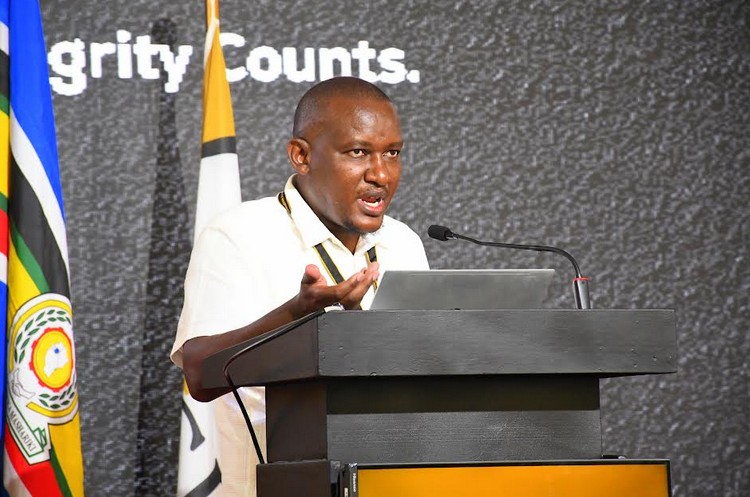
The Principal Secretary for Irrigation, CPA Ephantus Kimotho, is championing the expansion and structuring of Public-Private Partnerships (PPPs) to speed up the country’s economic transformation and ease pressure on the national budget.
Speaking during the 42nd Annual Seminar of the Institute of Certified Public Accountants of Kenya (ICPAK) in Mombasa, themed “From transaction to transformation: Accountancy impacting the world,” PS Kimotho urged accountants to embrace PPPs as a pathway to unlocking Kenya’s economic potential.
The PS cited the Galana Kulalu Food Security Project, which attracted Sh12.5 billion in private capital. The government has leased 20,000 acres of idle land in Kilifi and Tana River counties for the project, implemented by Selu Limited. The government provides irrigation water for the venture at an agreed fee.
For sustainable PPPs, the PS stressed the importance of affordability, value for money, and proper risk transfer through sound financial structuring led by accountants.
“When we talk about PPPs, a lot of risk is transferred to the private party. Starting with finance risk and market risk, operational risk, and that shoulders and leaves the government safeguarding the public asset,” he explained.
To realise successful PPPs, PS Kimotho noted the need to build the capacity of contracting authorities, starting with Certified Public Accountants who are trained on finance structuring, business finance, and financial management.
ICPAK members were urged to partner with the government to unlock the potential of PPP, citing the current fiscal challenge in the national budget, PS Kimotho said that, “PPP needs not to be taken as an alternate, but now needs to be one of the mainstream ways of financing our public infrastructure, so that we can leave the budget to deal with the social infrastructure.”
By that, he added, the country will be able to balance the interests of the public and create opportunities for the private sector, at the same time, unlock the potential of the economy by building huge infrastructural projects.
On her part, PS Aurelia Rono, State Department for Parliamentary Affairs said the accountancy profession is a cornerstone in every sector.
She urged Accountants to embrace integrity in all the institutions that they are serving by ensuring resources are used prudently for national goals to be achieved, and the country moves from a third-world country to a first-world country.
“It is a clarion call to everyone to embrace accountability, transparency, integrity and discipline in managing our financial resources, to ensure that we deliver the goals and the objectives that we decide to achieve,” said PS Rono, adding that the government has lined up several laws to sustain the fight against graft.
ICPAK CEO, Dr Grace Kamau, also challenged accountants to uphold ethical working practices for the country’s resources to be used in transforming the country into a first-world country.
“Accountants have a very critical role to play in that transition of us from third world to first world. Actually, many of these commissions, including the EACC, would not exist if every accountant were able to pick up and work ethically and ensure they ingrain ethics in their work,” she said.
EACC Chairperson Bishop, Dr David Oginde, noted that in many corruption scandals, accountants who lack integrity are usually the conduits who facilitate them.
“I can tell you without any fear of contradiction that where I sit in EACC, every corruption case we have dealt with, there is an accountant involved. Whether small or big, there is none of them that does not involve an accountant,” stated the EACC Chairperson.
He added, “Anti-corruption mechanisms are tools that protect, reinforce and give effect to the principles of integrity. And as I have said, no law, no matter how good, can bring about ethics and accountability if there is no integrity.”
Dr Oginde also lauded the introduction of electronic procurement, noting that it is a great system in curbing corruption in the public procurement sector, which accounts for 80 per cent of the cases that the commission is dealing with.
ICPAK Chairperson, CPA Prof Elizabeth Kalunda, noted that the seminar theme is not just rhetorical, but it serves as a guiding principle, urging accountants to move beyond merely recording transactions to becoming architects of institutional trust, supporters of sustainable development, defenders of the public interest, and drivers of inclusive growth.
“This second edition of our Annual Seminar takes place amidst significant economic challenges and issues of accountability. According to the latest Auditor-General’s reports, nearly Sh 1.7 trillion of public expenditure across national and county entities remains unaccounted for, lost in unsupported documentation, pending bills, and irregular procurement processes,” she stated.
by Sadik Hassan