Principal Secretary (PS) for Livestock Development, Jonathan Mueke, has challenged livestock farmers across the country to embrace improved and high-yielding breeds that can attract better market returns both locally and internationally.
Speaking in Kitui Town, the PS emphasized the need to enhance livestock health and quality to position Kenya’s livestock sector competitively in the global market.
He expressed concern over challenges faced by his Ministry in marketing the country’s livestock products internationally, attributing this to poor breeds and substandard animal health practices.
Mueke also decried the exploitation of farmers by unscrupulous middlemen who buy animals at throwaway prices in local markets, leaving producers with minimal profits. He urged farmers to join livestock cooperative societies to gain stronger bargaining power and improve access to reliable and fair markets.
“Once you enroll as members of livestock cooperatives, you will be able to earn higher prices for your livestock and products while protecting yourselves from exploitation by middlemen,” said Mueke.
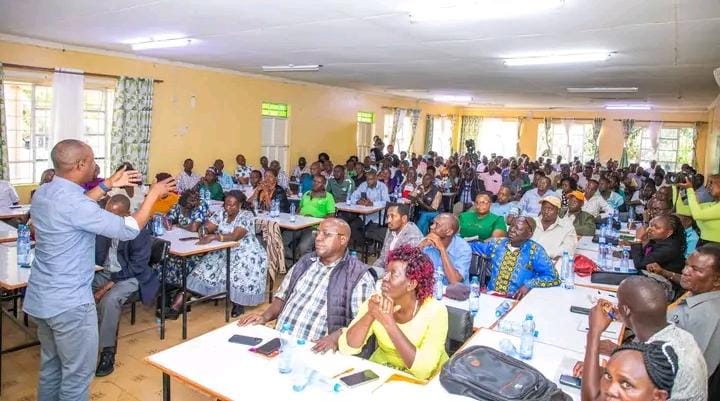
The PS was speaking during the opening of a three-day training workshop on Capacity Building and Market Linkages for Ward-Based Cooperatives for Goat and Indigenous Chicken Meat, held at the Kitui Agricultural Training Centre. The event brought together hundreds of farmers from across the county.
He explained that through cooperatives, farmers can access essential services such as training, improved animal breeds, affordable farm inputs, livestock vaccines, and veterinary services. “Cooperatives create economies of scale and enable members to collectively negotiate better prices while ensuring consistent supply to both local and export markets,” he noted.
The training, organized by the State Department for Livestock Development through the National Livestock Development and Promotion Service (NLD&PS) and the DRIVE Project, in partnership with Strathmore University, seeks to sensitize farmers on cooperative strengthening and sustainable market linkages.
Kitui County is the second-largest producer of Galla goats and one of the leading producers of indigenous chicken in Kenya. However, livestock value chains in the region remain largely underdeveloped and fragmented, with most marketing done individually.
“Most marketing is individually driven, which limits producers from leveraging economies of scale,” lamented the PS, adding that cooperatives can bridge this gap by enhancing collective marketing, aggregation, and profitability.
Mueke reaffirmed the government’s commitment to uplifting livestock farmers’ livelihoods through development, promotion, and trade facilitation of livestock and related products. He said the NLD&PS plays a pivotal role in promoting aggregation, feedlot systems, breeding programs, livestock trade services, and strategic coordination across the sector.
“The agency seeks to transform the sector into a commercially viable and resilient industry while ensuring that livestock keepers are fully included in equitable and inclusive decision-making processes,” Mueke added.
He noted that the establishment of the NLD&PS marks a major turning point in Kenya’s livestock development, aligning the sector’s priorities with the country’s long-term development frameworks — including Vision 2030, the Bottom-Up Economic Transformation Agenda (BETA), and the Sessional Paper No. 3 of 2020 on National Livestock Policy.
The PS underscored that the livestock sector remains a cornerstone of Kenya’s agricultural economy, contributing about 12 percent of the national GDP, 42 percent of agricultural GDP, and employing over 50 percent of the agricultural labor force.
It also supports the livelihoods of more than 10 million households, particularly in arid and semi-arid lands (ASALs), which constitute about 80 percent of Kenya’s landmass. In these regions, over 60 percent of households depend primarily on livestock for food, income, and social well-being.
Despite its importance, livestock marketing in Kenya remains fragmented, characterized by poor market access, unorganized trading systems, and inefficient off-take practices that limit profitability.
Mueke urged farmers and cooperative societies to take advantage of government-led programs aimed at addressing these challenges and unlocking the sector’s full potential.
By Joy Mwangangi and Isaac Wambua