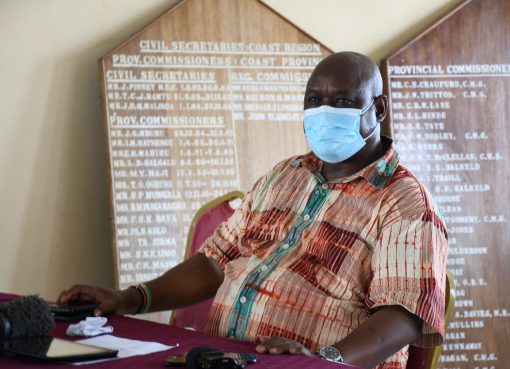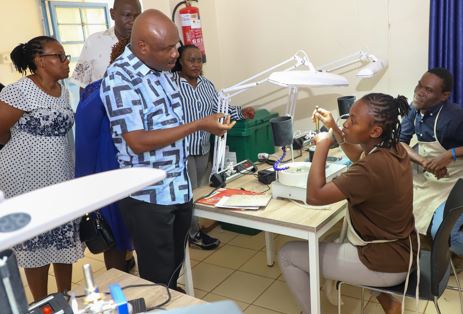
Principal Secretary for Labor and Skills Development Shadrack Mwadime has urged youth in the country to take advantage of emerging overseas job opportunities, revealing that thousands of positions remain untapped due to low participation and lack of awareness.
Speaking at Taita Taveta National Polytechnic in Voi, Taita Taveta County, Mwadime said the government is intensifying efforts to connect Kenyan youth with international employers, particularly in the cruise ship industry, while lowering barriers that have historically locked many out.
He noted that although international recruitment firms such as the Mediterranean Sea Company have been operating in Kenya since 1989 and offering jobs to young people across the country, only a small number of applicants from Taita Taveta have benefited.
“From the statistics we have, very few youths from this county have been able to secure these opportunities, and that is why we are here, to enlighten them on what they must do to access these jobs,” he said.
Mwadime described cruise ships as floating luxury hotels that offer lucrative employment opportunities for skilled workers, ranging from hospitality to technical services.
“Cruise ships are patronized by very, very rich people, billionaires, and therefore some of them are five-star, some are six-star, even seven-star hotels that can carry about 2,000 to 3,000 visitors from one corner of the globe to the other. These are good jobs that our young people can access,” he said.
The PS emphasized that the government is working to attract more international employers into the country, noting that recruitment depends entirely on the availability of vacancies rather than government directives.
“We cannot command any company to provide a given number of vacancies. It depends on the opportunities that are opening up. That is why we are working to bring in as many companies as possible so that the number of available jobs increases,” he explained.
To further ease access to overseas employment, Mwadime said the government is transforming technical institutions into recruitment hubs, enabling graduates to transition directly into the job market.
“We will keep on encouraging more companies to come over because our objective is to convert every institution into a recruitment center so that our young people can know that the moment they are through with their courses, they can be employed immediately after,” he said.
He added that the long-standing challenge of lack of experience among graduates is being addressed through curriculum reforms.
“As you know, we are converting our curriculum now so that we have a dual curriculum. We offer 80 percent practical experience that is required by the industry and 20 percent theory. Now, when this young person graduates, they have both the experience that is required and the skills they have earned through the theoretical framework taught in class,” he said.
Mwadime said the new system will ensure graduates are job-ready and better aligned with international labor market demands.
“So, when one completes the course, they will be ready for the job market and can be taken in by these companies. The conversation that we have with Mediterranean Sea Company will continue, and we will have the same with other major employers so that we can guarantee our young people good employment,” he added.
The PS decried the current mismatch between skills and employment in the local economy, saying many young people are underpaid despite their qualifications.
“The unfortunate situation in our economy is that these young people, much as they are highly skilled, are eventually engaged in jobs that do not require the skills they have acquired. So, they earn less than their skills deserve, which is not right. It is actually immoral,” he said.
On recruitment processes, Mwadime reassured the youths that placements at Mediterranean Sea Company are free.
“It is free recruitment. The only thing that a youth must have is a passport, which is required for travel abroad. The only costs they will incur are for the passport, medical certificate, and the STCW course,” he said.
He revealed that the government has already reduced the cost of the mandatory STCW (Standards of Training, Certification and Watchkeeping) course from Sh75,000 to Sh35,000, with plans to lower it even further to Sh15,000.
“We are trying to reduce the cost that will be needed so that a youth can get the job,” he added.
The PS also warned against rising cases of fraud targeting job seekers and announced the formation of a multi-agency team to crack down on scammers.
“Nobody should feel intimidated that they have given out their money and they haven’t gotten the job that they were promised. As long as one has a receipt as evidence, the law will take its course,” he said.
The team comprises officers from the Directorate of Criminal Investigations (DCI), the National Police Service, the Ministry of Foreign Affairs, and the Office of the Director of Public Prosecutions (DPP).
According to data from the National Employment Authority, at least 562,000 Kenyan youths have secured jobs abroad between 2022 and 2026, a figure the government aims to increase through expanded partnerships and policy reforms.
Mwadime encouraged students and young people in Taita Taveta to position themselves competitively by acquiring the necessary certifications and staying informed about legitimate recruitment channels.
“There are many good companies out there that have employed thousands of our youth. What we want is for every young person here to have the right information and the right skills so they can also benefit,” he said.
The government’s renewed push signals a broader strategy to tackle youth unemployment by aligning education with global labor demands while protecting job seekers from exploitation.
By Arnold Linga Masila