Climate change is no longer an abstract global debate but a reality, for the livelihoods of many Kenyans are seriously affected through low farm yields leading to food insecurity and straining public resources.
The nation’s commitment to plant 15 billion trees by 2032, if achieved, could transform its climate trajectory and safeguard future generations.
For the public service, the consequences of climate change are already visible; declining agricultural yields are leading to inflated food prices, extreme weather is damaging infrastructure, and environmental degradation is worsening public health.
Each of these factors undermines the productivity of the very workforce responsible for driving Kenya’s development agenda.
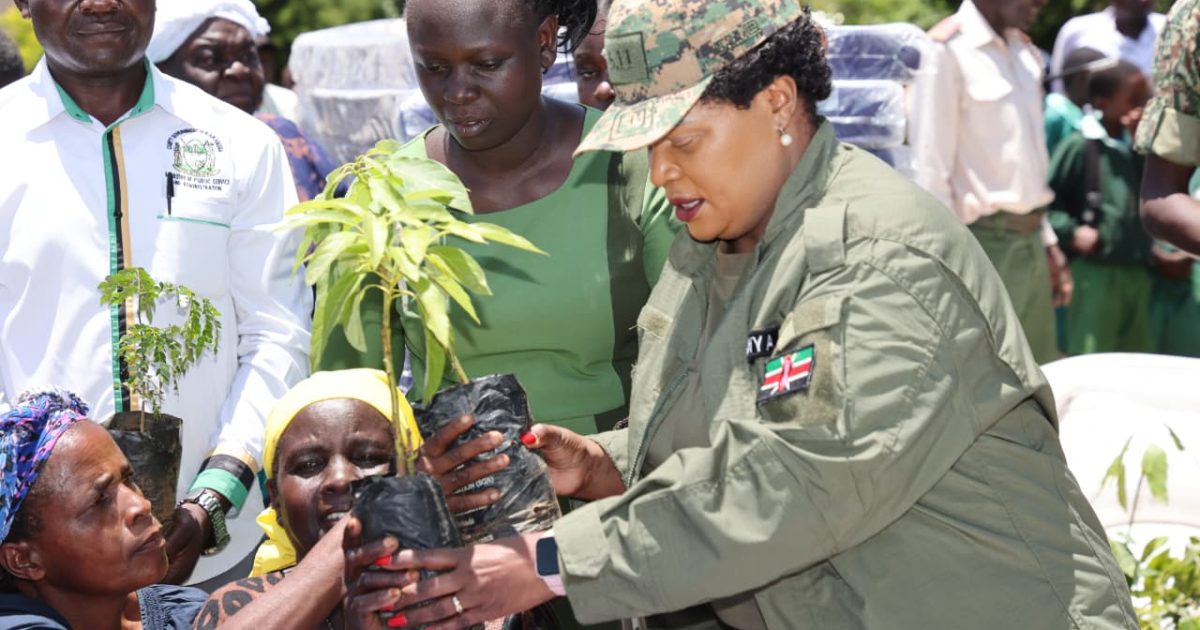
To mark this year’s Mazingira Day, government agencies spearheaded a national tree-planting campaign dubbed “Twende Primo Tukadonate Fruit Trees”. The initiative, led by Principal Secretaries, Accounting Officers, and senior government officials, saw the donation and planting of fruit trees in primary schools across the country.
According to the Principal Secretary for Public Service and Human Capital Development, Dr Jane Kere Imbunya, the exercise was designed to serve dual purposes conserving the environment and providing nutritional value to school children.
“These trees are not only good for restoring our environment but also important for nourishing our children,” Dr Imbunya said. “Fruit trees contribute to environmental conservation, create a conducive ecological system, and serve as a sustainable food source for thousands of pupils in our schools.”
Speaking at Matende Primary School in Shirere Ward, Lurambi Constituency, and Kaimosi Demonstration Primary School in Vihiga County, where she led tree-planting activities, Dr. Imbunya emphasized that fruit tree planting promotes both environmental conservation and food security in schools.
She noted that the exercise aligns with the National Landscape and Ecosystem Restoration Programme, popularly known as the Road to 15 billion Trees, which assigns specific tree-growing targets to all Ministries, State Departments, and Agencies (MDAs).
The programme aims to increase Kenya’s tree and forest cover to over 30 percent by 2032.
“This national campaign is about more than numbers it is about climate resilience,” she said. “By growing these trees, we are reducing greenhouse gas emissions, mitigating deforestation, improving water security, and strengthening agricultural productivity.”
The State Department for Public Service and Human Capital Development has demonstrated strong leadership under its performance contract on Tree Growing Implementation and Targets for FY2025/2026, which sets a goal of 10 million seedlings for the current financial year and 20 million since the directive was first issued two years ago.
Records from the Ministry of Environment, Climate and Forestry indicate that by August 2025, the State Department and its affiliated institutions had planted 53,172,324 seedlings over two years surpassing its targets by 23,173,324 seedlings, more than 200 percent of its goal.
This makes the department the first and leading state agency to meet and exceed its assigned target.
Dr Imbunya commended this progress but cautioned that planting alone is not enough.
“We must track whether these seedlings are growing into functioning ecosystems. Without proper monitoring, this campaign risks being remembered more for photo-ops than forests,” she said.
She reaffirmed the state department’s commitment to mobilizing public servants and communities nationwide to participate in tree-growing and environmental protection efforts.
“A happy public servant is a productive public servant,” she remarked. “But public servants cannot thrive in a collapsing environment. Environmental restoration is not just an ecological duty; it is an economic and social imperative.”
She further challenged schools to establish nurseries, businesses to adopt sustainable practices, and households to dedicate space for fruit and indigenous trees, noting that the government cannot shoulder the reforestation burden alone.
Kenya’s tree cover currently stands at 12.13 percent, surpassing the constitutional target of 10 percent, but forest cover remains at 8.83 percent. The government aims to reach 30 percent tree cover by 2032 through the 15 Billion Tree Initiative, designed to reduce greenhouse gas emissions, enhance water security, and boost agricultural productivity.
“Climate responsibility, when embedded in our institutions, schools, and businesses, can cascade into national transformation,” Dr Imbunya concluded. “If we get it right, this will not only be a green revolution; it will be a generational legacy.”
By Lamech Willy. A -PCO