Efforts to end Female Genital Mutilation (FGM) in Kenya and globally by 2030 are ongoing in West Pokot, with anti-FGM crusaders bringing together journalists, government officials, and non-state actors to assess their roles in the crucial fight against the vice that is still prevalent in some parts of the county.
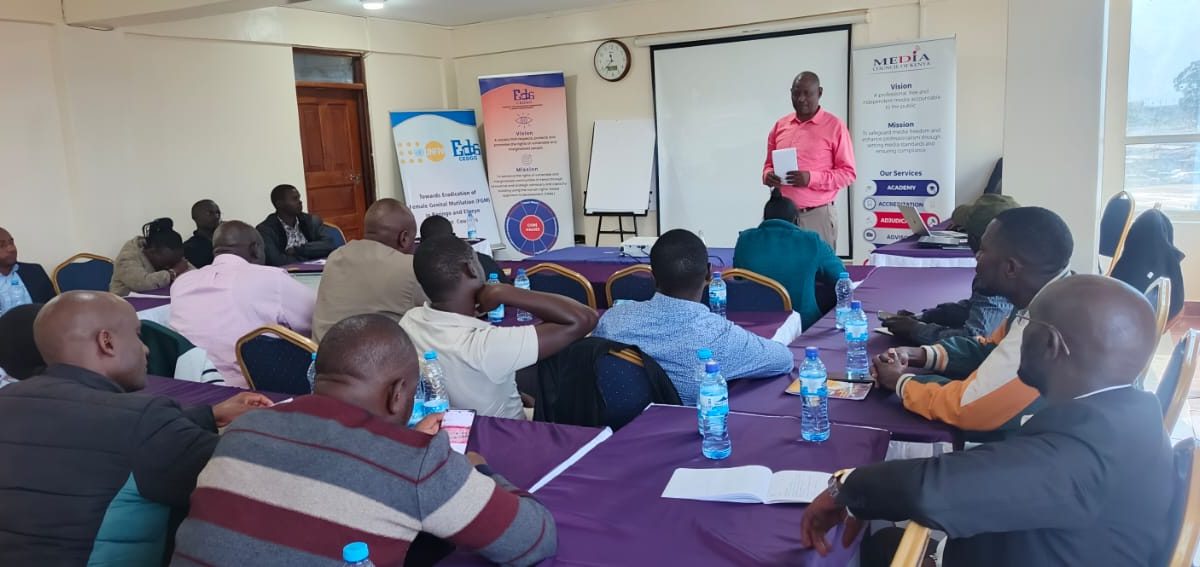
In a meeting organized in collaboration between the Media Council of Kenya and the Centre for Enhancing Democracy and Good Governance (CEDGG) in Kapenguria Town saw experts emphasise on the need for a paradigm shift in reporting on matters of FGM, with the media being placed at the centre stage in promoting the fight against the vice that is a global phenomenon.
MCK Rift Valley Regional Coordinator Joseph Mecha urged fellow journalists in the region to shift from sensationalism to solutions journalism on matters of FGM that still pervades in the society despite the government’s relentless efforts to have it wiped out completely.
“This partnership is aimed at empowering journalists to report on FGM professionally and ethically because the media plays an active role in sensitizing the public on the dangers and long-term effects of FGM on girls and women,” posed Mecha.
He said bringing journalists and other stakeholders together to ensure that FGM is brought to light and properly addressed in public discourse will help everyone understand the harm it causes.
Mecha appealed to journalists to engage in comprehensive research on FGM and do comprehensive stories that offer solutions rather than just amplifying the prevalence of the vice.
He said participants explored strategies to enhance collaboration and ensure that anti-FGM messaging reaches even the most remote communities, with stakeholders citing poor road and communication networks as some of the major challenges towards the fight against the vice.
They also hinted that there has been a lack of political goodwill from the community members, with the fear that talking about ending the vice would deny aspirants’ political support.
Mecha stressed that fighting FGM is not a one-term conversation but a continuous campaign requiring media commitment, government involvement, and community participation.
He urged journalists to work closely with all stakeholders and serve as watchdogs to ensure the government fulfills its role in enforcing FGM-related laws and policies.
On his part, West Pokot Director of Gender Emmanuel Oigo revealed that the region has seen progress in reducing FGM, with the prevalence rate tremendously dropping from 72% in 2014 to 44% in 2022.
However, Oigo regretted that the county remains among the 22 counties in Kenya still significantly affected by FGM, with a national average of 15%; hence, more efforts have to be initiated so that the global and national target of zero FGM by the year 2030 is realized.
“Despite notable improvements, West Pokot is still a hotspot. That is why accurate and responsible reporting of FGM is so crucial,” Oigo said, noting that the remote areas within the county, such as Lomut and Masol and North Pokot, are still deeply in support of FGM.
The Director underscored the role of journalists as truth-tellers, historians, and moral compasses, adding that the information they publish creates a record for future generations.
He encourages the media to relay verified and impactful messages to the grassroots and to maintain integrity in all reporting.
Center for Enhancing Democracy and Good Governance (CEDGG) Chief Executive Officer (CEO) Paul Masese said the meeting aimed to develop effective strategies in collaboration with media and stakeholders to eliminate FGM in West Pokot and the neighbouring counties.
He cited the rise of cross-border FGM, particularly during school holidays in November and December, when girls are secretly sneaked to the neighbouring Uganda or other neighbouring counties like Elgeyo Marakwet, Baringo and Turkana to undergo FGM.
“We are seeing a trend where girls cross the border to escape enforcement, undergo FGM, and return. Journalists must be on high alert during these months to expose such activities,” he said.
According to the Kenya Demographic and Health Survey (KDHS) 2022, 15 out of every 100 girls and women in Kenya, he said are at risk of undergoing FGM.
Masese warned that in some Northern Kenya counties, the prevalence can reach high.
“To reduce West Pokot’s current rate of 44%, there must be coordinated efforts across all sectors, including media, civil society, government, and religious organisations,” said Masese.
Masese therefore urged stakeholders to join accountability campaigns addressing key drivers of FGM, including FGM, climate change, cultural practices, and poor enforcement of laws.
He highlighted that FGM is illegal under the Prohibition of FGM Act, 2011, which was passed by Parliament.
The CEO said the law outlines penalties for those involved in FGM and assigns responsibility to national government administration officers, including chiefs and assistant chiefs, to take action against violators within their jurisdictions.
“The law is clear, and we have the Anti-FGM Board mandated to oversee the implementation of Anti-FGM strategies, but enforcement remains weak in some areas due to cultural resistance,” Masese argued.
He called for the Anti-FGM Board to decentralize its presence to the village levels to increase awareness of the law and address FGM-related risks more effectively.
Masese also raised concern over emerging trends that complicate the fight against FGM, hinting that in some parts of the country people have elusively started engaging in medicalized FGM, which is still illegal.
The media fraternity cited a lack of adequate facilitation to conduct detailed reporting on matters of FGM, pinpointing that most stories happen in very remote areas that require huge budgets.
By Richard Muhambe and Anthony Melly