Muranga’a-based non-governmental organization, Women in Climate Change Organization (WICCO), has urged residents to adopt vertical gardening and water harvesting techniques as a sustainable way to improve food production and protect the environment.
Speaking in Githama Village of Kandara Sub County during a community training session, WICCO chairperson Diana Muthoni said agroecology offers long term solutions to food insecurity, shrinking land sizes and climate related challenges.
“We want to promote agroecology which plays a crucial role in protecting soils and reducing dependence on conventional agricultural chemicals as a key to building resilient communities.”
She reiterated that through vertical gardens, water harvesting, and soil-friendly practices, households will secure food, improve nutrition, and conserve the environment.
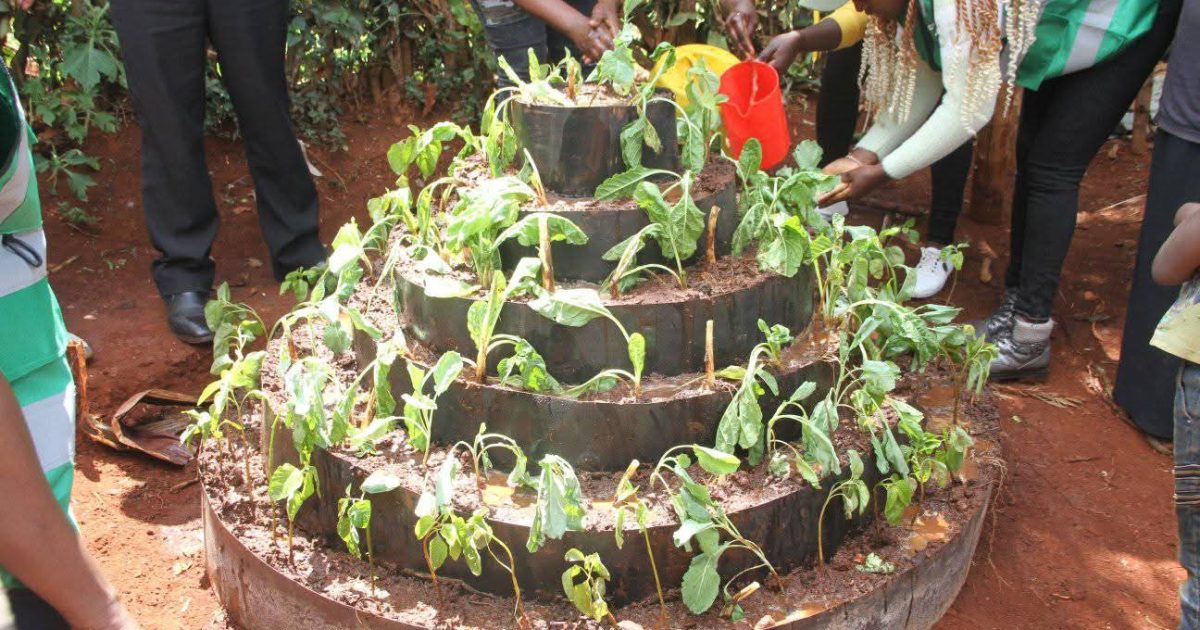
“In order to support households with limited land space, we are championing vertical gardening which is an innovative and highly productive method of growing food in cone-shaped gardens.”
“These gardens, made from durable HDP polythene, can hold between 80 and 120 seedlings, with some models accommodating up to 150 plants of spinach and kales,” she said.
Notably, a well-established cone garden can last up to 15 years, making it both economical and sustainable.
Muthoni said that with availability of kitchen gardens, families will not have to buy vegetables every other day considering these gardens take limited space and use very little water.
She noted that water harvesting remains one of WICCO’s major innovations as climate change increasingly affects rainfall reliability in the region.
“We will also train residents on how to harvest water during the rainy season to ensure they have plenty even during dry months. This will greatly improve family nutrition,” she said.
During a practical demonstration, agronomist Lawrence Njuguna emphasized the efficiency and nutritional benefits of the vertical gardens.
He noted that vertical gardens use very little water and can sustain up to 150 plants of spinach or sukuma wiki—enough to feed a household of up to six people.
“A vertical garden with a circumference of about six metres can be harvested within 4 to 6 weeks,” Njuguna said.
The ideal soil mixture is one-part soil to one wheelbarrow of manure, creating a strong multi-storey structure with excellent water retention,” he explained.
Because of this, watering is required only once a week, reducing labour and conserving water.
Farmers were advised to ensure their sites are well drained and level before setting up the gardens.
Njuguna further counselled that if water contains chlorine, it should not be used directly on the plants, as it may inhibit growth.
To enhance natural pest control, WICCO has also encouraged farmers to plant onions within the cone gardens, as they help repel insects without the use of harmful chemicals.
The residents were also trained on water harvesting techniques, including installing gutters and using storage tanks to collect rainwater—a step expected to significantly ease water challenges in many households.
Joseph Ng’ang’a Chege a resident expressed gratitude for the training saying, “We are happy to learn how to construct vertical gardens, nurture our plants, harvest water, and care for the environment. These skills will help our families get enough to eat and even sell the surplus,” he said.
By Florence Kinyua