The government is focused on automating and digitizing Kenya Revenue Authority tax and revenue administration in order to seal revenue loopholes and enhance the efficiency of tax system.
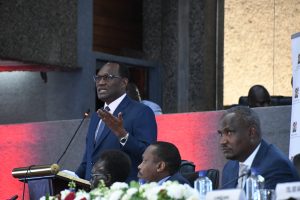
Speaking during the Public Sector Hearings for the FY 2026/27 and the Medium-Term Budget hearings held at the Kenyatta International Convention Centre, Principal Secretary National Treasury Dr. Chris Kiptoo said by sealing leakages through automation and digitization, the government will enhance tax compliance, expand the tax base and minimize expenditure.
The PS said the Tax Policy and the Tax Administration reform measures implementation of the Medium-Term Revenue Strategy are envisioned to progressively strengthen tax revenue mobilization to 20 percent of the Gross Domestic Product (GDP) over the Medium-Term 2026/27.
Dr. Kiptoo said there is need for the country to strengthen fiscal sustainability through reforms that promote inclusive growth and job creation, which he noted can be done by restoring various sectors among them manufacturing.
“Through intervention in manufacturing, the cost of power can be brought down, challenges in value chains such as cement, steel, leather and edible oils can be addressed,” he said, adding that the cost of capital can also be reduced and access enhanced.
The PS at the same time observed that the macroeconomic medium-term reforms being implemented for the 2026/2027 Medium-Term Budget are expected to strengthen macroeconomic stability and support the government’ s efforts to safeguard livelihoods, create jobs, revive businesses and drive economic recovery.
“The ministerial budget ceiling for the FY 2026/27 is projected at Sh2, 818.6 billion which comprises of Sh1,992.9 billion in recurrent expenditure and Sh825.7 billion in development expenditure,” announced Dr. Kiptoo.
He noted that the development of the 2026 Budget Policy Statement will detail the progress in the implementation of government policy priorities anchored on the Bottom-Up Economic Transformation Agenda.
Dr. Kiptoo said the Macroeconomic outlook for FY 2026/27 and the Medium -Term Budget shows that the global economic growth is projected at 3.2 percent in 2025 and at 3.1 percent in 2026, adding that the growth in 2025 is supported by front loading of exports to the United States ahead of the implementation of higher tariff rates on trade, improved financial conditions and strong consumer spending.
He however, stated that the growth in 2026 is projected to slow down on account of higher effective tariff rates and elevated trade policy uncertainty, adding that the country’s economy continues to record a strong and resilient growth of 4.9 percent and 5.0 percent in the first and second quarters of 2025.
The sectors that supported the growth include mining and quarrying, agriculture, real estate among others.
He also said that interest rates declined to 9.3 percent in October 2025 compared to 12.1 percent in October 2024 while the 91-day Treasury Bills rate declined to 7.9 percent from 15.0 percent over the same period.
Lending rates also declined to 15.1 percent in September 2025 from a peak of 17.2 percent in November in November 2024, of which the PS noted are expected to decline further.
PS further said as the Capital market indicators continue to improve, investor confidence has strengthened thereby improving activities in the Nairobi Securities Exchange making the 20 Share Index improve by 63.6 percent to 3,117 points in October 2025 up from 1,906 points in October 2024.
By Bernadette Khaduli