

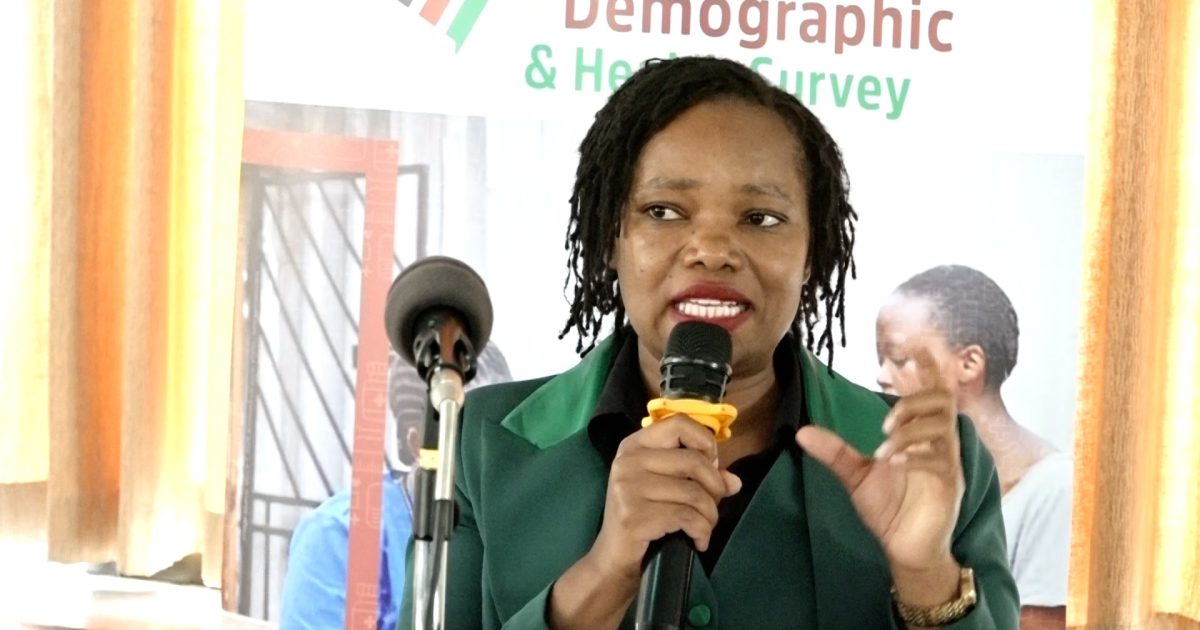
The National Gender and Equality Commission (NGEC) has voiced concerns over surging incidents of technology-facilitated gender-based violence (TFGBV) in the country, mainly targeting women and young girls.
The violence, according to the Commission’s Chief Executive Officer, Dr Purity Ngina, is manifested through stalking, cyberbullying, sexual harassment, defamation, extortion and exploitation.
Dr.Ngina regretted that TFGBV carried significant health, safety, political and economic consequences for women and girls, their families and communities and the society as a whole, both in Kenya and across the world.
“As women and girls self-censor to prevent technology-facilitated gender-based violence, their voices are silenced, and in turn democracies suffer,” Dr. Ngina added.
The CEO made the observation during the ongoing training programme in Nakuru for personnel who will conduct an inaugural mini-Kenya Demographic and Health Survey (KDHS) scheduled to kick off in November this year.
She expressed hope that the exercise will yield quality data that will help fight TFGBV through policy advocacy, partnerships, and a survivor-centred approach for support and for prevention, adding that the commission was collaborating with government agencies and civil society to strengthen laws, increase investment in prevention, and establish support systems for victims of TFGBV.
Technology-facilitated gender-based violence (TFGBV) is an act of violence perpetrated by one or more individuals that is committed, assisted, aggravated and amplified in part or fully by the use of information and communication technologies or digital media against a person on the basis of gender.
The Kenya National Bureau of Statistics has confirmed that the Mini-KDHS will feature a new component on Sexual and Gender-Based Violence (SGBV) that will factor in technology-facilitated SGBV, taking into account the expanded social media platforms in the country.
Dr Ngina pointed out that the world was witnessing a rise in the weaponising of technology and online platforms to attack women and girls on the basis of their gender.
She explained that the technology-assisted violence had infiltrated homes and bedrooms, workspaces and schools and had no limits or geographical boundaries, as it could start online and escalate to physical spaces, or vice versa, creating a dangerous continuum of online-offline abuse that could end in the most extreme forms of violence, including femicide.
Dr. Ngina said the Mini KDHS was a step in the right direction, as it was the first time the country would get reliable data on TFGBV that would inform the policies needed and what measures to put in place to forestall future TFGBV.
She said the Commission was organising and participating in public awareness initiatives, including grassroots dialogues, webinars, and regional events, to educate the public about TFGBV and encourage community-based prevention efforts.
“The TFGBV is a vice that disproportionately impacts women and girls, forcing them to disengage from public discourse and leadership positions.
A comprehensive approach is necessary to address this violence, which requires collaboration to create safer digital spaces, strengthen legal frameworks, and provide support for survivors,” she added.
Dr. Ngina, who is also a member of Kenya’s Technical Working Group on Gender-Based Violence and Femicide, decried rising cases of femicide, calling it a national emergency requiring urgent and radical action.
At the same forum, the Anti-Female Genital Mutilation (FGM) Board warned of a resurgence of the practice in areas where it had been abandoned, including parts of Central Kenya.
The Board’s Chief Executive Officer, Ms Bernadette Resian Loloju, expressed concern that despite a government ban in 2011 and a decline in national prevalence rates, new challenges are emerging that make eradication more difficult.
Ms Loloju noted that previously, Central Kenya was considered free of FGM, but reports now suggest the practice was creeping back into the region, where she said some nascent traditional and cultural groups were encouraging the outdated practice.
She said the Board had noted a shift in how the practice was being carried out where in some areas, instead of traditional circumcisers, a significant portion of new FGM cases were being performed by qualified medical personnel, complicating surveillance efforts.
Ms Loloju said Kenya and neighbouring countries have launched regional initiatives to curb cross-border FGM through education, enforcement, and community collaboration.
“Porous borders call for stronger surveillance and joint government commitment,” Loloju advised.
According to the 2022 Kenya Demographic and Health Survey, the country has 15 per cent prevalence, meaning 15 in 100 girls and women aged 15–49 have undergone the cut. This remains high, notwithstanding the progress recorded over the years.
Among the communities leading in conducting FGM are Kisii, Maasai, Samburu and Somali.
According to Ms Loloju, counties that are hotspots for the outdated practice include Mandera, Garissa and Wajir, which have a prevalence rate of 90 percent, Kajiado, Narok, Bomet, Kisii, Nyamira, West Pokot, Elgeyo Marakwet, Marsabit, Isiolo and Samburu.
Others are Taita Taveta, Bungoma, Tana River and Tharaka Nithi. Curiously, Ms Loloju observed that prevalence rates in Kisii and Nyamira counties have now outnumbered Kajiado and Narok counties.
The CEO said the board had rolled out a massive sensitisation campaign against the practice in the areas to make people understand it’s a harmful procedure and a violation of women’s rights.
“FGM has no health benefits, and it’s the worst form of human assault that can be done to anyone,” she added.
Ms Loloju revealed that although Kenya’s national FGM prevalence has dropped to 14.8 per cent, some counties still record rates as high as 90 per cent, citing counties in the northeastern region which she said continued to record high numbers, largely driven by religious misconceptions.
“Some believe that FGM is a religious obligation, particularly the practice referred to as ‘sunna’. This has become our biggest challenge,” she lamented.
The Director General for the National Council for Population and Development (NCPD), Dr Mohammed Abdi Sheikh, said marginalisation, limited access to education, and expansive geography also contributed to persistent FGM in areas such as Mandera, Marsabit, and Samburu.
Dr Sheikh emphasised that female genital mutilation was the worst form of gender-based violence, affecting over 200 million women globally, and stated that Kenya must act urgently with only five years left to achieve Vision 2030 and SDG 5 on gender equality.
The Director General regretted that survivors often suffer physical, psychological, and mental trauma, with many girls dropping out of school and being pushed into early marriage, which deepens poverty and economic disempowerment, adding that education remained critical in preventing FGM, child marriage, and teenage pregnancies.
He stated that engaging men and boys was crucial to ending female genital mutilation (FGM), a practice rooted in gender inequality, adding that although FGM had traditionally been seen as a “women’s issue”, men in affected communities had significant influence as fathers, husbands, and community leaders.
By Esther Mwangi and Dennis Rasto

