In the hills of Rong’e Juu in Mwatate Sub-County, Taita Taveta County, a quiet revolution is taking shape.
The revolution is not crafted in boardrooms or policy forums, but on the dusty village playground where a group of determined girls chase possibility with every kick of the ball.
Their story is a reminder that talent exists everywhere, but opportunity does not. And when the distance between the two grows too wide, many dreams die before they even begin.
The afternoon sun hangs heavy over the rough patch of earth that serves as their training ground.
There are no white lines marking boundaries, no proper goalposts, and no smooth grass underfoot. Just dust, stones, determination, and a collection of sand-filled bottles arranged carefully to mark training cones.
This is where the Shining Stars girls’ football team has spent time honing skills that could one day take them far beyond these hills, and that is if only the world would give them half a chance.
Mary Mwende Mwasaru remembers those early days with a mixture of pride and pain.
As the Assistant Team Manager, she has watched these girls grow from timid beginners into formidable players, all while battling circumstances that would have broken lesser spirits.
“When we started, we were using bottles filled with sand as cones for training the girls, but they really worked hard. I am happy with them because they never gave up,” she says.
Those sand-filled bottles represent more than just makeshift equipment. They are symbols of what happens in countless villages across Kenya, where talent blooms in the most unlikely places but withers for lack of the most basic support.
God distributes gifts without discrimination, as a child in Nairobi’s affluent neighbourhoods and one in rural Mwatate might possess identical athletic prowess or creative genius.
But their paths diverge sharply based not on ability but on access to the resources that transform raw talent into realised potential.
Kennedy Mwangure, a bodaboda rider from the village, knows this truth so well.
He coaches the Shining Stars not for money because there is none, but because he believes in what these girls can become.
He has watched them train in worn-out shoes and sometimes barefoot. He has seen them compete with a single mismatched uniform, and further, he has felt the sting of lost points because they could not produce an alternative coloured jersey when rules required it.
“These girls are hard-working, and they really love this football. Most of them are school going girls and despite this team being a village team not sponsored by anyone, they brace the challenges and do their best,” he explains.
But doing your best, as Mwangure has learnt, is sometimes not enough when the playing field is so uneven.
When Shining Stars face opponents from better-resourced areas, they are competing against more than just other players.
They are up against entire systems of advantage, facing teams with proper training facilities, qualified coaches, nutritious pre-game meals, physiotherapists, and the psychological boost that comes from knowing you are valued and supported.
Abigael Mwandawiro, who is the team’s captain, carries the weight of these challenges on her young shoulders.
She is articulate about what her team has endured, but there is no bitterness in her voice, only a quiet determination and hope that things might finally be changing.
“We have had a lot of challenges, including lack of sports shoes to play football, lack of uniforms and lack of a good field where we could practise well and play our matches,” she says.
Even their home ground, rough and poorly maintained, has become a source of embarrassment.
“When the opponents come to play in our field, they complain that our pitch is not in good condition and that is why most of the matches are played far from this place,” she explains.
They have been forced to surrender home advantage repeatedly, playing perpetually as visitors in their own competitions.
This is the reality for talented youth in marginalized communities across Kenya. The gifts, such as athletic ability, artistic brilliance, innovative thinking, and technical skills, are there, but the ecosystem needed to nurture these gifts is absent.
Without proper facilities, equipment, mentorship, and exposure, even the most promising talents gradually fade.
Young people who could have been champions, innovators, or leaders instead drift into idleness or worse, their potential never realised, their communities never benefiting from what they might have contributed.
Mwasaru sees this danger clearly. In rural areas where opportunities are scarce, talented youth without constructive outlets become vulnerable to destructive alternatives.
“When they take part in training and exercises, they get tired such that when they get back home, they cannot be easily drawn into these vices,” she says, referring to the early pregnancies, drug abuse, and other pitfalls that claim too many young lives in underserved communities.
Sport and talent development are not luxuries, she insists, stating that they are protective factors that keep young people engaged, purposeful, and on positive paths.
Beyond protection, these talents represent future livelihoods. When properly developed, they can help young people earn a living and support their families, breaking cycles of poverty that have persisted for generations.
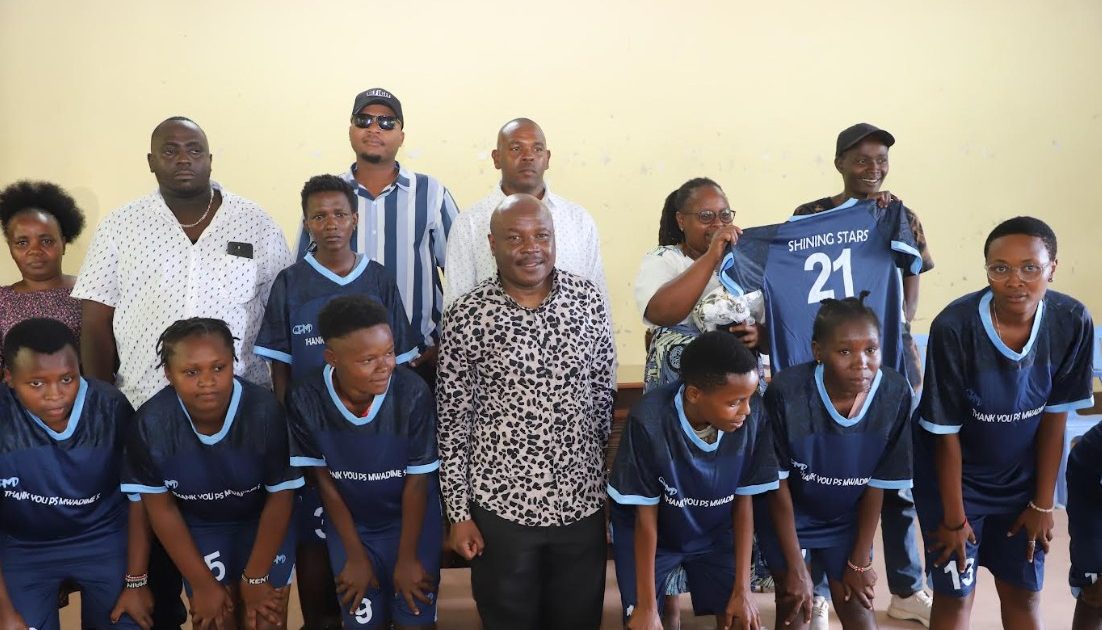
On Friday, the Principal Secretary for Labour and Skills Development, Shadrack Mwadime, stepped into this challenging landscape. His visit to Rong’e Juu was not just ceremonial but transformative.
He came with full sports regalia for the team, including proper uniforms, quality football boots, a new ball and the kind of equipment that had been luxury items for these girls.
But more than the physical gifts, he brought something the Shining Stars had been starving for-Validation.
“This shows the commitment that our young ladies have. It’s not a boys’ football club; it is a girls’ club who have sacrificed themselves to use their talents so that they can benefit from it in life,” PS Mwadime observed, acknowledging both their extraordinary dedication and the additional barriers young women face in pursuing sports careers.
In many communities, girls who choose sports over traditional domestic roles face scepticism and resistance that these girls have persisted despite cultural pressures, material poverty, and institutional neglect speaks to a resilience that deserves more than makeshift equipment and empty encouragement.
The PS understands that talent without support is like a seed without water, which may survive for a time on its own strength, but it will never flourish into what it could become.
“Our kids have talents but due to lack of support, they lack confidence,” the PS said.
Confidence is an intangible but crucial ingredient for success and cannot exist in a vacuum. It is built through investment, through being taken seriously and through having access to the tools needed to compete on equal terms.
“When they sometimes go out there, they play without shoes that could give them confidence to win the matches that they play,” PS Mwadime noted.
Playing barefoot against well-equipped opponents does more than physical harm; it sends a psychological message that you are less than, that your dreams are less valid, and that success is for others but not for you.
His intervention directly addressed this. “When confidence is established in a young person, it is very possible for them to succeed because they will be able to explore it to the maximum,” he explained, stating that giving young people the tools, the support, and the belief can make them soar.
The PS also stated that talent is not just recreation but a legitimate pathway to economic independence and professional success.
He pointed to athletes like Emmanuel Kipruto and countless others whose abilities have earned them millions, transformed their families’ circumstances, and brought glory to the nation.
“There are so many people who have used their talents to earn a living. We urge our youth to emulate the same and strive to utilise their talents well so that we can also see our very own bringing millions here,” he said.
This is the perspective the girls of Shining Stars needed to hear. They are not just playing for fun or exercise but they are investing in potential careers.
“In which ways can they utilise the talent that they have so that they can sustain themselves in life, so that they go into professional football?” PS Mwadime said, encouraging long-term thinking.
The individual support from PS Mwadime connects to broader government initiatives aimed at systematic talent development.
Through the Nyota programme, the administration is working to identify and support youths with diverse skills across various sectors of business, creative arts, technical skills, and more.
The programme recognises that different people possess different talents, all equally valuable when properly developed.
The government is doing exactly the same, PS Mwadime assured the Shining Stars.
“Through the Nyota programme, the youth with different skills will be supported so that they can also be successful either in business or any other field,” he said.
This programmatic approach through the department for labour and skills development represents a shift in how Kenya thinks about youth potential.
Rather than waiting for talent to somehow emerge despite obstacles, the government is actively working to create pathways, provide resources, and build systems that allow young people to develop their abilities systematically.
It is an acknowledgement that talent identification and development is not a private luxury but a public necessity and an investment in human capital that pays dividends across generations.
As PS Mwadime handed over the new uniforms, a ball and boots, for now, the Shining Stars glimmered a little brighter.
They have moved from sand-filled bottles to proper equipment, from playing barefoot to wearing quality boots, and from doubt to growing confidence.
They are proof that talent exists everywhere, waiting to be discovered and supported so that those dreams can be turned into reality.
By Arnold Linga Masila