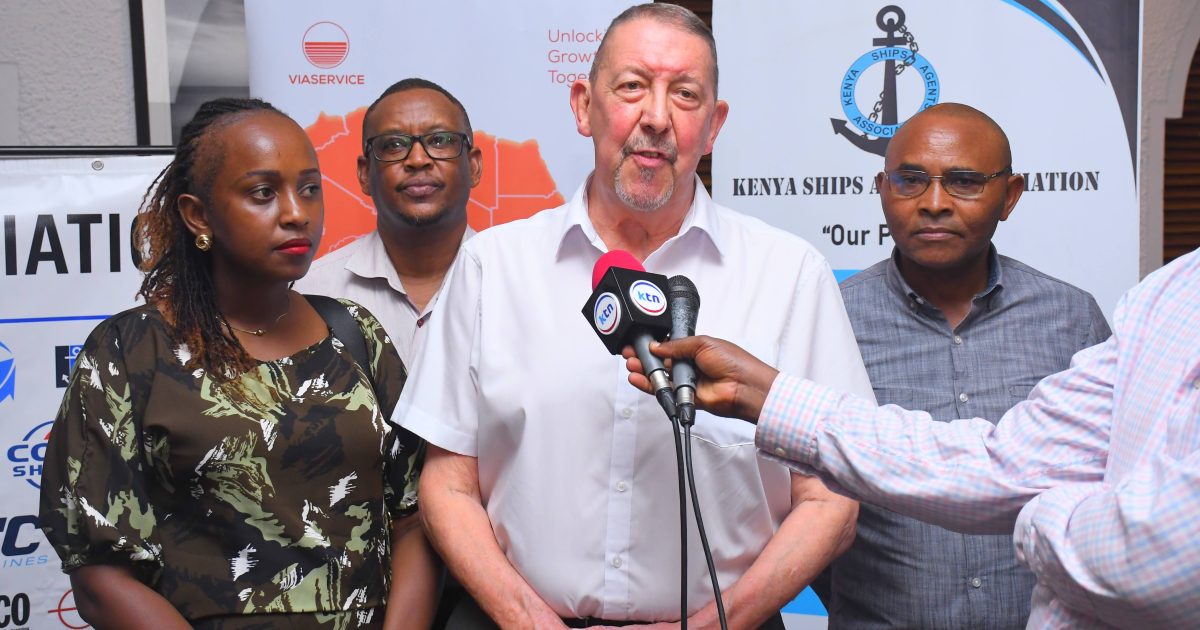
The Kenya Ship Agents Association (KSAA) has called on the government to accelerate investment in port infrastructure, eliminate additional charges imposed on vessels and review maritime regulations to improve efficiency and attract more international shipping lines to the Ports of Mombasa and Lamu.
The association said sustained investment in port infrastructure, modern equipment, berth capacity and cargo evacuation systems was critical to strengthening Kenya’s position as a leading maritime and logistics hub in East and Central Africa.
The Ports of Mombasa and Lamu have recorded significant growth in recent years, reflecting increasing confidence in Kenya’s maritime sector and its potential to handle rising regional and international trade volumes.
In 2025, the Port of Mombasa handled 45.5 million metric tonnes of cargo, up from 40.99 million metric tonnes recorded in 2024. Container traffic also reached 2.11 million Twenty-foot Equivalent Units (TEUs).
At the Port of Lamu, cargo throughput increased significantly from 74,380 metric tonnes in 2024 to 799,161 metric tonnes in 2025, while container traffic reached 55,687 TEUs.
To sustain this growth, KSAA is calling for further expansion of port infrastructure, berth capacity, equipment and cargo evacuation systems. The association also commended the ongoing expansion of Berth 19C, which is expected to increase the port’s capacity by an additional 300,000 TEUs.
KSAA Chairman Roger Dainty, speaking in Mombasa during the association’s year-end media briefing, said the growing confidence demonstrated by international shipping lines in the Ports of Mombasa and Lamu was a vote of confidence in Kenya’s future as East and Central Africa’s leading maritime and logistics hub.
Dainty said the association had held discussions with government agencies to address operational bottlenecks affecting shipping agents and other port users.
He also welcomed the government’s move towards privatising port operations, saying the initiative could significantly improve efficiency and service delivery.
“We are happy to see the progress that is being made towards the privatisation of the operations of the port. We see that as the way to bring greater efficiency to the way this port operates,” he said.
He noted that the Port of Mombasa had experienced a considerable decline in global rankings, calling for urgent interventions to reverse the trend and restore its competitiveness.
“We have all seen that the port has dropped considerably in world rankings, which is a crying shame.
We need that to be arrested and turned around to something very positive. We are hoping that our more direct, constructive engagement with the government will help to achieve that,” he stated.
Via Service Managing Director John Mathenge, who called for stronger collaboration among port stakeholders to address the growing challenge of empty container congestion at the Port of Mombasa.
Mathenge said coordinated efforts involving shipping lines, agents and other industry players were necessary to improve logistics efficiency, reduce operational costs and strengthen the competitiveness of the port.
“We need to work together to collaborate and seize those opportunities so that we can be able to achieve the efficiency required to ensure that our logistics system is efficient, and therefore we can reduce the cost of doing business,” he said.
Via Service is working with KSAA members, shipping lines and agents to provide a sustainable alternative to the traditional container deposit system.
Mathenge explained that the company issues digital certificates backed by trade finance to facilitate transactions between shipping lines and their customers, providing an alternative approach to container deposit arrangements.
Mombasa Governor Abdulswamad Nassir commended shipping lines for the improved performance of the ports of Mombasa and Lamu, assuring the association that the county government would strengthen its cooperation with industry stakeholders to further enhance port operations.
“Cargo throughput that has been done by the shipping lines has been on a steady increase. This is for both transshipment, imports and exports as well. So I think you know the proof of the pudding is in the eating,” said Nassir.
The governor added that the increase in cargo volumes was particularly encouraging as the country entered an electioneering period.
To ease congestion around the Port of Mombasa, Nassir announced that the county government would soon break ground for a marshalling yard, where long-distance trucks would be parked as they await clearance to enter the port.
He said the county government was also engaging the Kenya Ports Authority (KPA) on ways to expand storage space for empty containers, which remain a major challenge due to Kenya’s higher import volumes compared with exports.
“We are also discussing with KPA how we can increase space for empty containers. One of the biggest problems that has always been there as well is empty containers because Kenya is more inclined to imports rather than exports,” he stated.
KSAA CEO Elijah Mbaru called for sustained investment in port expansion, modern equipment and improved operational systems to prevent congestion, reduce vessel turnaround time and prepare the country’s ports for future growth.
Mbaru said despite the growing interest among international shipping lines in serving the region, infrastructure gaps continued to pose challenges to the sector.
“We are seeing a need for the ocean carriers and shipping lines to call this part of the world, but there are a lot of impediments in terms of soft and hard infrastructure, including the hinterland connectivity, which means road and railway connectivity. But by and large, the port has been trying to manage the situation,” Mbaru said.
“As you know, the port is full to the brim. It has outlived its capacity. There is also a need for the government to support the port in terms of infrastructure development, both soft and hard infrastructure, because the ships or the shipping agents follow efficient ports,” he added.
By Sadik Hassan