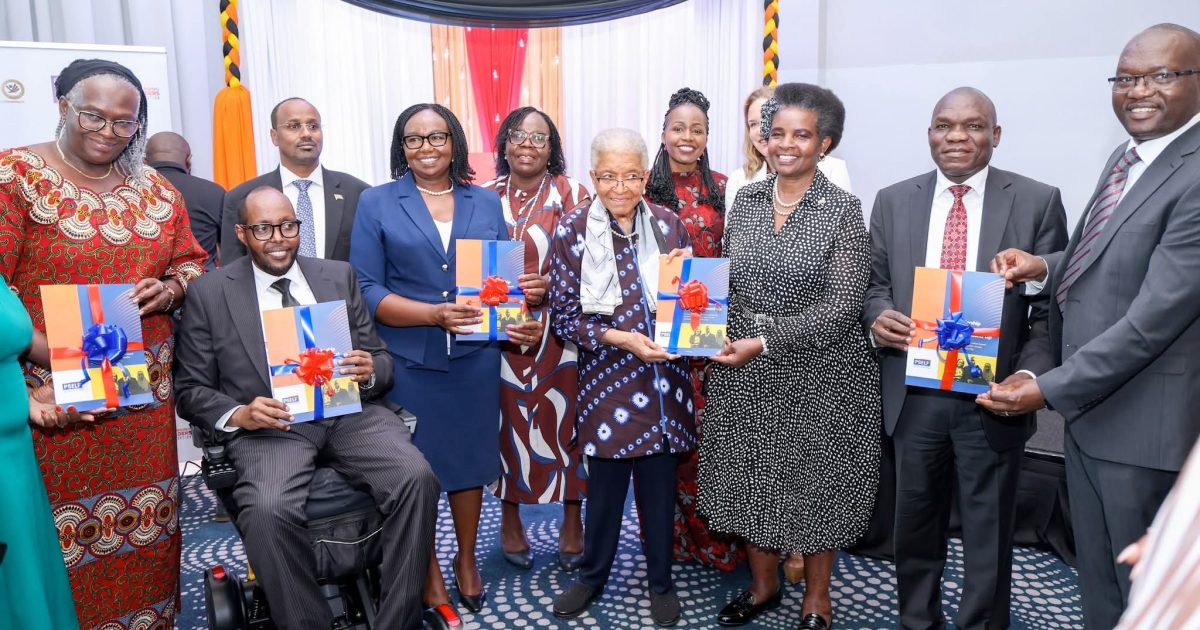
Former Liberian President Ellen Johnson Sirleaf has urged African governments to invest in young people, saying the continent’s future leadership rests in their hands.
Speaking in Nairobi during the launch of the Public Service Emerging Leaders Fellowship (PSELF) Impact Report, Sirleaf emphasised that Africa’s demographics make youth investment imperative.
“The demographics of Africa is evidence very clearly that the majority of people of our population on the continent are young people, and that the determination, the development of our continent will rest in the hands of the young,” she reiterated.
In retrospect, Sirleaf reflected on Liberia’s post-conflict recovery when she assumed office in 2006, saying the Civil Service Commission was ‘in a state of decay, totally incapacitated’.
She revealed that her administration sought to attract young Liberians who had left the country to return and serve, supported by provision of ‘a proper living wage’.
Further, Sirleaf credited the President’s Young Professionals Programme (PYPP) with nurturing leaders who continue to serve in senior positions.
“As I travel across the country, many introduce themselves as deputy ministers or ministers, but they are always careful to add that they come from the PYPP group — and that makes me very proud,” she said.
Concurrently, Head of Public Service Felix Koskei said the impact report demonstrates that leadership grounded in values and strengthened through mentorship produces measurable institutional reform.
“Institutions do not deliver results on their own. People do. Reform is human work. Service is human work. Trust is built by human conduct,” Koskei asserted.
He noted that fellows recorded an average 1.4-point increase in leadership competence, with nearly eight in ten rating their leadership ability as high or very high compared to 14 percent at baseline. In addition, more than one-third assumed supervisory roles within a year.
In remarks delivered on his behalf by Deputy Head of Public Service Amos Gathecha, Koskei disclosed that fellows initiated 62 cross-ministerial collaborations and introduced 37 new workplace processes, generating service efficiency ranging from 31 to 35 percent.
“In correctional services, anti-corruption protocols reduced case processing time by 42 percent. In health services, emergency coordination improved three-fold. In education, digital transformation reduced paperwork by 57 percent,” explained the Public Service Head.
He further emphasised the importance of mentorship stating, “The data shows a strong correlation between mentorship quality and programme outcomes. Therefore, where mentorship was weak, attrition risk rose sharply”.
Equally, Koskei called for scaling and institutionalising the programme.
“The question before us is no longer whether this approach works. The data confirms that it does. The real question is whether we will scale it, institutionalise it and finance it with the seriousness it deserves,” he posed.
In his remarks, Daniel Musinga, representing the Emerging Leaders Foundation board, urged emerging public leaders to uphold integrity.
“Success is not just about what you achieve but how you achieve it. It is about the positive impact you have on others. It is about the legacy that you create,” advised Musinga.
“Integrity is not a barrier to success, it is the bedrock of it,” he added.
Also speaking at the launch was Public Service Commission Vice Chairperson Mary Kimonye who mentioned that feedback received during the forum would guide improvements to the programme.
“We are going to be taking them home. They become working documents for us as we reorganise this programme,” she assured.
On her part, Founder and Chair of Emerging Public Leaders Betsy Williams argued that the programme’s origin in Liberia was based on strengthening public service.
“If you get the right people in the public service and instill them with the values, the skills, the spirit, the integrity, the trust you make everything else possible,” she affirmed.
Additionally, Williams pointed out that the Kenyan model was designed to reflect the country’s governance framework while maintaining the principle of investing in public servants.
“The report tells us that when you take talented young public servants seriously, their leadership grows,” she echoed.
Meanwhile, Matilda Esinyon, a beneficiary and Performance Management Officer at the Public Service Commission, stressed that the fellowship transformed her approach to public service and gave her the confidence to deliver citizen-centred solutions.”
By Naif Rashid