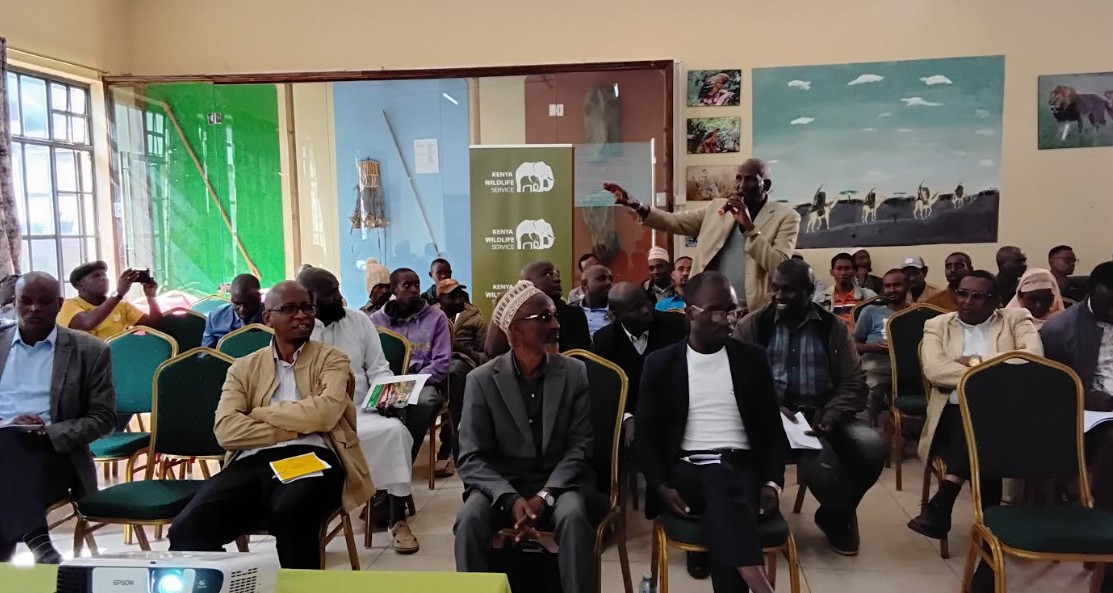
The Kenya Wildlife Service (KWS) conducted a public participation exercise at the Ahmed Gate Museum Hall in Marsabit National Park to collect views from stakeholders on the proposed new rates for park entry and conservation fees in the Northern Conservation Area (NCA).
Participants endorsed the revised conservation fees for entry into national parks, reserves, marine parks, and sanctuaries supported by the Wildlife Conservation and Management (Access and Conservation Fees) Regulations, 2025 draft, which were published in the Kenya Gazette on July 9 this year.
Speaking on behalf of the KWS Director General Prof. Erastus Kanga, the service Senior Assistant Director in charge of the Northern Conservation Area, Mr Mungumi Bakari, pointed out that the consultation forums underscored the government’s commitment to inclusive decision making for sustainability purposes.
Mr. Bakari said that the service was keen to hear from stakeholders, who include communities living near wildlife areas, tour operators, conservationists, and members of the public, during the national exercise scheduled to also run through other counties across the country until August 8, 2025.
“As we deliberate on this matter here in Marsabit, similar events are being held in other parts of the country, including Homabay and Hola and will include 17 other in-person forums across as many counties through to 8th August 2025,” he said.
The forum, whose participants were drawn from Marsabit, Wajir and Mandera counties, was informed that KWS was grappling with a Sh12 billion annual funding gap occasioned by inflationary pressures and rising operational demands, hence hindering the service’s ability to fulfil its conservation mandate.
Owing to the low charges, KWS managed to generate Sh7.92 billion against a projection of Sh19.79 billion in the 2024/2025 financial year, which limits its capacity to protect wildlife, restore degraded ecosystems, and respond to challenges such as human-wildlife conflict and poaching.
It was against this background, as well as numerous highlights on the importance of wildlife and tourism to the country’s economy, that participants unanimously approved the effort to review the access and conservation fees.
Molu Yattani, the Managing Director at Imperial Dale hotel, rallied the call for the approval of the proposals, noting that the review on conservation fees that was last carried out in 2007 was being undertaken after 18 years.
“The new regulations are long overdue, as this move reflects the current situation on matters of conservation, which, to my view, requires an urgent need for sustainable financing,” said Yattani, adding that wildlife conservation was the backbone of the tourism sector that supports the livelihood of thousands of Kenyans.
His sentiments were echoed by Sheikh Bashir Somo, who hailed KWS for involving Kenyans and drafting the proposed changes on access and conservation fees, saying that every voice matters in shaping the future of the parks in the country.
More than 90 per cent of KWS’ internal revenue comes from tourism-related activities; hence, the need to bridge the widening fiscal deficit lest it undermine conservation and the livelihoods of over one million Kenyans whose jobs depend on a thriving wildlife economy.
Under the new framework, park revenues are projected to grow from Sh7.92 billion in 2024 to Sh16.58 billion by 2028 with KWS planning to reinvest in conservation through this initiative in order to unlock greater socio-economic and ecological benefits.
According to the director-general, the proposed changes will maintain Kenya’s status as an accessible, competitive, and world-class conservation destination, as global best practices recommend periodic reviews for sustainability.
Wildlife tourism, which contributes approximately 10 per cent to the national GDP, remains an important pillar of the economy, offering employment to community scouts, rangers, tour operators, hoteliers and artisans.
The proposed changes are part of a broader revenue enhancement strategy designed to support core conservation activities, including restoration of habitats and ecosystems, mitigation of human-wildlife conflict, and enhanced anti-poaching and wildlife security operations.
Also expected to benefit from the changes is the modernisation of park infrastructure and services, while the expansion of conservation education and awareness programs will be taken a notch higher.
Mr. Bakari thanked stakeholders in the Northern Conservation Area for throwing their weight behind the proposed changes, saying the KWS Strategic Plan 2024–2028 depends on adequate and predictable funding.
By Sebastian Miriti