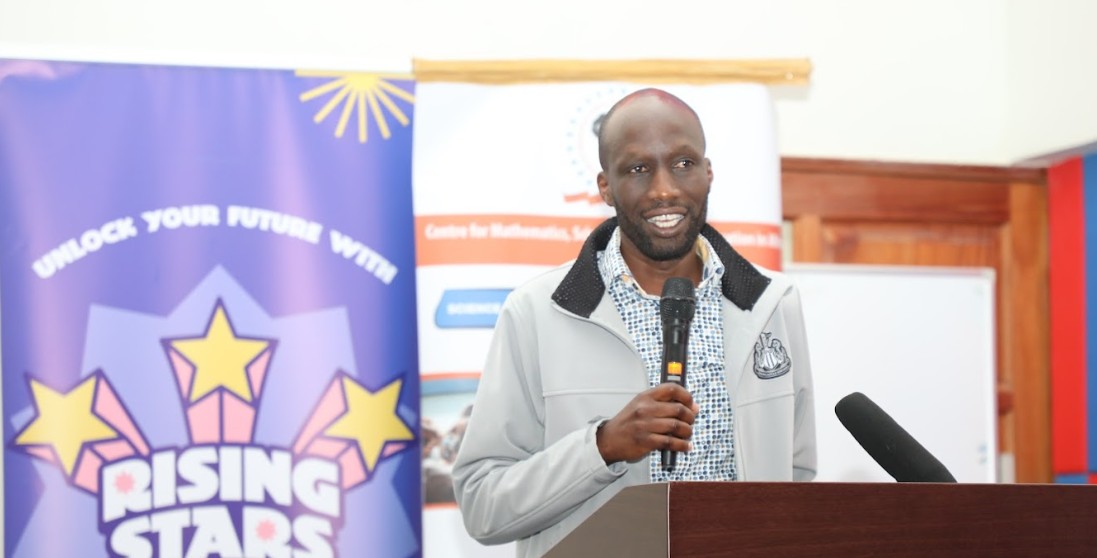
Former Cherangany Member of Parliament Wesley Korir has urged young people to fully embrace mathematics as a pathway to solving everyday problems.
Speaking during the opening ceremony of the 2026 African Olympiad Academy (AOA) Rising Stars Training Camp at the Centre for Mathematics, Science and Technology Education in Africa (CEMASTEA), Korir encouraged learners to take advantage of the training opportunity to think about how to develop solutions, not just for academic purposes.
“Acquiring mathematics skills will help students become innovative and contribute meaningfully to society by generating new ideas and boosting the economy,” he said.
Korir, a former marathon world champion and 2016 Olympic representative for Kenya, used the platform to reflect on his journey from athletics to public service and now academia.
The former legislator urged students to be creative and critical thinkers, noting that today’s challenges are best solved through critical thinking.
The former athlete commended youngsters for their resilience and determination, asking them to utilise their time while they are still young to build their careers.
He emphasised that today’s global challenges are best addressed using modern skills and urged them to apply mathematics and science to make their work and life easier.
The MP who served his constituents for five years currently works with the University of Waterloo’s Centre for Education in Mathematics and Computing (CEMC), where he supports partnerships and linkages across Africa.
Through his initiative and capability, Korir has helped many bright students achieve their dreams by linking them directly to opportunities to pursue STEM.
“I represent the African continent in building partnerships and linkages with the University of Waterloo,” he said, adding that one of his key responsibilities involves promoting problem-solving through mathematics across the continent.
Korir emphasised the role of the CEMC, noting that the institution, which conducts the world’s largest mathematics contests, holds over 300,000 bright students across 85 countries.
Korir emphasised that mathematics should be treated as a main career pathway, not just a supporting subject for engineering or other disciplines.
He urged the government to emulate the University of Waterloo’s mathematics faculty, which has established mathematics as a core career pathway.
“You can literally take mathematics as a career path,” he said, encouraging students to develop strong analytical and problem-solving abilities.
He further noted that Kenya is among the leading African countries actively participating in these initiatives, alongside Rwanda and Ghana, through programmes designed to strengthen mathematics among learners.
Korir underscored that Africa’s development challenges require stronger problem-solving skills, saying many leaders struggle to address even basic societal issues due to gaps in critical thinking.
He argued that strengthening problem-solving skills could transform how young Africans approach challenges, innovate solutions, and create economic opportunities.
“If you become a problem solver, you can go back to your village and make money by solving people’s problems,” he said, urging students to think creatively and apply knowledge practically.
Korir also shared his broader vision of nurturing excellence, comparing academic development to his experience in athletics, where discipline and structured systems produce champions.
He called for stronger institutional support, including formal recognition of students representing the country in mathematics competitions, complete with official uniforms and national symbols.
“When they go out there, they are not representing themselves, they are representing Kenya,” he said.
He expressed hope that mathematics Olympiad participants could be supported and recognised at a national level, similar to athletes representing Kenya internationally.
The students will undergo a rigorous mathematics contest; thereafter, they will earn scholarships from prestigious institutions.
The students who will qualify get admission to the African Olympiad Academy (AOA) in Kigali, Rwanda, to advance their training.
The intensive contest is specifically designed to further prepare the students for major global competitions such as the Pan-African Mathematics Olympiad (PAMO) and the International Mathematical Olympiad (IMO).
The exercise promotes collaborative learning and knowledge exchange among CEMASTEA and its key partners, including the University of Nairobi (UoN) and the University of Waterloo’s Centre for Education in Mathematics and Computing (CEMC), which play a key role in advancing STEM education.
Korir commended partnerships between the CEMASTEA, the University of Nairobi, and the University of Waterloo, noting that such collaborations could help develop global champions in mathematics and science.
By Ian Chepkuto