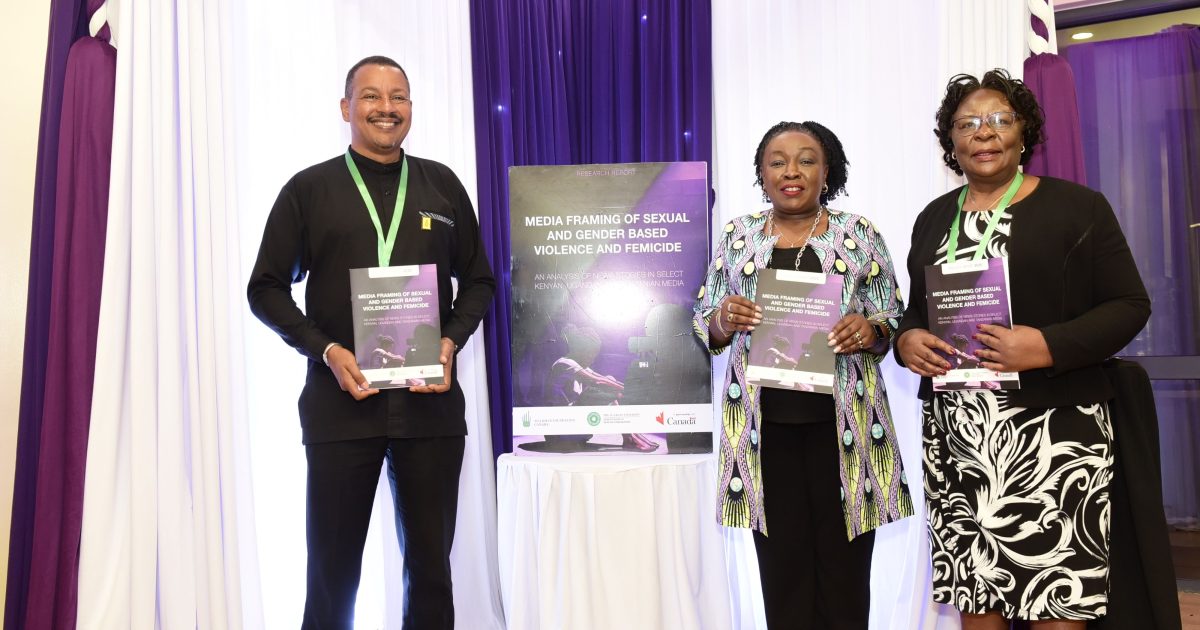
A new study by the Aga Khan University’s Graduate School of Media and Communications (GSMC) reveals that a persistent focus on event-driven narratives, victim sympathy, and official sources is failing to hold perpetrators of sexual and gender-based violence (SGBV) and femicide in Kenya, Uganda, and Tanzania accountable and hindering the pursuit of justice.
Drawing on data from more than 1,200 news stories published between January 2024 and April 2025, the report title ‘Media Framing of Sexual and Gender-Based Violence and Femicide in East Africa’ sheds light on a critical gap where only 3 percent of stories focused on perpetrators, despite thematic framing which situates violence within broader social structures dominating 78 percent of the coverage reviewed.
Professor Nancy Booker, Dean at GSMC noted that the study underscores the critical role of the media in shaping how societies understand and respond to gender-based violence.
“It challenges journalists and editors to move beyond the headlines to tell stories that humanise survivors, question impunity, and hold systems accountable. Journalism has the power not just to inform, but to drive justice and change,” stated Prof Booker in a press statement.
While the study noted positive progress, including a dominant trend towards situating violence within broader social and cultural contexts, the findings highlight a failure to connect incidents to accountability.
A stark 3 percent focus on perpetrators means the individuals responsible for violence often remain out of sight in media narratives, especially in follow-up reporting whereas only 11 percent of stories amplified survivor voices, despite survivors being central to the narrative of violence.
Further, Kenya accounted for more than half of the regional coverage (54%), followed by Tanzania (28%) and Uganda (18%), suggesting a positive impact from the institutionalisation of gender desks and targeted newsroom training.
In his remarks, lead researcher Dr Hesbon Hansen Owilla pointed out that this invisibility is a major barrier to progress affirming that there’s growing awareness in East African media that gender-based violence and femicide are societal issues rather than isolated incidents.
“But coverage remains largely event-driven, and perpetrators are still invisible, especially in follow-up reporting. That invisibility fosters impunity and weakens deterrence,”explained Owilla.
Meanwhile, the report, part of GSMC’s Advancing Gender Equality in Media and Civil Society in East Africa (AGEMC-EA) project, urges media houses to institutionalise gender desks, embed gender-sensitive journalism in editorial practice, and strengthen collaborations with academia, policymakers, and civil society.
“The media is not just a mirror of society, it is an agent of change. This report is a wake-up call to reimagine how we tell stories about gender-based violence, and whose voices we choose to centre,” implored Prof Booker.
By Michael Omondi