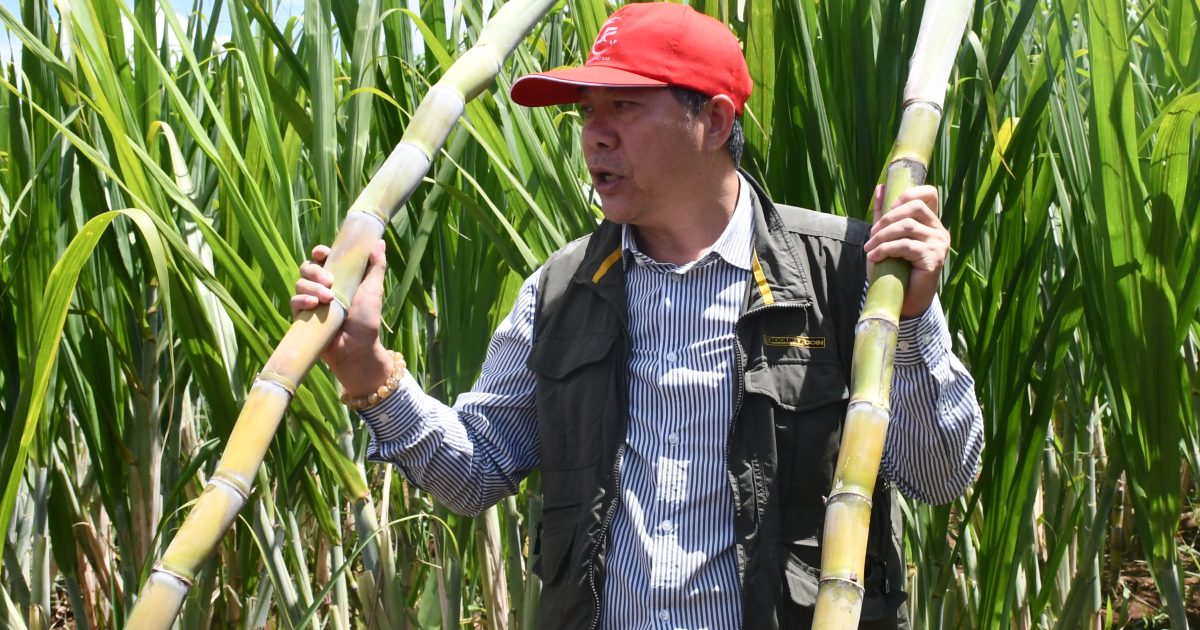
A Chinese investor in Kenya is on a mission to improve sugarcane production and offer Kenyan farmers better incomes for their produce.
The investor, Jack Liu, who is working with a team of researchers through a Kenyan-based
firm Crevation International Limited is currently developing two new tissue culture sugarcane seed varieties, focusing on early maturation, drought and disease resistance as well as high sugar content to boost farmer income and mitigate climate change effects on agriculture.
Liu and his team of 15 experts have already received approval from the Kenya Plant Health Inspectorate Services (Kephis) to conduct trials in Rongai Sub-County on the ‘Golden Fruit 2 variety’ which is being developed for the manufacture of industrial sugar and ‘Golden Fruit 1 variety’ meant for chewing or manufacture of sugarcane juice.
In May 2022, Liu leased 50 acres of land in Kambi Ya Moto Area in Rongai Constituency of Nakuru County, where he started conducting the trials.
The farm has now become a demo and learning site where companies, organisations, and institutions are coming to learn about the two sugarcane varieties, which are set to be released to the market in June 2026 subject to approval by Kephis.
Liu indicates that the improved seed varieties whose technology originates from China mature in 7-10 months, compared to most varieties in the local market that take 18-24-month cycles, making farming more profitable and sustainable by reducing crop loss and increasing yields.
The agripreneur states that new varieties also offer increased sucrose content and overall yield, enhancing profitability for farmers in key sugar-growing regions.
Mr Liu indicates that the two varieties once approved by Kephis will be distributed to farmers in Western Kenya (Kakamega, Bungoma, Busia, Kisumu, Migori, Nandi), parts of the Rift Valley (Narok, Trans-Nzoia, and Kericho), and parts of coastal region (Kwale, Tana River, Kilifi, Lamu).
He states that trials have established that the ‘Golden Fruit 2 Variety’ has 80 percent juice content, while ‘Golden Fruit Variety 1’ millers can get 15 tons of refined sugar from 100 tons of sugarcane as it has at least 50 percent more sucrose than traditional seed varieties.
Liu assured farmers that the new sugarcane breeds are designed to withstand climate change shocks, offering better drought tolerance and pest/disease resistance.
“Sugarcane is a water-intensive crop. It thrives best in regions with consistent rainfall of 1,100–2,500 mm annually, warm temperatures and well-drained, fertile soils. Counties like Kakamega, Bungoma, Busia, parts of Nyanza and the Rift Valley have long provided the ideal environment for cane farming,” states the agri-preneur.
“Today, farmers in these areas will tell you that the rains no longer come as they used to. Sometimes, droughts are prolonged; when the skies finally open, heavy downpours result in flooding. It is harder than ever to predict the seasons—and that is why the sugar sector needs resilient seed varieties,” he adds.
Mr Liu stated that Crevation International Limited was determined to contribute to efforts towards transforming Kenya’s sugarcane sector with research-backed varieties that are more resilient, productive and economically viable for farmers.
“Our efforts aim to overcome challenges with disease-prone varieties, making sugarcane farming more profitable by increasing yield per acre and reducing time to harvest. It is our sincere hope that the development will encourage farmers to double their efforts amid challenges bedeviling the sub-sector,” he added.
He noted that quality sugarcane seed is crucial for Kenyan farmers as it produces healthier, more robust plants, directly leading to more cane and better income.
Liu said that lack of certified seed often constraints farmers to use poor-quality material from ratoon crops (second-generation growth) or cane tops, leading to poor establishment and low yields.
Presently, the average sugarcane yield in Kenya is around 60.52 tonnes per hectare, far below its capacity of between 90-150 tonnes per hectare.
Liu observes that since sugarcane is propagated vegetatively, it favours the accumulation of pathogens. This, he elaborates, is because the disease-causing pathogens are introduced into the new areas along with seed canes.
“The slow accumulation of different pathogens over time makes minor diseases become major ones. Disease-infected seed cane can play a significant role in the multiplication and spread of diseases, as has been the case with red rot, smut, wilt, grassy shoot, ratoon stunting, yellow leaf and leaf scald. Unfortunately, we have operated the industry without following the scientific system of seed cane production,” he lamented.
According to Liu, a robust seed cane system is essential to reversing this trend. He states that the ideal structure comprises three critical and interdependent stages: breeder seed, foundation seed, and certified seed.
Breeder seed is the first tier in the seed cane pipeline. It is preserved by research institutions under strictly controlled environments to maintain genetic integrity. Derived from nucleus stock, breeder seed is grown in isolation and subjected to rigorous monitoring to prevent contamination.
Foundation seed, he explains, serves as the intermediary stage between breeder and certified seed. It is cultivated under stringent agronomic and phytosanitary protocols, typically by research farms, public private partnerships, or licensed multipliers. The goal is to produce sufficient volumes of clean, high quality planting material to supply certified seed producers while safeguarding varietal purity and health standards.
Certified seed, the third and most critical tier, Mr Liu elaborates, is what farmers directly plant in their fields.
With regard to seed propagation, the agri-preneur explains that one acre can hold up to 6000 seedlings of each variety.
“Each seedling can propagate 20 to 30 stems but we recommend that each seedling propagates a maximum of 5 to 10 seedlings. This means any farmer propagating either of the two varieties on an acre will yield at least 30,000 stems,” he notes.
Crevation International Limited Marketing Manager, Penina Karimi, notes that with proper land preparation, choice of the right varieties, and good market planning, sugarcane cultivation in Kenya can provide steady income and attractive returns.
The main sugarcane-growing areas in Kenya include Western Kenya (Kakamega, Bungoma, Busia), Nyanza (Kisumu, Migori), and parts of Rift Valley (Trans-Nzoia and Kericho).
Ms Karimi emphasizes that quality seed cane is fundamental for Kenya’s sugar industry, as it directly impacts yields, disease resistance, and farmer profitability, with systems like the three-tier seed cane program (Breeder, Foundation, Certified) ensuring high-quality, disease-free planting material, crucial for a healthy and productive sector.
She notes that focus on advancing research, innovation and technology transfer within the Kenyan sugar industry must take the lead in breeding drought-tolerant, pest-resistant cane varieties that mature faster and require less water.
Furthermore, Ms Karimi points out that partnerships between national and county governments should focus on proactive extension services, including training on soil conservation, mulching and intercropping to build resilience at the farm level.
“Climate change is not a distant threat—it is already affecting cane in the fields and the lives it supports, from farmers to mill workers, rural communities and the national economy. This new reality is rewriting the rules of agriculture in real time. We cannot assume that sugarcane will continue to thrive as it always has,” observes the Marketing Manager.
In 2024 the firm also introduced Kenya Juncao grass, commonly called Chinese magic grass.
According to Liu, the grass, which is locally called ”Chinese magic grass”, can increase milk production by 50 per cent thanks to its high protein content and reduce the dairy costs at processing and packaging as silage,” said Liu.
The grass, he said, has 18.6 percent crude protein content, taking the second position after Lucerne, which has 22 per cent, Napier at 10.8, maize leaves at 8 per cent and Boma Rhodes Hay at 2 per cent.
By Jane Ngugi and Dennis Rasto