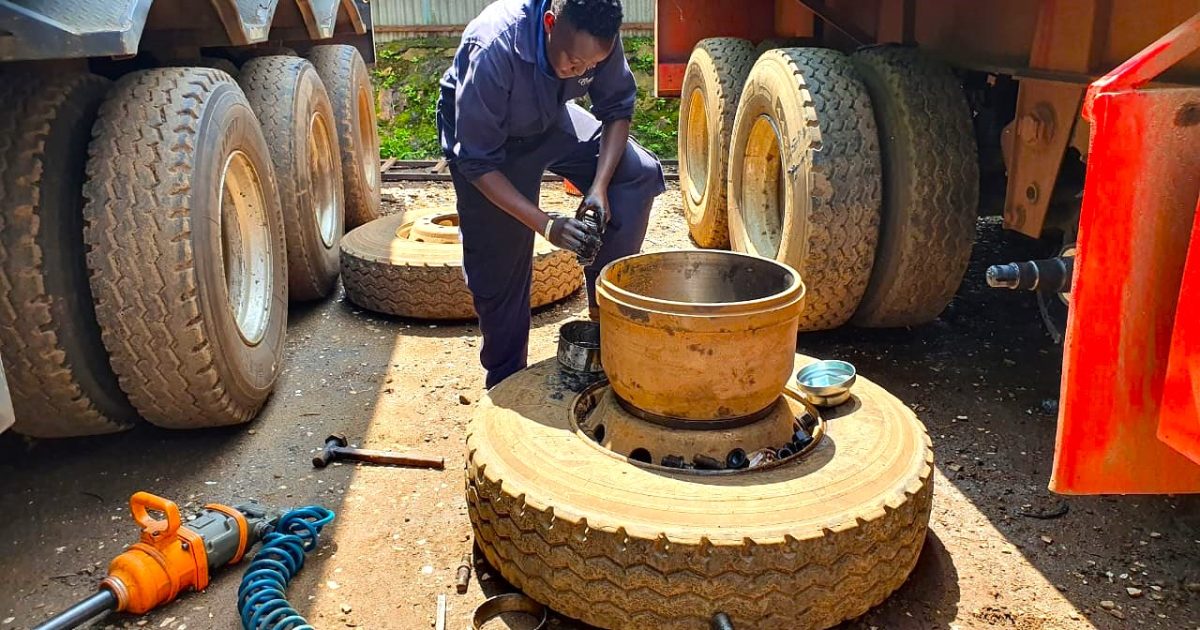
Tucked behind a row of modest buildings on the outskirts of Kericho town, a small tin-roofed garage buzzes with life.
The rhythmic clank of metal, the hiss of oil, and the occasional roar of an engine fill the air.
At the heart of this mechanical symphony is 21-year-old Miriam Chepchumba, her overalls smeared with grease, her focus razor-sharp.
In a field long dominated by men, Miriam is not just fixing engines; she’s dismantling stereotypes and proving that skill, not gender, defines a mechanic.
The scent of engine oil clings to the air, mixing with the earthy aroma of the surrounding tea fields. For most, it’s just another weekday morning. But for Miriam, every day is a statement.
She is not just fixing motorcycles and cars. She is rebuilding belief, one stripped bolt and stubborn engine at a time.
Miriam did not inherit a garage or go to a technical school. Her journey began with a borrowed motorcycle manual, a broken-down bike, and the kind of determination that refuses to be ignored.
She was still a teenager when a neighbor, desperate for transport, challenged her to take a look at his faulty boda boda. What followed was not only a successful repair, but the spark that lit a fire within her.
“Everyone thought I was just playing,” she recalls, tightening a lug nut as sweat beads on her brow.
“But when that bike roared to life, something changed. People looked at me differently. More importantly, I looked at myself differently,” she said.
That small success gave way to bigger challenges. Word began to spread in the villages and trading centers around Kericho.
Curious boda boda riders brought their bikes. Then came matatus with overheating engines. Soon, personal cars followed. Then, against all expectations, even luxury car owners at first skeptical began to pull up to her garage.
“I don’t get offended when someone walks in and asks where the real mechanic is,” she says, laughing softly. “I just lift the bonnet and show them that she is already here.”
But for all the praise and recognition, Miriam’s climb has not been without challenges. Suppliers have tried to shortchange her.
Some customers have refused to believe she is in charge, speaking only to her male apprentices. Others, impressed with her skill, still leave without ever uttering an apology for their earlier doubt.
Even so, she has learned to let her work do the talking. “I do not have to shout. The engine speaks for me,” she says, turning back to her tools with the quiet assurance of someone who has nothing to prove and everything to offer.
Her garage, modest but always busy, has become an unlikely classroom. Two young men now train under her guidance, slowly letting go of the biases they walked in with. But Miriam’s bigger dream stretches far beyond these walls.
She wants to build a modern, fully equipped automotive training center where girls from villages and informal settlements can come, learn, and leave with skills that empower them to be independent, respected, and financially stable. “I want girls to know that they do not have to choose between femininity and skill.
Her story comes at a time when Kenya, like many African countries, is grappling with how to bridge the gender gap in technical professions.
Despite progress, female mechanics remain rare, and young women often face resistance from family and society when they pursue careers considered too masculine.
Miriam’s journey is not just inspirational, it is instructive. It tells young women that their dreams are valid even when they are loud, dirty, mechanical, and misunderstood.
She challenges the tired narratives that keep women out of workshops, labs, studios, farms, boardrooms, and building sites.
She proves that passion, when pursued with discipline, can turn into a profession. And that profession, with consistency, can spark a movement.
As the day winds down at the small garage, the clatter of tools fades and a quiet calm settles over the once-busy space. Miriam wipes the last streak of grease from her hands; her overalls smudged with the grit of honest work.
Around her, the soft hum of cooling engines and distant chatter of passersby mark the close of another chapter. With a tired but contented breath, she leans against the doorframe, her gaze steady, already focusing on tomorrow’s challenges.
To young girls across the country, her message is clear and unwavering: “Step out of your comfort zone.
Ask questions. Try something different. If you want to become a mechanic, a welder, a pilot, or an engineer, do not let society’s fear become your limitation. You are capable. You are enough. And the world is ready for your light, she added.
By Gilbert Mutai