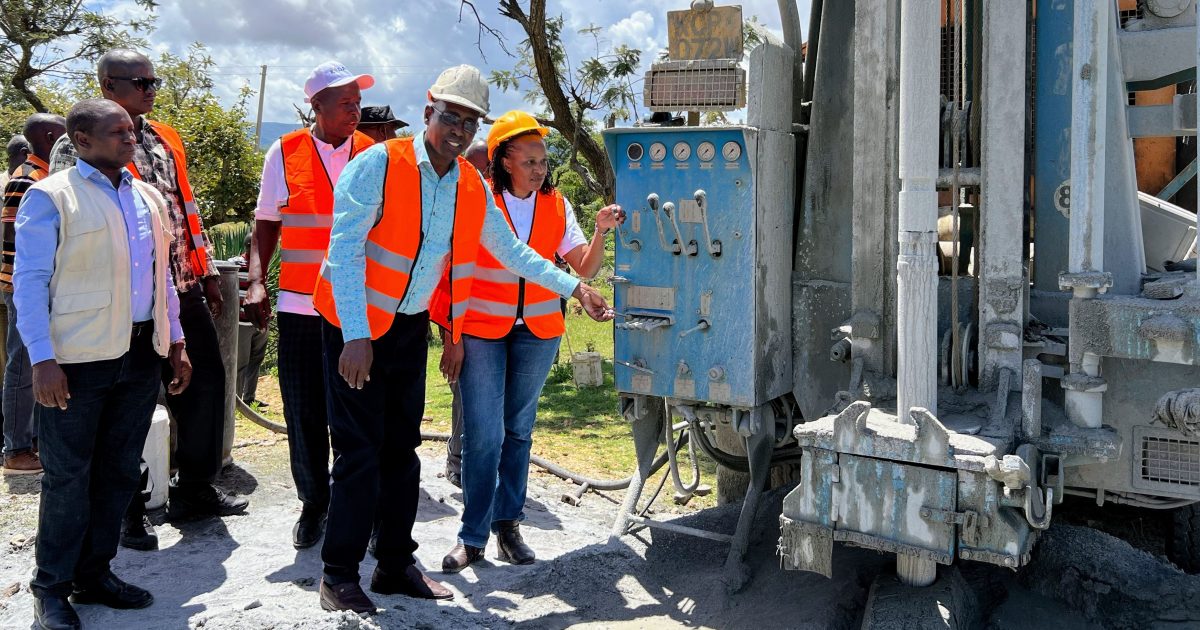
In an effort to enhance water security in arid regions of West Pokot County, with an emphasize on community development, education, sustainable resource management, Kerio Valley Development Authority (KVDA) has officiated the groundbreaking of borehole projects aimed at improving water access in the region.
Speaking during the groundbreaking of a borehole water project in Chepukat primary and junior secondary school in Kipkomo Sub County of Pokot South Constituency, KVDA Managing Director Sammy Naporos disclosed that KVDA has eleven water projects at various stages of implementation across the Kerio Valley region, with Chepukat borehole being the first among them.
‘‘West Pokot has about six of the water programs because the area is drought-prone. We have two water projects in Turkana South and some in Baringo and Samburu North and Central, and specifically to caution farmers or the residents of this particular area,’’ the MD Naporos highlighted.
He said Kipkomo Sub County, including Chepukat area, is among the driest areas, particularly in Pokot South Constituency.
He underscored that the boreholes are intended to mitigate water scarcity, helping farmers and residents by providing safe, clean drinking water and reducing the need to travel over two kilometers for water, which is often of poor quality.
He said Chepugat borehole will serve approximately 400 households and over 300 animals including goats, sheep, cattle among others.
He said improved water access will boost school enrollment, possibly doubling the number of students, and could transform the school into a boarding facility in the future.
Naporos emphasized that the borehole project is a government-funded initiative aimed at supporting pastoralists and children in drought-affected areas, ensuring they have access to safe drinking water.
In her remarks, Wanjiku Manyatta from Ministry of ASAL and Regional Development and East African Community recognized KVDA as one of Kenya’s six regional development authorities actively implementing projects for the benefit of residents in ASAL areas.
She commended KVDA for successful project implementation calling for continued collaboration between KVDA, stakeholders, and the county government to ensure project sustainability.
Dismus Juma, head teacher of Chepugat Primary and Junior Secondary School, expressed heartful gratitude to the KVDA for considering implementing the water project at their school.
He emphasized that the water initiative will greatly benefit both school and the wider community.
Historically, he said the Chepukat area has faced a severe water shortage for many years, forcing villagers to travel nearly five kilometers in search of water for domestic use and their livestock.
Juma highlighted that with the commencement of the borehole project, the community and school are very pleased, as the longstanding water problem is expected to come to an end.
‘‘The availability of water will enable learners to have more time for studies, as they will no longer need to spend hours fetching water from distant sources,’’ he disclosed.
Juma also acknowledged the government’s school feeding program, stating that improved water access will facilitate better sanitation and nutrition at school.
He noted that livestock herders have had to move their animals to Uganda during dry seasons in search of pasture and water, which has led to disruptions in learners’ education and attendance.
With availability of water at the school, he remains optimistic that the water hardship problem will be alleviated, allowing children to stay in school and focus on their studies.
‘‘Lack of water in the region has resulted in inconsistent attendance and academic progress,’’ Juma said.
Vitalis Wamalwa, deputy head teacher Chepugat school shared that teachers, especially non-locals, have faced numerous challenges due to the water scarcity.
‘‘Teachers have been forced to fetch water themselves using various containers, including cups, to store water for personal and school use during dry periods,” he said.
Sometimes, he said the school has had to close early so students can fetch water for their families, and in some cases, the school has been unable to cook meals for students due to lack of water.
He emphasized that access to water is a privilege many regions lack, underlining the critical need for water resources.
Rosaline Chebet, the school cook, expressed happiness that water availability at the school will help reduce the arduous tasks of travelling long distances with donkeys to fetch water.
She is optimistic that the availability of water will ease her work and improve hygiene and sanitation at the school.
Philomena Chelimo, a teacher, observed that learners often find it difficult to concentrate during afternoon classes because they are eager to go home early to fetch water for their families.
‘‘Water shortage has thus affected learners’ focus and overall learning experience,’’ Chelimo said.Parent Samson Lolem disclosed that there is no borehole in the area and that residents have been traveling up to 20 kilometers in search of water.
He thanked KVDA for prioritizing the drilling of a borehole, which will bring numerous benefits, including improved health, education, and livelihoods for the community.
By Anthony Melly