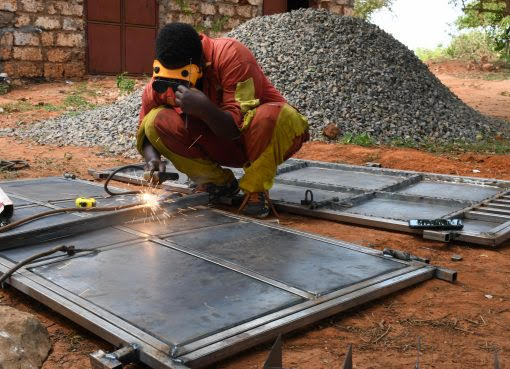
Under the harsh mid-morning sun in Tinderet Sub-County, in Nandi County, the sharp crackle of welding machines blends with the steady rhythm of hammers striking metal, forming a familiar soundtrack across trading centres in Nandi County.
In these open-air workshops, often shielded only by iron sheets and wooden poles, the Juakali sector continues to thrive, shaping not just metal but the economic lifeline of the community.
In Kabiyet Ward, one such entrepreneur stands out. Peter Kiprotich, a 34-year-old metal fabricator, has steadily built a name for himself through resilience, skill and an eye for opportunity. What began several years ago as a modest one-man operation has since evolved into a growing business that now employs two young assistants, Kevin Cheruiyot and Brian Kiptoo, both of whom he mentors in the trade.
Kiprotich’s workshop, strategically located along a busy roadside, produces a wide range of household and construction items. From metallic doors and window frames to cooking jikos, wheelbarrows and water tanks, his work has become a staple for residents across the ward and neighbouring areas.
Customers trickle in throughout the day, some placing new orders while others collect finished products, a clear indication of the steady demand he enjoys.
He recalls starting out with only a basic welding machine and a handful of tools, often working long hours to meet customer needs. Over time, his consistency and craftsmanship earned him trust among clients, allowing the business to grow organically through referrals.
Today, he is able to handle multiple orders simultaneously, thanks to the support of Kevin Cheruiyot and Brian Kiptoo, who have acquired practical skills in welding and fabrication through hands-on experience at the workshop.
For the two young men, the opportunity has been life-changing. Having joined the workshop as inexperienced helpers, they have gradually developed technical expertise that now enables them to undertake fabrication tasks with minimal supervision.
Kiprotich notes that equipping them with skills is just as important as expanding his business, as it opens doors for them to eventually start their own ventures.
The enterprise has not only created employment but also serves as a training ground for youth who might otherwise struggle to find formal jobs. In a region where employment opportunities are scarce, such initiatives play a crucial role in addressing joblessness among school leavers.
On a good day, the workshop generates between Sh2,000 and Sh5,000, depending on the volume and type of orders. This translates into a stable monthly income that comfortably sustains the business, pays wages and supports his family.
The affordability and durability of locally fabricated products have made juakali artisans like Kiprotich indispensable, especially as more residents opt for cost-effective solutions in construction and household needs.
Across Kenya, the informal sector remains a dominant force in the economy. Data from the Kenya National Bureau of Statistics indicates that the sector employs approximately 16.7 million people, representing about 83.5 per cent of total employment.
It is also the leading source of new jobs, accounting for over 90 per cent of employment opportunities created annually. Economists estimate that the sector contributes between 24 and 32 per cent of the country’s Gross Domestic Product, highlighting its critical role in sustaining livelihoods.
Within this broader framework, metal fabrication and small-scale manufacturing continue to play a significant role, particularly in rural and peri-urban areas such as Tinderet. The growth in construction activities has further fuelled demand for items produced within the juakali sector, giving artisans a steady market.
Residents in the Ward have increasingly turned to local fabricators for their needs, citing affordability, accessibility and the ability to customise products. Many say this shift has reduced reliance on expensive factory-made goods sourced from urban centres.
Despite the progress, challenges persist. Fluctuating prices of raw materials such as metal, limited access to credit facilities and lack of formal certification continue to hinder expansion for many small-scale entrepreneurs.
Kiprotich acknowledges these hurdles but remains optimistic, noting that determination and customer trust have kept his business afloat.
By Sammy Mwibanda