The Teachers Service Commission (TSC) has this year retooled a total of 52,452 senior school teachers in a nationwide programme in preparation for the roll out of Competency-Based Education (CBE) at senior secondary level.
Senior Deputy Director, Teacher Professional Development at the Commission Mr Andrew Mwathi said the number included teachers currently deployed in regular secondary schools, Special Needs Education (SNE) institutions and vocational training centres who are expected to teach Grades 10 to 12 beginning January 2026.
The Senior Deputy Director indicated that TSC was actively collaborating with the Centre for Mathematics, Science and Technology Education in Africa (CEMASTEA) to carry out nationwide STEM teacher training programmes as a foundation for Competency-Based Education (CBE) and assured that the retooling programme had focused on aligning teachers with the new senior school pathways introduced under the Competence Based Curriculum (CBC).
The Senior Deputy Director explained that the 52,452 participants had been clustered into three broad learning areas of Science, Technology, Engineering and Mathematics (STEM), covering pure sciences, applied sciences, and technical subjects, Social Sciences including languages, humanities, and business studies and Arts and Sports Science that is encompassing music, visual and performing arts, and physical education.
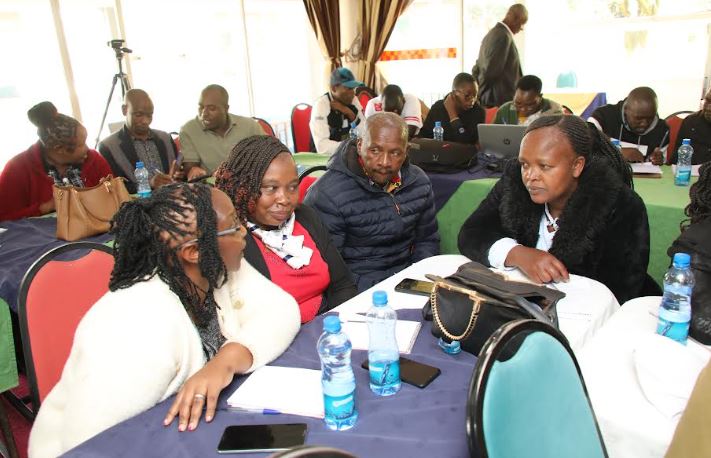
Speaking at Egerton University’s Agriculture Resource Centre (ARC) during the closing of a four-day workshop where 102 county trainers underwent training in preparation for the transition of Junior Secondary School (JSS) learners to Senior Secondary School starting next year, Mwathi said the retooling exercise was a critical component in ensuring that teachers are adequately equipped with the skills and knowledge required to effectively deliver the CBC framework in senior secondary schools.
A total of 290 County Trainers underwent retooling through the programme themed “Enhancing the Capacity of STEM Heads of Departments to manage transition to Competency Based Education” which was conducted at three centres spread across the country including Egerton University in Nakuru, CEMASTEA headquarters in Ngara-Nairobi and Golf hotel in Kakamega, with facilitators from CEMASTEA, the Teachers Service Commission (TSC), the Kenya National Examination Council (KNEC), the Kenya Institute of Special Education (KISE) and County Trainers.
County trainers are being retooled to enable them to cascade the training to Heads of Department (HoDs) in schools.
Mwathi noted that HoDs are strategically placed to facilitate successful implementation of the curriculum and hence the need to enhance their handling of the transition successfully.
He further explained that the County trainers who were trained under the programme would serve as a backup and fill gaps when some school heads retire before transition to the new curriculum.
“TSC will continue to build capacity of all teachers to ensure a successful transition,” added the official.
The training of County Trainers was spearheaded by the Ministry of Education and facilitated by the Centre for Mathematics, Science and Technology Education in Africa (CEMASTEA).
The Senior Deputy Director noted that the CBC had already been implemented at the pre-primary, primary, and junior secondary levels with the retooling of senior school teachers marking the final phase of its rollout, as the first CBC cohort transitions to senior secondary in January 2026.
The Deputy Director stated that in line with Kenya’s Vision 2030 of providing globally competitive quality education, training and research to the citizens for development and individual well-being, TSC, CEMASTEA and their partners were endeavouring to improve the quality of STEM education in Kenya.
“The purpose is to improve the quality of teaching mathematics and science education by enhancing pedagogical skills of teachers which in turn is expected to help young Kenyans in schools develop and acquire relevant core competences such as communication and collaboration, critical thinking and problem solving, creativity and imagination, citizenship, self- efficacy, digital literacy and learning to learn,” he pointed out.
Mwathi indicated that one unique aspect of STEM is its role in helping to improve Kenyans’ well- being as individuals and society as a whole, not only through improvements in fields such as technology and medicine but also as a stimulus for promoting improvements in the community and beyond.
Mwathi pointed out that the Commission had also conducted a training programme on CBE for principals in April and June this year.
Head of Secondary School Programmes at CEMASTEA Livingstone Makanda announced that the 290 County Trainers will engage with HoDs from schools across the country on the curriculum transition from November 24, to November 27.
Makanda stated that in the CBC curriculum, teachers were expected to use a variety of teaching strategies and resources that involve the learner while learners, on the other hand, are expected to be active and responsive during lessons so as to construct knowledge, skills and attitudes.
He stated that the training had been designed to address teaching and learning gaps observed in schools in terms of interpretation of CBC designs for grade 10 and implementation to realize learner centered practices.
The official added that the County trainers had been trained on preparation of innovative lessons that integrate ICT, enhancing professional growth by enacting communities of practice and pedagogical content knowledge, rationalization of the implemented curriculum and integration of mentorship and career guidance.
He said STEM literacy is crucial for developing nations to keep pace with technological advancements and remain globally competitive because it enables the country to develop a skilled workforce, foster innovation, and address national challenges.
He said they had trained all the Senior School principals and that the HoDs were supposed to assist school principals to ensure transition to grade 10 was done at school level adding that they had already established a high-quality training index which stood at 4.67 training index.
In his remarks, Rift Valley Regional Director of Education James Indimuli that said in the curriculum transition, the teacher is supposed to switch from the role of an expert who transfers knowledge, to a coaching role, facilitating and guiding the learning process.
He explained that in competence-based curriculum, skills are not taught but are built, where the learner is necessarily the first actor in the construction of their skills.
The Regional Director added that learner-centred teaching strategies advocated for the implementation of competence-based curriculum in schools including role plays, problem solving, projects, case study, simulation, discussion, and outdoor activities.
Indimuli said the training was aimed at improving the quality of teachers in terms of attitude, pedagogy, and mastery of content, resource mobilization and utilization of locally available teaching materials.
Sustainable Development Goal number 4, Indimuli added, advocates for quality and equitable education by 2030 and for this to be realised, improving the quality of teachers was a prerequisite.
He noted that the country’s education system is currently on a reform path, a move geared towards improving the human capital index and quality of life.
Kenya has been making strides in providing quality education, which is not only a constitutional right but also guided by Sustainable Development Goal 4 (SDG), calling for inclusive and equitable education that promotes lifelong learning opportunities for all.
“Every country is looking forward to responding to the demands of the 21st century, which requires an innovative human capacity and revitalizing the teaching profession will ensure quality, equity and relevance at all levels of education,” Indimuli added.
The Regional Director affirmed that teachers should be well equipped with changing trends of teaching and class management, while at the same time inculcating a tech-friendly model because it is impossible to separate technology and education.
He indicated that in a world where the education system is shifting to remote learning with so many digital apps which have developed and become so popular, teachers should have access to more of them.
By Esther Mwangi and Dennis Rasto