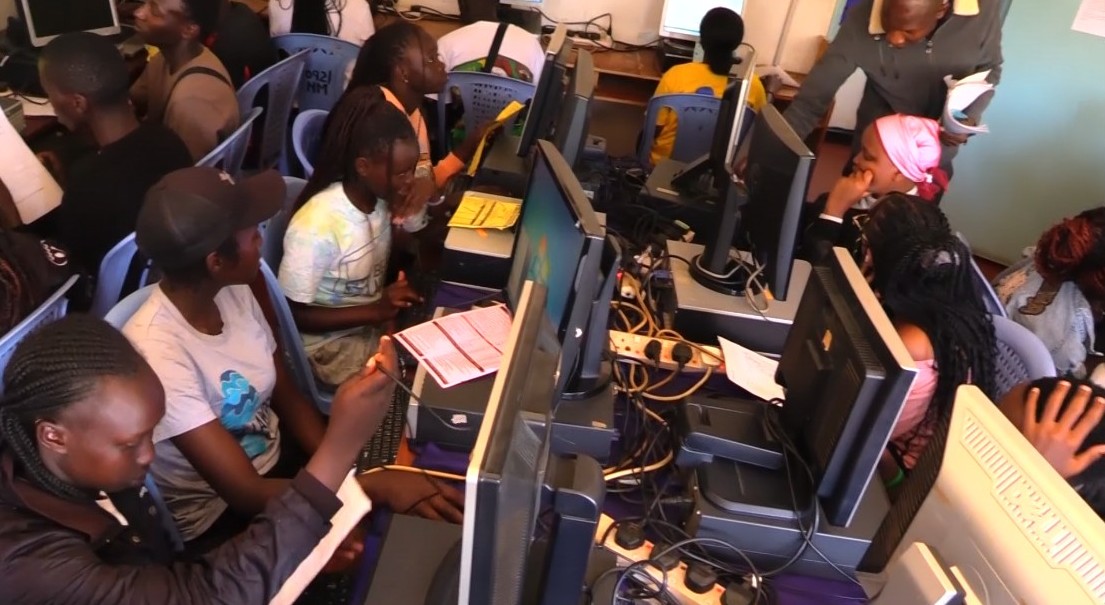
Students from various Technical Vocational Education Training (TVET) institutions in Uasin Gishu County have supported the implementation of the skills-based education curriculum popularly known as Competency Based Education and Training (CBET), noting it has reduced the overreliance on theoretical examinations and instead equips students with practical skills as well as developing talents and skills.
Speaking in Eldoret, led by lecturer John Kimani, who is also a graduate of Nehema College of Science and Technology, the students said that many courses under the new CBE and CBET curriculum focus more on practical training through technical disciplines.
They said the system has increased the efficiency of TVET students to continue their higher studies easily, due to the experience they gain early in the courses they are studying as well as developing their talents.
The students noted that the new curriculum emphasizes hands-on training, innovation, and entrepreneurship, enabling graduates to become self-reliant and competitive both locally and internationally. They said the approach bridges the gap between theory and practice, making learning more relevant to industry needs.
Kimani, a Lecturer and Banker, who started his academic journey from artisan level before excelling to become a lecturer and later being employed at the Central Bank of Kenya (CBK), lauded the CBE and CBET curriculum noting it will equip youth with employability requisite skills to compete in the job market.
“I can attest to it. It has been a place for second chance because when we came here in 2008, the KNEC system did not recognize the old system, the KCPE system of education. we were denied a chance of doing the diplomas we had enrolled for. So, we were forced to do craft certificates and we agreed. Those of us who felt that the school meant well for us, we took the certificates and we performed well. We also took diplomas, which some of us, including me,) we performed extremely very well,” noted Kimani.
“Currently I am also doing ethics of teaching, which is something I feel like our previous teachers didn’t really get into. I am now getting to understand, especially talking about learner abilities, I’m able to understand the differences in learners on the basis of their cultural differences, in basis of their learning abilities. I think that is something that was not really taken into consideration once I was a student,” noted Sharon Koiser, Student undertaking Education Course.
Clementina Lakedo, a student undertaking supply chain management course at Nehema Institute of Science and Technology, said the curriculum has help her achieve her dream, despite failing to realize her initial dream of becoming a lawyer, and now she has a skill to seek employment, thanks to CBET.
“I had distinctions in the units I did. I started from scratch, from the Artisan courses. I did my certificate course, I finished it, and now I’m doing a diploma course,” she said.
“I really loved computing things, hardware, software, because that was my main focus. The thing that I needed so that I can pursue this course is an environmentally friendly institute that can help me nurture my talent and also create new things for society,” said Eric Nyangile; Student of Information Communication Technology.
The students emphasized that their aim is not only seeking employment but also creating job opportunities from the skills they have acquired while at the same time creating a space to facilitate transfer of skills to next generations.
According to education stakeholders, the full implementation of the CBE curriculum is expected to transform the country’s education system by focusing more on skills, creativity and the needs of the job market.
By Ekuwam Sylvester