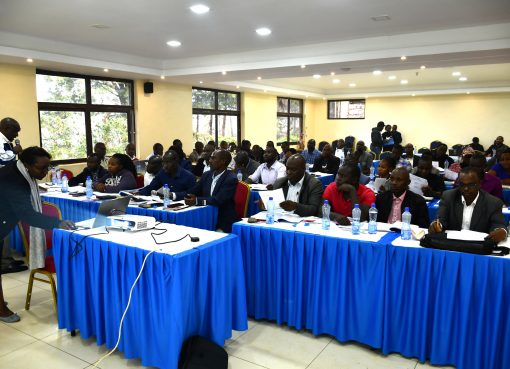
In a bid to strengthen youth empowerment and expand employment opportunities in the North Rift, two nonprofit organizations, Brighter Monday Kenya, in partnership with the Mastercard Foundation, have rolled out the Generation Kazi (GenKazi) Program in Uasin Gishu County.
Speaking on Thursday during the Career Fair Youth Empowerment event at the Rift Valley Technical Training Institute (RVTTI) in Eldoret, Brighter Monday Kenya Managing Director, Sarah Ndegwa, said the program is expected to directly benefit 2,000 young people in Uasin Gishu through training sessions and employer engagements.
“By equipping youth with practical skills and matching them with hiring organizations, the GenKazi Program addresses the persistent unemployment gap in Kenya. Underserved and regional towns also need to be prepared as growing hubs for workforce innovation,” Ms Ndegwa said.
The initiative, part of the Mastercard Foundation’s Young Africa Works (YAW) strategy, is designed to bridge the gap between job seekers and employers by equipping young people with practical, market-ready skills, including Curriculum Vitae (CV) writing, interview preparation, personal branding and direct engagement with more than 40 employers.
Brighter Monday reports that more than 100,000 young people have been trained nationwide since January, including 9,000 in Uasin Gishu County.
Ms. Ndegwa added that dignified work opportunities extend beyond traditional career paths, citing the importance of blue-collar, pink-collar and digital sectors.
She further noted the growing role of digital and AI-driven tools in improving job placements, while also stressing inclusive hiring practices for women, persons with disabilities, and internally displaced persons.
On his part, Uasin Gishu County Executive Member (CECM) for Sports, Youth Affairs, ICT and Innovation, Robert Kemei, said the county government is committed to creating an enabling environment for youth.
“Youth are the backbone of any society. They are the leaders of today and tomorrow, and when you train them, you take care of the future,” Kemei said.
He explained that 902 youth have already benefited from internship opportunities across different sectors, alongside county investments in entrepreneurship training, financial literacy and ICT hubs.
Kemei also noted that the upcoming Governor’s Cup will feature football, volleyball, netball, athletics and pool, adding that the county has plans to establish a pool academy and develop indoor sports facilities to further nurture talent.
County Chief Officer for Youth and Sports, CPA Victorine Kapkiyai, emphasized the importance of collaboration with partners in tackling youth unemployment.
“As a department, we are embracing the digital space by developing a website to map youth skills and match them with employer needs. The entry of Brighter Monday and MasterCard Foundation is timely as it will bridge the information gap and open more opportunities,” said Kapkiyai.
She added that youth offices will be set up in all 30 wards to strengthen outreach, while 13 vocational training centers already established will continue to support skilling initiatives.
Kenya National Chamber of Commerce and Industry (KNCCI) Uasin Gishu Chief Executive Officer, Collins Kipchumba, noted that the Chamber is also supporting young people through its Genuine Growth Program.
“Many young people are educated but lack practical skills required in the job market. Through our programs and partnerships, we want to ensure they are well-prepared for both employment and entrepreneurship,” Kipchumba said.
He encouraged young people to take advantage of the ongoing career fair and KNCCI support programs for further opportunities.
According to the Kenya National Bureau of Statistics (KNBS), the youth unemployment rate in Kenya stood at 11.9 per cent in 2024. In comparison, the country’s overall unemployment rate for the same year was 5.43 per cent, according to World Bank data, marking a slight decline from 2023.
The Federation of Kenya Employers (FKE) notes that youth aged 15–34 years, who make up 35 per cent of the population, face the highest unemployment burden estimated at 67 per cent.
FKE further highlights that over one million young people join the labour market each year, many without adequate skills, as some drop out of school while others complete basic education without advancing to tertiary institutions.
By Fredrick Maritim