A joint report by the Communications Authority of Kenya (CA) and the Kenya National Bureau of Statistics (KNBS) shows significant progress in mobile and Internet uptake across Kenya, while highlighting greater efforts are required to bridge the digital divide.
The Analytical Report on ICT Based on the 2023/24 Kenya Housing Survey, which covers ICT ownership, usage and smart technology adoption, there are marked disparities between urban and rural communities and among income groups.
The report indicates that there is higher ICT adoption strongly linked to income, education, and reliable electricity.
It identifies that people living with disabilities, the elderly, and those with limited schooling face greater digital exclusion.
According to the report, 53.7 percent of Kenyans aged three years and above own a mobile phone. It highlights the fact that those within urban areas lead with 64.6 percent ownership compared to 48.6 percent in rural areas.
In terms of gender, the report shows near-gender parity in mobile ownership with males reported at 54.5 percent compared to 52.9 percent females. It shows minimal gender gap in mobile ownership with males reported at 54.5 percent compared to 52.9 percent for females.
The report identifies people living with disabilities, the elderly and those with limited schooling face greater digital exclusion. It further shows that people living with disabilities, the elderly, and those with limited schooling face greater digital exclusion.
The report which surveyed 25,000 households across the 47 counties, indicates that mobile phone usage stood at 64.9 percent at the national level, with 65.5 percent of males and 64.4 percent of females using mobile phones, respectively.
While mobile ownership is associated with a range of benefits such as unrestricted use of digital services, communication, and financial inclusion, the report indicates that a portion of the population continued to use mobile services through shared arrangements, highlighting underlying inequalities in digital inclusion.
Nationally, 11.3 percent of individuals reported using a mobile phone without owning one, with a slightly higher proportion among females at 11.5 percent, compared to males at 11.0 percent.
Mobile phone sharing was marginally higher in urban areas at 11.8 percent, with 12.4 percent of females and 11.2 percent of males using phones they did not own.
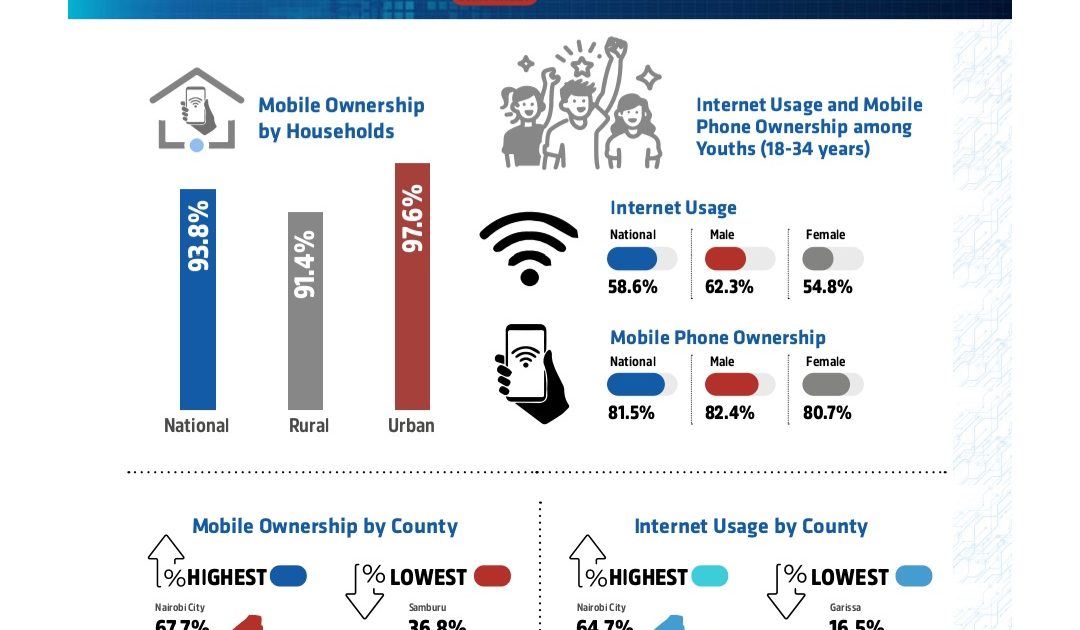
About 35.0 percent of Kenyans now use the Internet, with youth aged 18-34 leading the digital adoption race, with over 80 percent owning a mobile phone and 58.6 using the Internet.
The report shows that unserved and underserved counties have the least mobile phone ownership, with West Pokot County recording the lowest at 29 percent, followed by Turkana (29.4 percent), Marsabit (34.8 percent), Tana River (35.5 percent) and Samburu (36.8 percent).
Nairobi City County leads in mobile ownership at 67.7 percent, followed by Kirinyaga with 65.0 percent and Nyandarua at 63.9 percent in second and third positions, with Muranga and Kiambu sealing the top five at 62.3 and 62.1 percent ownership, respectively.
On Internet usage, Nairobi is ranked first at 64.7 percent, followed by Kiambu (54.0 percent),
Nyeri (50.1 percent), Mombasa (46.9 percent) and Uasin Gishu (42.1 percent). West Pokot (9.1 percent), Turkana (12.7 percent), Tana River (15.5 percent), Marsabit (16.3percent) and Garissa (16.5 percent) Counties recorded the least Internet usage.
The report also shows low computer and smart technology uptake with only 11.6 percent of Kenyans aged three years and above using computers, with just over 20 percent in urban areas. Adoption of smart home technologies remains limited, particularly outside high income and urban households.
The findings underscore the need for targeted investment in digital infrastructure, affordable connectivity, and digital literacy, particularly in unserved and underserved areas of the country, and inclusive policies to empower all Kenyans in the digital era.
Director General of the Communications Authority of Kenya David Mugonyi said in a press statement that these insights provide a robust foundation for policy interventions to make Kenya a more digitally inclusive society.
“Bridging urban-rural and social gaps is critical for equitable national development,” he said, adding that this is in line with the Bottom-Up Economic Transformation Agenda (BETA) and Sustainable Development Goals.
The Director General, Kenya National Bureau of Statistics Dr. George Obudho urged all stakeholders; government, private sector and development partners to prioritize investments and programmes that address digital access disparities and promote universal digital literacy.
By Anita Omwenga