For many older Kenyans, fading eyesight is viewed as just another part of aging, a quiet burden they learn to live with, not something to question or treat.
But to Hilton Ngombo, an Ophthalmic Clinical Officer now working at Malindi Sub-County Hospital, this resignation is not just unfortunate, it is unacceptable and he is determined to change it.
“Losing your sight to cataract does not have to be your fate,” Ngombo says with calm conviction. “This condition is common, yes, but is also one of the most treatable forms of blindness. People just need to come forward early enough,” he explained.
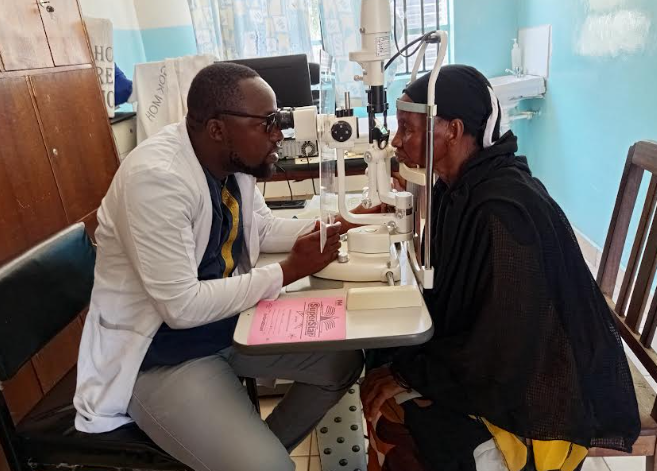
Ngombo has dedicated his career to helping people see again. Previously stationed at Homa Bay County Teaching and Referral Hospital, he has performed hundreds of cataract surgeries, each one transforming someone’s life.
With gentle hands and a steady heart, he brings back light to eyes that had long gone dark.
“That smile, that moment when someone opens their eyes and sees clearly again, that is what gives me motivation to keep going,” he says with pride.
In many communities, people wait too long to seek help, and that is if they seek it at all. Despite the prevalence of cataracts, misinformation, fear of surgery, or the belief that poor vision is just part of aging keeps many suffering in silence.
He says, “Some think surgery is risky, or they will end up completely blind. That fear is understandable, but misplaced. Cataract surgery is one of the safest procedures in medicine today,” he assured.
“With proper screening and preparation, the chances of success are incredibly high and vision is restored almost entirely,” Ngombo says, but he knows the road to recovery begins long before the operating room.
Cataracts develop when the eye’s natural lens becomes cloudy, a condition known as pacification that slowly blurs vision, making it harder to read, recognize faces, or move around safely. It often creeps in quietly, starting around the age of 40 and worsening over time.
“When the lens is clouded, light cannot properly pass through to the retina, which leads to vision problems. The good news is that we can fix it. In modern cataract surgery, we replace the cloudy lens with a clear artificial one. The whole thing takes about 10 to 15 minutes,” he assures.
Cataract surgery uses a technique called phacoemulsification, where the cloudy lens is broken up and replaced with a clear artificial one.
However, the word “surgery” can be intimidating especially to elderly patients and that is why Ngombo takes time to take them through every step from screening and preparation to recovery and aftercare.
Some conditions can affect healing. That is why Ngombo insists on thorough screening and counselling before scheduling any procedure for better outcomes.
“We do not rush anyone into the operating theatre,” he says. “First, we treat any infections or underlying conditions like diabetes and high blood pressure so that healing can go smoothly. We always do everything we can to make sure the conditions are right before proceeding with the operation,”
Post-surgery care is just as important as the procedure itself. Patients are advised to avoid dust, smoke, soap, and even sleeping on the affected side of their face.
Recovery usually takes a week or two but only if the eye is well protected. “You cannot afford to take shortcuts when it comes to your eyesight,” he adds, and urges patients to get help with chores during recovery and follow medical advice to the latter.
On average, Ngombo performs 10 to 15 cataract surgeries every week all with a 100 percent success rate.
“For me, the real reward is seeing someone go from nearly blind to seeing again. It is life-changing not just for the patient, but for their whole family,” he insists.
Still, he worries about those who come in too late when vision has already deteriorated and daily life becomes a struggle.
He insists that early intervention is key to vision restoration because it gives good outcomes.
The doctor, however, warns against herbal remedies or over-the-counter eye drops sold by untrained individuals without a prescription, especially in rural areas where access to qualified professionals is limited.
“Some people come to us after using unsafe treatments that have damaged their eyes. It is devastating when we realize we could have helped them if only they came earlier,” he says.
He stresses the importance of relying on certified eye care professionals, ophthalmologists and trained ophthalmic clinical officers like himself, implying that even within the profession, the depth of knowledge varies.
“Not everyone who wears a white coat is properly trained, those who have pursued advanced post-basic training tend to have a more comprehensive understanding of eye health and are better equipped to handle complex eye issues and one can rest assured of better outcomes in regards to eye care,” he informs.
But beyond the surgeries and diagnoses, Ngombo believes the real key to solving cataract problems lies in public education which he says is just as vital as treatment, and by breaking down the myths and raising awareness, he hopes to help more people seek care before it is too late.
“If we can spread the message, if we can help people understand that their vision can be saved then we can truly change lives,” he advises.
Because for Ngombo, it’s not just about surgery. It’s about restoring hope, dignity, and the simple, priceless gift of sight.
Cataracts can result from various factors like aging, diabetes, smoking, obesity, long-term steroid use, or prolonged exposure to sunlight.
Symptoms include cloudy vision, light sensitivity, and seeing halos around lights, all of which could make even the simplest tasks feel overwhelming.
Left untreated, cataracts could leave people feeling isolated and dependent, robbing them not just of their independence, but their dignity and joy.
“Blindness caused by cataracts can have a serious impact on an individual’s quality of life, affecting not only their independence but also their emotional and social wellbeing,” the doctor notes.
Globally, cataracts are the leading cause of blindness. Of the estimated 36 million people who are blind worldwide, around 12 million have untreated cataracts.
In Kenya, cataracts are responsible for nearly half of all blindness cases with a national prevalence of blindness at 0.7 percent, with cataract accounting for nearly half (43 percent of those cases) making them the single most cause of blindness, according to reports.
In counties like Homa Bay, the burden is especially heavy and data shows cataracts as the leading cause of avoidable visual impairment, highlighting the urgent need for early detection and community awareness.
By Sitna Omar