Kirinyaga Governor Anne Waiguru has stepped up her administration’s climate resilience and development agenda with the rollout of a broad range of community-focused projects aimed at tackling environmental challenges, improving livelihoods, and promoting clean energy.
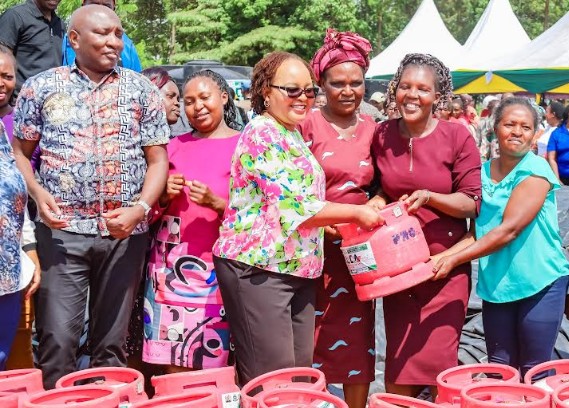
The governor led the distribution of 5,800 free gas cylinders to households across the county in a public event attended by Kirinyaga residents at Kamiigua Grounds in Kutus.
The initiative, she said, is part of an ongoing effort to reduce the use of firewood and charcoal, protect forests, and safeguard the health of women and children exposed to indoor smoke.
“As a county, we are no longer just reacting to climate change. We are responding with sustainable and people-driven solutions. These gas cylinders are not just cooking tools; they are instruments of health, of environmental protection, and of dignity for thousands of our families.” said Waiguru.
The gas cylinder distribution is part of the Financing Locally-Led Climate Action (FLLoCA) programme, a government initiative that empowers counties to implement climate adaptation projects suited to local needs.
Waiguru noted that the county had previously distributed 600 cylinders to families living near Mt. Kenya, where forest conservation is a pressing concern.
“With each family that transitions from charcoal to gas, we are preserving our trees, improving air quality in homes, and saving lives. We estimate that this move will save over 500 mature trees every year.” she added.
Alongside the gas distribution, Waiguru’s administration has initiated several complementary development interventions, including water supply and irrigation support, waste management, and climate-smart agriculture.
To boost access to water and improve household food security, 10,000-litre water tanks were handed over to 20 community groups to support rainwater harvesting and kitchen gardening.
“Every drop of rain that falls on our roofs should not go to waste. These tanks will help our people grow food in their homes, even during dry seasons,” said the governor.
She also highlighted the Inua Jamii Rupingazi Water Project, which will connect over 500 households in Njukiini and Murinduko wards to clean, piped water. Another irrigation initiative, the Rukenya Project, received new piping infrastructure to help farmers shift away from dependence on erratic rainfall.

Addressing the issue of waste and sanitation, the county distributed 26 garbage skips and a skip loader truck to improve cleanliness in markets and trading centers. Waiguru further revealed that the county is setting up a Material Recovery Facility (MRF) to sort and recycle waste.
“This is not just about keeping our environment clean. It’s about creating jobs for our youth, tapping into the circular economy, and building a culture of responsibility in how we handle waste,” she said.
The governor also turned her attention to agriculture, where 60 farmers received dam liners to support irrigation and fish farming. In addition, the county introduced a fish feed production machine, enabling local farmers to produce quality feed at lower cost, reducing dependency on commercial suppliers.
“Our goal is to make our farmers self-reliant. When we support fish farming, we are not only creating food but also creating business opportunities for our people,” says Waiguru.
Looking ahead to the rainy season, Waiguru announced that 20,000 avocado and macadamia seedlings would be distributed to farmers as part of an agroforestry initiative aimed at increasing tree cover while boosting household incomes.
These are high-value crops. They will not only green our county but also put money in our farmers’ pockets,” she stated.
To support social cohesion and grassroots development, the county also issued tents, chairs, and a public address system to 17 self-help groups for use in community events, weddings, and fundraising activities.
The Kirima Dairy Cooperative Society, which has a membership of 6,400, received milk testing equipment and chemicals to ensure the quality and safety of dairy products.
“Cooperatives like Kirima are at the heart of our rural economy. With better equipment, they can fetch better prices and ensure their milk meets all health standards,” said the governor.
The County Assembly Speaker Murimi Mutemi praised the initiative as “a real investment in people’s lives” and called for continued cooperation between the executive and the assembly.
“This is the kind of leadership we need: solutions that touch the ground and respond to the daily struggles of ordinary citizens,” said Speaker Mutemi.
David Karatai, a farmer from Murinduko Ward who has transitioned from muguka farming to fish, avocado, and coffee farming, welcomed the new focus on climate-smart agriculture, noting that the county government has been instrumental in offering both material and technical support.
“As a fish farmer, I’ve received training through the county government in collaboration with extension officers. That training has helped me manage water and fish feed more efficiently,” said Karatai.
He added that avocado farming is becoming more promising due to the growing investment in its value chain. “We’ve seen support in avocado and even tomato farming. There is growing market linkage and advice on value addition. The county has not just given us inputs—they’ve followed up with information, training, and encouragement,” he said.
Karatai said many farmers in his area are rethinking traditional crops and exploring more sustainable, profitable options.
“I used to do muguka farming, but I’ve moved into coffee and fish farming, which are now doing well. Farmers are slowly changing, especially when they see real results,” he noted.
Governor Waiguru also took the opportunity to outline the broader development vision of her administration, which includes the upgrading of health facilities, cabro-paving of market centers, and the creation of the Sagana Industrial City, a flagship project expected to transform the region into a hub for agro-processing and manufacturing.
“We are laying the foundation for long-term growth,” she said. “Development must be practical, visible, and inclusive—and that is what we are doing here in Kirinyaga.”
By David Wandeto