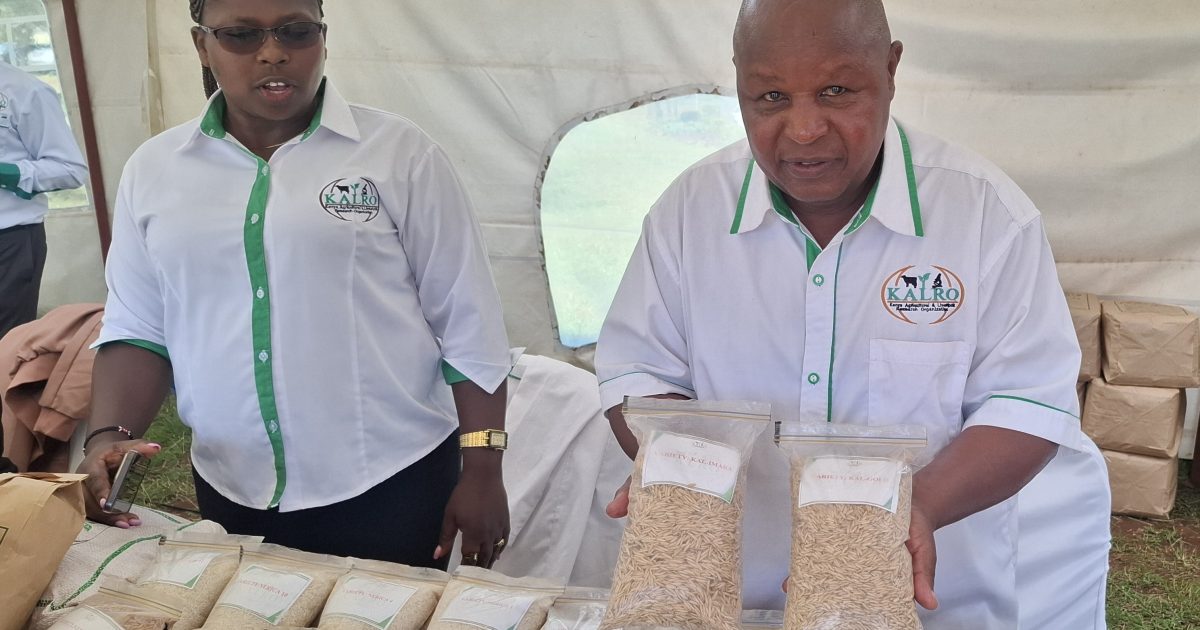
The Kenya Agricultural Livestock Research Organization (KALRO) has in the recent past introduced four new, climate-smart, high-yielding rice varieties—Kalgold, Kalpaa, Kalfine, and Kal-Imara—to help boost production, reduce imports, and enhance farmers’ incomes.
The new rice varieties are designed not only for high yields but also to offer improved disease resistance, faster maturity, and resilience to climate-related challenges. Notably, Kalgold is capable of producing up to 5.5 tons per hectare, making it a competitive choice for farmers across the country.
Rice remains a major staple food in Kenya, yet the country faces a significant production deficit. Kenya currently produces only about 20 percent of its annual demand, approximately 230,000 tonnes, while consuming over one million metric tonnes annually. This deficit has contributed to more than Sh55 billion in imports every year, highlighting the urgent need for increased local production.
KALRO has been aggressively promoting these new high-yielding, climate-smart rice varieties to encourage adoption by farmers and ultimately enhance national food security.
Speaking at a two-day Kilimo Biashara Expo in Thika, a programme that has been running for five years, Sammy Kagito, an agronomist and senior research scientist from KALRO Mwea, said the new varieties are in the process of multiplication and will soon be available for planting.
“Most farmers are familiar with Komboka rice, which has been the premium variety. But with these new varieties, we are introducing options that are not only high-yielding but also suited to different ecological zones and farmer preferences,” Kagito said.
He explained that Kalgold is tolerant to cold, making it resilient against frost, which can be a major challenge in certain regions. Kal-Imara, on the other hand, is ideal for saline soils, such as those found in coastal counties including Kwale and Tana River. “Kal-Imara will grow and produce well in soils where most crops fail, giving farmers in these areas a reliable option,” Kagito noted.
Kalfine is an early-maturing variety designed to allow farmers to harvest even in changing climatic conditions, while Kalpaa is both high-yielding and early maturing. “The name ‘paa’ reflects its fast-growing nature. It also produces good long-grain rice, which is preferred by many farmers,” he added.
Kagito also addressed persistent challenges posed by the Quelea bird, considered the world’s most abundant wild bird, with an estimated population of 1.5 billion, causing massive damage to crops like rice and wheat in sub-Saharan Africa. He said the new rice varieties are developed with a “frag leaf” that emerges on top of the panicle. “When birds attack, the frag leaf pierces them, discouraging feeding on the seed. For early-maturing varieties, we also advise farmers to plant and harvest early so that crops are collected before the birds arrive,” he said.
The new rice varieties are suitable for irrigated ecologies such as Mwea, Bura in Tana River, Bunyala in Busia, West Kano in Kisumu, Taita in Taita Taveta, and selected areas in Kwale. Kagito said that each variety underwent national performance trials across different ecological zones to determine its adaptability and productivity.
“Before any crop variety is officially released, it must undergo rigorous trials to assess performance. We carried out these tests across diverse ecological zones to ensure farmers know which variety will perform best in their region,” he explained.
To support farmers, the seeds will be sold at Sh130 per two kilograms at KALRO Mkulima shops nationwide, subsidized under a sustainable production project. The actual price is Sh160, but the subsidy is designed to encourage widespread adoption. Kagito urged farmers to embrace the new varieties due to their high yields, aroma, resilience to cold and high pH levels, and adaptability to various farming conditions. He emphasized that adopting these varieties will improve both income and food security for farmers.
KALRO has also pioneered public engagement initiatives such as “Mkulima Open Week”, aimed at facilitating access to research outputs and cutting-edge agricultural technologies. Through such platforms, farmers and other stakeholders can interact with scientists, gain knowledge about new crop varieties, and receive hands-on demonstrations to support adoption.
“The introduction of these new rice varieties is part of KALRO’s commitment to improving food security and farmer livelihoods. By integrating climate-smart traits, early maturity, and farmer-preferred qualities, we aim to enhance productivity and ensure sustainable rice production across the country,” Kagito concluded.
By Wangari Ndirangu