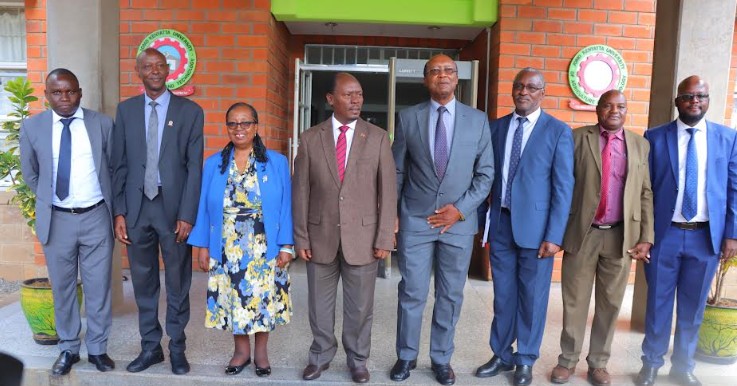
Information, Communications and the Digital Economy Cabinet Secretary William Kabogo has identified JKUAT Industrial Park as the future powerhouse of Kenya’s Digital Assembly.
He conveyed strong confidence in the institution’s park ability to serve as a national nerve centre, producing the essential devices needed to drive the nation’s ICT initiatives.
While on a visit to the facility to discuss local manufacturing within Kenya’s digital economy on Thursday, the CS applauded JKUAT’s history of proven expertise in executing large-scale public initiatives and categorised the university as a steadfast partner, essential to the realisation of the nation’s digital transformation goals.
“We have seen JKUAT’s excellence in action on major national tasks and that proven capacity is exactly why we trust the institution to serve as a central pillar in the government’s mission in building the Digital Superhighway,” noted the CS.
In alignment with the BETA agenda, CS Kabogo similarly highlighted the government’s push to expand the Digital Superhighway with key priorities including the rolling out of nationwide high-speed internet, digitising government operations, and creating digital jobs to position Kenya as a leader in African tech innovation.
Furthermore, the CS also emphasised how the extension of duty remissions for telecom equipment inputs had made local assembly much more affordable with tax relief covering essential parts for mobile phones and computers, significantly lowering the cost of manufacturing digital devices within Kenya.
During the visit, the University’s Vice Chancellor Prof. Victoria Wambui Ngumi, demonstrated how JKUAT’s assembly capabilities support the national BETA initiative, noting that they had already delivered at a massive scale, most notably supplying 390,412 devices for the Digital Literacy Programme and over 190,000 components, including tablets and solar kits for the 2019 National Census.
“At JKUAT, we are bridging the divide between innovation and industry, led by our expertise in assembling TAIFA digital devices. Our goal is to sustain an electronics ecosystem where research will translate into industrial success and create a future where jobs emerge and the youth are at the forefront of Kenya’s digital economy.” Professor Ngumi explained.
To support the nationwide rollout of 1,450 Jitume Digital Hubs, Prof. Ngumi added, JKUAT Industrial Park has optimised its three assembly lines to produce upwards of 3,000 units per day. These cutting-edge facilities are specifically designed for high-precision electronics assembly.
On his part, JKUAT Council and Industrial Park Board Chair Dr James Micah Onsando confirmed the Park’s capacity to expand its output, noting that the facility was prepared to meet growing national needs and support the country’s long-term economic and industrial growth.
JKUAT and the ICT Authority have a proven track record of success and their ongoing collaboration will ensure that Kenya has the innovation and reliability needed to reach its digital transformation goals.
By Hellen Lunalo