In Songhor Soba ward of Tinderet Sub County, one woman has been quietly carving a niche for herself by building an enterprise that is transforming not only her life but also the economic fabric of her community.
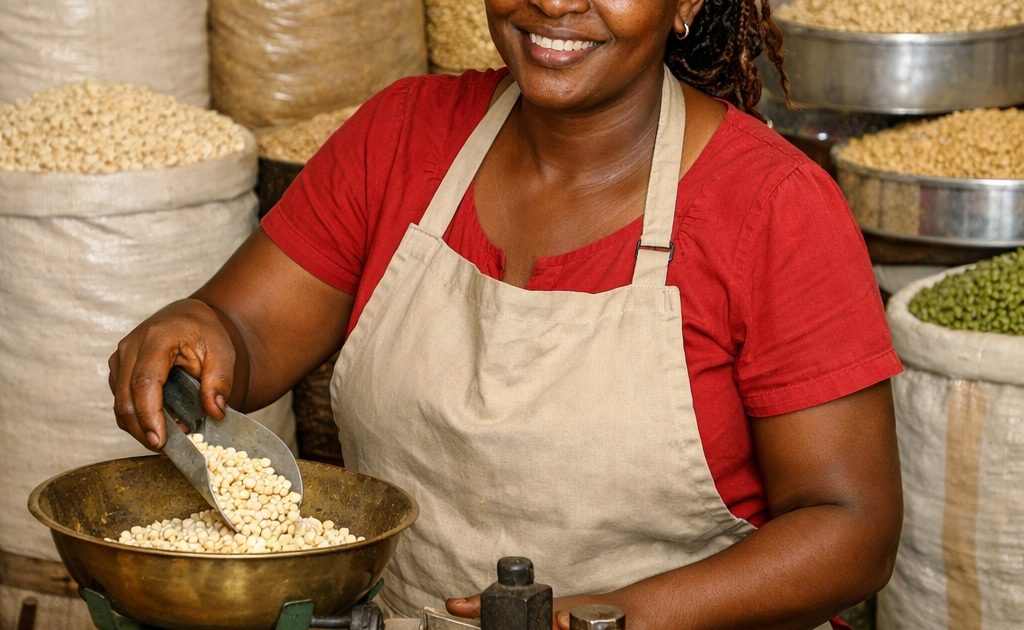
Jane Chebet, a 39-year-old entrepreneur, has turned a small cereal trading venture into a thriving enterprise that now supplies grains across Nandi County and beyond, standing as a testament to the power of women’s economic empowerment.
Fifteen years ago, Chebet’s journey began modestly. Armed with just Sh5,000 borrowed from a local women’s table banking group, she started buying small quantities of maize and beans from farmers and reselling them at the local market. At the time, the returns were barely enough to meet her family’s daily needs. However, she quickly realized that the cereal trade, if well managed, held immense potential due to the region’s strong agricultural base.
“I saw that farmers struggled to find reliable buyers, while traders in towns needed consistent supply. I decided to bridge that gap,” she recalls.
What started as a survival tactic gradually evolved into a structured business. Within three years, Chebet had increased her working capital to Sh50,000 through disciplined savings and reinvestment. She expanded her network of farmers, began bulk purchasing during harvest seasons, and introduced basic storage solutions to reduce post-harvest losses.
Today, her enterprise handles an average of 20 to 25 tonnes of cereals per month, including maize, beans, finger millet and sorghum. During peak harvest seasons, this volume rises to over 40 tonnes. With maize retailing at an average of Sh4,000 per 90-kilogramme bag and beans fetching up to Sh8,000 per bag, her monthly turnover ranges between Sh 800,000 and Sh1000,000, depending on market conditions.
Her clientele has grown significantly over the years. What began as sales to local consumers has expanded into supply contracts with schools, small-scale millers, and traders in nearby towns such as Kapsabet, Nandi Hills and Eldoret. She has also embraced mobile money platforms, making transactions more efficient and secure.
The growth of Chebet’s business has not only increased her income but also created employment opportunities. She currently employs five permanent workers who assist with sorting, drying, packaging and bookkeeping, alongside several casual laborers during peak seasons. Most of these employees are young people from the area, many of whom previously struggled to find stable work.
“Giving jobs to the youth is something I take seriously because I was once in a position where I had no income at all,” she says.
Beyond employment, her enterprise supports dozens of local farmers by providing a reliable market for their produce. She often buys directly from them at fair prices, reducing their dependence on middlemen who tend to exploit them during harvest gluts.
Her success, however, did not come without challenges. In the early years, Chebet faced skepticism from sections of the community who viewed large-scale trading as a male domain. Access to credit was another major hurdle, as financial institutions demanded collateral she could not provide.
Undeterred, she relied on women’s savings groups and gradually built a financial track record that enabled her to access larger loans. By 2018, she had secured her first formal bank loan of Sh300,000, which she used to construct a proper storage facility with a capacity of 100 tonnes. This significantly reduced losses due to pests and moisture, boosting her profitability.
Her resilience reflects the broader reality faced by many women entrepreneurs across Kenya, where access to finance and resources remains a persistent challenge. Yet, her story also highlights the immense potential that lies untapped when women are given the opportunity to thrive economically.
With increased earnings, Chebet has been able to educate her four children, improve her family’s living standards and invest in additional ventures, including dairy farming. She has also become a mentor to other women in Songhor Soba, training more than 25 of them on cereal aggregation, storage techniques and basic financial management.
“When women are empowered, they don’t just uplift themselves—they uplift everyone around them,” she explains.
Community leaders in the Sub County agree that such initiatives are key to sustainable development. They note that women tend to reinvest their earnings into their families, ensuring better nutrition, education and healthcare outcomes.
Indeed, the ripple effects of Chebet’s enterprise are visible across the ward. More farmers are now motivated to increase production, knowing they have a dependable buyer. Youth who once migrated to urban centres in search of work are finding opportunities locally. Women, inspired by her success, are venturing into agribusiness and other income-generating activities.
Chebet has also demonstrated remarkable adaptability in the face of changing economic conditions. During periods of fluctuating market prices, she has diversified her operations to include value addition, such as milling and packaging branded flour for retail. This has not only increased her profit margins but also expanded her market reach.
Looking ahead, she plans to invest in a larger warehouse and acquire modern grain drying equipment to further scale her operations. She also hopes to establish a cooperative that will bring together local farmers and traders, enhancing their bargaining power and access to markets.
Her vision aligns with the growing recognition that women-led enterprises are central to economic transformation, particularly in rural areas. By empowering women with skills, capital and opportunities, communities can unlock new levels of productivity and resilience.
At Senetwo trading centre In Songhor Soba ward, Jane Chebet’s cereal business stands as a powerful example of this principle in action. What began as a small, uncertain venture has grown into a thriving enterprise that supports livelihoods, strengthens local agriculture and inspires change.
Her journey underscores a simple but profound truth: when women are given the tools to succeed, the impact extends far beyond individual households. It shapes stronger families, more vibrant economies and more resilient communities.
By Sammy Mwibanda