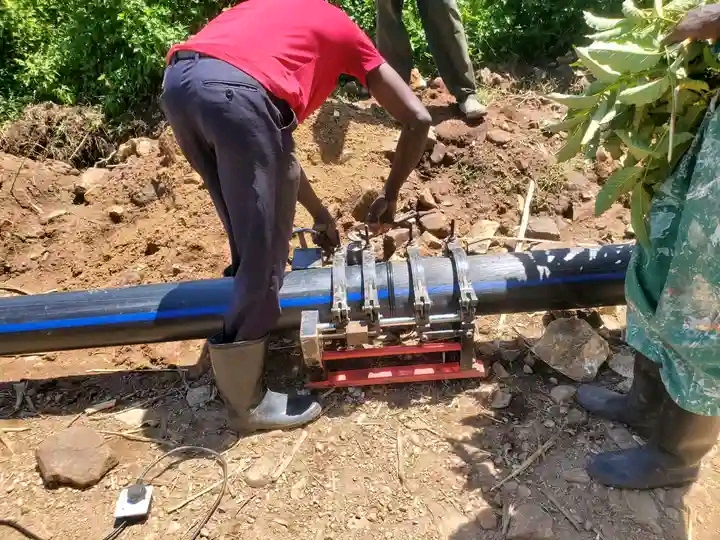
Residents of Chemelil-Chemase ward in Tinderet Sub County are set to benefit from improved access to clean and reliable water following significant progress in the Kaptamwa Water Project, where installation of distribution pipelines is currently underway.
The ongoing works, which involve laying modern high-density pipes across key sections of the project area, mark a crucial phase in the implementation of the initiative that is expected to transform water access for hundreds of households.
The project has now entered an advanced stage, with pipe-laying activities progressing steadily toward completion, signaling a major step toward delivering water directly to homes.
The Kaptamwa Water Project is being implemented under the Nandi County water service framework, with Nandi County Water and Sanitation Company overseeing its execution. The initiative forms part of a broader county strategy to expand water infrastructure and ensure equitable distribution of water resources, particularly in underserved rural areas.
Speaking during a recent inspection of the project, the company’s technical manager, Eng. Joseph Kiprono, expressed optimism about the pace and impact of the works, noting that the installation of pipes represents a major milestone in achieving last-mile connectivity.
“This phase is critical because it directly links the main supply lines to homes and institutions,” said Eng. Kiprono. “We are moving beyond bulk supply to ensuring that water actually reaches the people who need it most.”
He added that the adoption of durable piping materials is expected to reduce leakages and maintenance costs while improving the efficiency of water delivery across the network.
“The use of modern pipes ensures longevity and minimizes losses. It is a sustainable investment that will serve the community for many years,” he said.
For years, residents of Chemelil-Chemase ward have struggled with unreliable water supply, forcing many to rely on seasonal streams, shallow wells, and, in some cases, expensive water vendors.
The completion of the Water Project is expected to significantly ease this burden by providing a stable and accessible source of clean water.
Local residents have welcomed the progress, expressing hope that the project will address challenges they have faced for decades.
Among them is Mary Chepkemoi, who said access to piped water will greatly improve household welfare.
“This project will change our lives. We have been walking long distances to fetch water, but now we can see hope that water will come closer to our homes,” she said.
Another resident, David Kiplagat, emphasized the economic benefits of the project, noting that reliable water supply will support small-scale farming and other income-generating activities.
“With water nearby, we can irrigate our crops and even start small businesses. It opens up many opportunities for us,” he said.
Similarly, Jane Cherono noted that access to clean water will enhance sanitation and reduce waterborne diseases in the area.
“Clean water will help us maintain hygiene at home and in our businesses. It will also reduce cases of illness that come from unsafe water sources,” she said.
The impact of the project is particularly significant in the context of last-mile connectivity, a concept that focuses on ensuring that infrastructure investments translate into actual service delivery at the household level.
While many water projects in the past have concentrated on bulk supply systems, the Kaptamwa initiative places strong emphasis on extending pipelines to reach individual users.
According to Eng. Kiprono, bridging the gap between main supply lines and end users has been a key priority in the design and implementation of the project.
“Last-mile connectivity is where the real value lies. It is not enough to have water in reservoirs or main pipes; what matters is whether it reaches the kitchen taps of our residents,” he explained.
He further noted that the project includes provisions for connecting public institutions such as schools and health facilities, ensuring that essential services are supported by reliable water supply.
“Schools and health centers are among our priority beneficiaries. Access to clean water in these institutions is fundamental to improving education and healthcare outcomes,” he added.
The county government has intensified efforts to invest in water infrastructure, with multiple projects involving pipe distribution, tank construction, and solar-powered systems being rolled out across different wards.
The Kaptamwa Water Project stands out as one of the key initiatives aimed at closing the gap in water access at the grassroots level.
As the project progresses, authorities have assured residents that quality standards are being upheld to ensure durability and efficiency of the system. Engineers on site are overseeing the installation process to guarantee that the pipes are properly laid and connected.
Eng. Kiprono reiterated the company’s commitment to timely completion of the project, stating that all stakeholders are working collaboratively to ensure that residents begin to benefit as soon as possible.
“We understand the urgency of this project to the community. Our teams are working round the clock to ensure that the remaining works are completed within the set timelines,” he said.
He also called on residents to support the project by safeguarding infrastructure and reporting any cases of vandalism or interference.
“This is a community asset, and its success depends on collective responsibility. We urge residents to protect the pipelines and ensure that the system is used responsibly,” he added.
As pipes continue to be laid across Chemelil-Chemase ward, anticipation is growing among residents who see the project as a long-awaited solution to water scarcity.
Once completed, the Kaptamwa Water Project is expected to mark a significant milestone in the county’s journey toward universal water access, bringing services closer to the people and improving livelihoods across the region.
By Sammy Mwibanda