The Engineers Board of Kenya (EBK) has reaffirmed its unwavering commitment to strengthening the country’s capacity to realize her development agenda towards the envisaged first-world status by 2055.
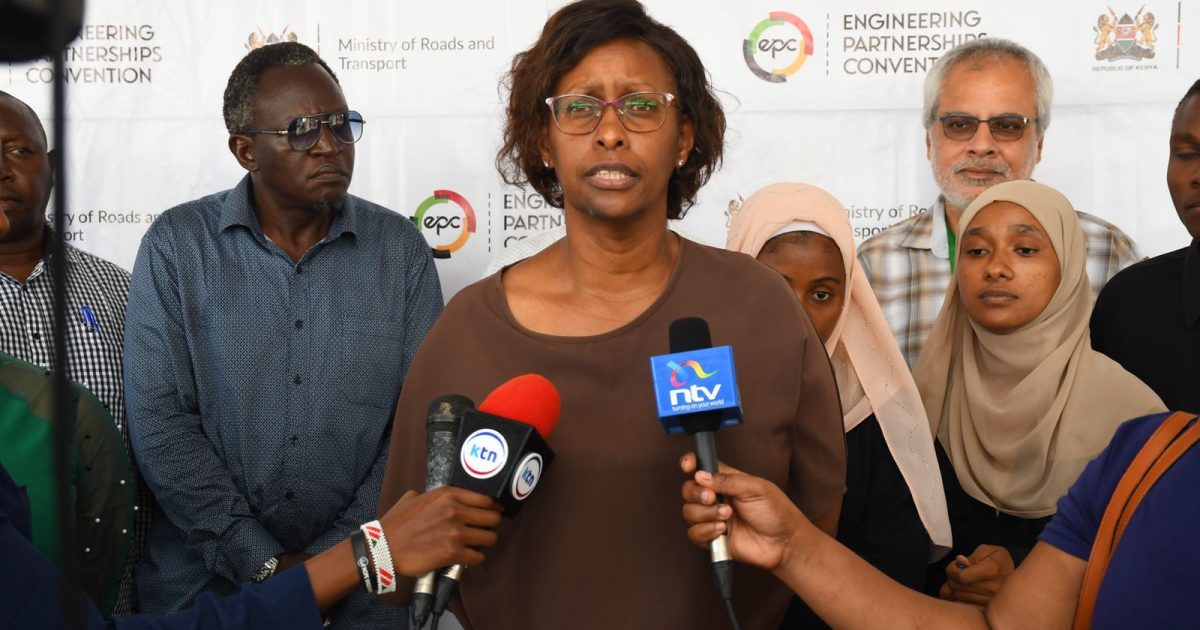
EBK Chief Executive Officer Eng. Margaret Obai said the country’s bold vision of attaining first-world status is heavily anchored on robust infrastructure development, placing engineers at the centre of this transformative journey.
“In Kenya, we place great emphasis on engineering as both a profession and a practice. We have seen strong examples from countries like China and South Korea, where engineering capability has been a key driver of national progress,” said Eng. Obai.
She noted that Kenya currently boasts 77 accredited engineering programmes, commending institutions of higher learning for meeting the required standards.
“For EBK, we have addressed the challenge of universities offering unaccredited programmes. Today, I am proud to say we have achieved 100 per cent qualification of graduates joining EBK as graduate engineers,” she said.
Engineers were also challenged to tap into the vast, largely untapped opportunities within the Blue Economy sector.
Speaking during a mentorship programme with engineering students at the Technical University of Mombasa (TUM) ahead of the 7th Engineering Partnerships Convention, Eng. Obai described the maritime sector as a promising frontier that both emerging and experienced engineers have yet to fully exploit, despite its immense potential.
She emphasised that with the right skills, innovation, and investment, the sector could significantly drive economic growth and open up new professional opportunities.
The CEO further underscored EBK’s inclusive approach, noting that no student is being left behind. The board currently has 22,000 registered graduate engineers, alongside 30,000 professional and consulting engineers. However, the number of marine engineers remains low at just 50.
Eng. Obai attributed this gap to the distinct licensing regime governed by the International Maritime Organisation (IMO).
She revealed that EBK has initiated negotiations with the IMO to establish Mutual Recognition Agreements with major shipping nations such as South Korea and Singapore to facilitate employment opportunities for Kenyan marine engineers.
“There are endless opportunities. As a country, we have yet to fully export our engineering expertise and have largely remained net importers of engineering knowledge,” she said.
“I am proud to note that we are looking at countries like the Philippines, which has over 100,000 engineers practicing abroad. There are limitless opportunities, including in the infrastructure needed to drive the Blue Economy,” she added.
Engineering students lauded the EBK mentorship initiative, describing it as an eye-opening experience that exposed them to a wide range of career opportunities after graduation.
Fadhlun Athman Ali, a Mechanical Engineering student at the Technical University of Mombasa, said the mentorship programme inspired her to switch her career path from medicine to engineering while still in secondary school.
“I learned what engineering truly entails and decided to follow that path. From 2018 to 2026, I have grown through this influence, and now I am about to graduate as a mechanical engineer. These programmes are important because they shape and guide students,” she said.
Jacob Juma, Chairperson of the Engineering Students Association at TUM, called for the mentorship sessions to be held after every semester to benefit more students.
“I am truly grateful for the programme. I have gained valuable insights on transitioning from a student member to a consulting engineer, which has been very helpful,” said Juma.
Fatma Mahmoud, a third-year Mechanical Engineering student, said the session helped her understand the professional journey after graduation.
“From this mentorship session, I learned that one must first register as a graduate engineer and, after three years, qualify as a professional engineer,” she said.
by Sadik Hassan