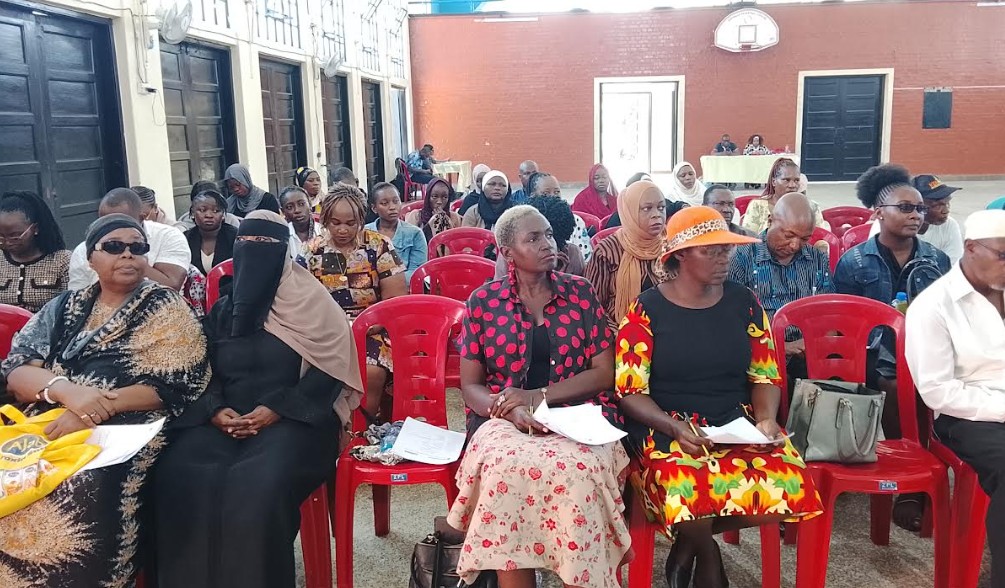
The Kenya Industrial Property Institute (KIPI) has launched a public participation drive along the Coast region to gather views on the proposed Geographical Indications Bill, a legislation that would allow communities to legally protect and market products uniquely tied to their geographic locations.
The Bill, if enacted, would give producers the legal standing to distinguish their goods based on origin, shielding them from imitation and unlocking access to premium domestic and international markets.
KIPI officials confirmed that all submissions gathered during the public participation exercise would be reviewed and incorporated before the Bill proceeds to Parliament for enactment.
Speaking at Tononoka Social Hall in Mombasa, Hussein Haji, a KIPI official, said the exercise was designed to transform the Bill from an institutional document into one that genuinely reflected the voice of ordinary Kenyans.
“We engage the public, we get the comments and views. The comments will be considered and captured in the document. During validation, we will still come back to them to see whether the document they commented on is the same document that is going to come out as an Act,” Haji said.
The forum had participants from across the Coast region, including representatives from Kilifi, Kwale, Lamu, Taita Taveta and Tana River counties, underlining the breadth of interest in legislation with far-reaching implications for agricultural producers, cottage industries and small enterprises.
Among those thrilled by the Bill’s prospects was Marietta Gona, a member of the Coconut Producers Consortium (CPC) from Munase Processing Plant in Mtundia, Kilifi County.
Gona said the legislation would enable her community to formally distinguish their coconut products, particularly mnazi, a traditional palm wine, from similar products produced in other regions.
“The mnazi from Kilifi County does not taste the same as mnazi from Kwale or Lamu. When the geographical indication comes, we will be able to specify that this is mnazi from Kilifi County,” she said.
CPC currently markets three branded varieties of mnazi: Munana for a stronger taste, Katosi for medium, and Viche for sweet, targeting different consumer segments across age groups and occasions.
The consortium also produces extra virgin and cold-pressed coconut oil and coconut shell black ash, with products already being distributed as far as Nairobi.
Gona said the group was piloting processing, packaging and distribution systems but needed urgent support to scale up. She called on county governments, development partners and financiers to provide machinery, qualified food technologists and access to grants.
“We cannot do it alone. We want to get machinery and qualified labour so that we can produce to full capacity,” she said, adding that consumer market development remained a key priority alongside production.
However, concerns over inclusion and accessibility dominated the forum. Omar Kofa Komora from Tana River County warned that small-scale traders, rural communities, persons with disabilities and marginalised groups risked being left behind if the Bill remained inaccessible in its current form.
“Those who come from rural areas cannot read these laws. Many of them are afraid and cannot come forward,” Komora said.
He urged county governments to dedicate resources toward community education on the Bill and to partner with civil society and non-governmental organisations to translate its contents into local languages and accessible formats.
By Ramadhan Nassib