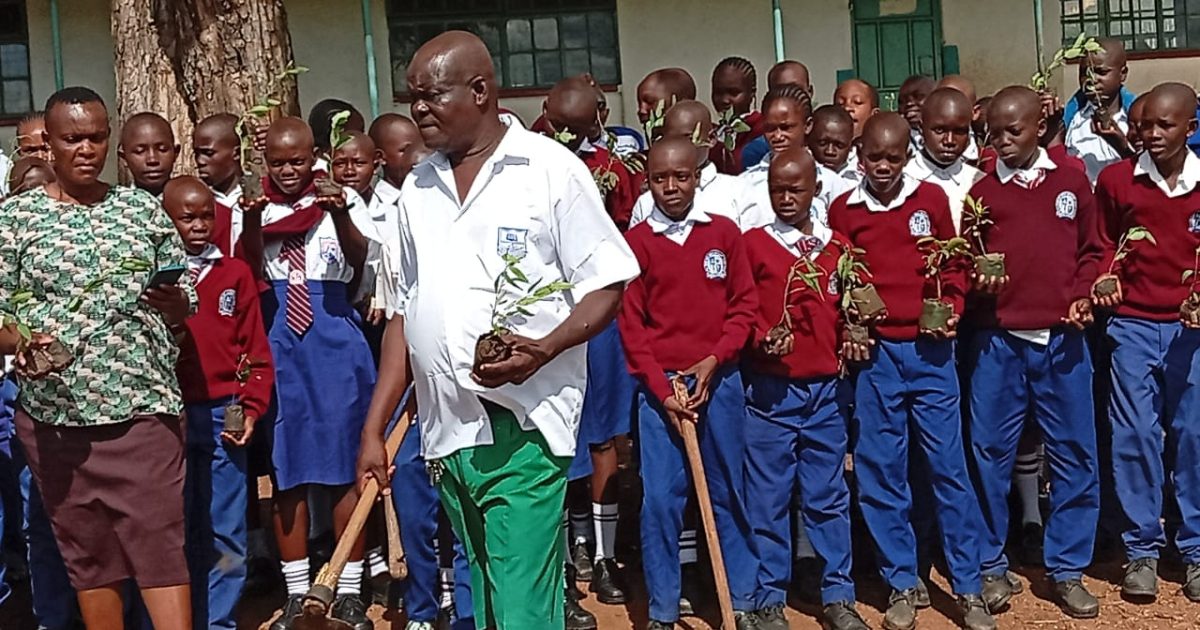
Environmental conservation efforts in Homa Bay County received a boost this week after an environmentalist, Nuhu Omollo Masoud led a tree-planting exercise at Homa Bay Comprehensive School under a project dubbed the “Back to School with a Seedling Program.”
The initiative, organized by the community-based organization ‘Plant Trees for Better Environment CBO,’ saw a total of 200 seedlings planted within the school compound. The program aims to instill a culture of tree planting among learners, parents, and the wider community as schools reopen.
Speaking at the school, Masoud emphasized the importance of integrating tree planting into everyday life and urged learners and parents to adopt the practice as part of their routine. “We are encouraging all learners and parents that as schools reopen, let us plant trees as we continue learning. Let us embrace the culture of planting and nurturing trees,” he said.
Masoud said the long-term benefits of tree planting extend beyond environmental conservation, noting that trees can serve as an economic safety net for learners, as mature trees may later be harvested and sold to support school fees when need arises.
“It’s not just a matter of planting trees. We should plant and grow trees. In the future, learners can benefit from timber, especially during times of financial difficulty,” he explained.
The environmentalist recognized the school’s commitment to environmental stewardship, adding that trees planted during previous visits are said to have flourished, a testament to the institution’s dedication to nurturing them.
Masoud further linked increased tree planting in Homa Bay County to improved weather patterns and healthier crops as a result of the consistent rainfall in the region since the year begun.
Teacher Carolyne Ndinya welcomed the initiative, describing it as both timely and impactful. Ndinya noted that high temperatures often affect learners’ concentration and outdoor activities, making tree cover essential for a conducive learning environment.
“Tree planting helps maintain our environment and is also a way of attracting rain. When it’s too hot, children lose focus in class and find it difficult to play outside,” she added.
She called for the expansion of such programs to other institutions across the county, aligning with Kenya’s national target of planting 15 billion trees by 2030.
She emphasized that environmental conservation should be a shared responsibility. “Tree planting should not be left to a specific group; it is a collective effort. As environmentalists and citizens, we must all take responsibility,” Ndinya said.
The teacher was hopeful that nurturing a culture of tree growing among young learners would yield long-term environmental and economic benefits.
By Sitna Omar