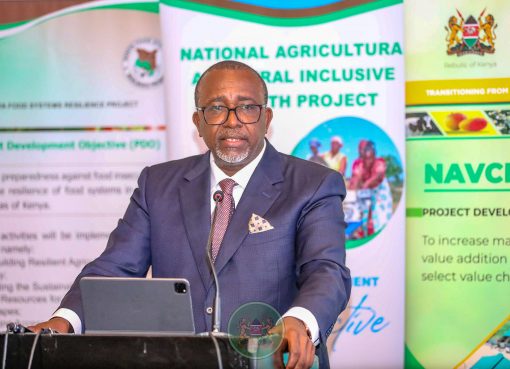
The government is working on modalities to harmonized regulatory framework to promote the visibility and the demand for local agricultural products in both regional and the larger international market.
Investment, Trade, and Industry Cabinet Secretary Lee Kinyanjui stressed that the diversification of the agricultural and food export base was essential in marketing and making local produce more competitive in the ever changing global trade.
For that reason he said the government was committed to pursuing a harmonized regulatory environment that reduces trade friction and support farmer led growth.
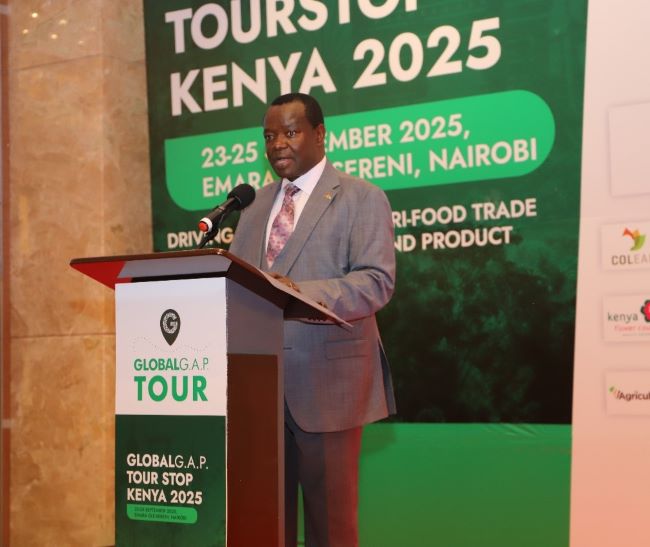
In a speech read on his behalf by Ag. Secretary for Trade, Michael Mandu, the CS told the Global G.A.P. tour stop 2025 meeting in Nairobi the CS said the Ministry was already promoting value addition ventures through investments in Special Economic Zones (SEZ) and County Aggregation and Industrial Parks (CAIPS) to make local products more appealing in the international market.
He said the move was deliberately tailored to support agro processing, micro small, and medium enterprises (MSMEs) to move up the value chain to comply and meet the export market standards.
“Our long-term goal is to move beyond primary commodities into semi-processed, processed, branded, and specialty food products, including organics, functional food , indigenous crops and transition Kenya into a newly industrializing middle-income economy’, he said.
Kinyanjui however regretted that only a paltry 10 to 12 percent of the continent’s export trade was among fellow African nations compared to North Americans who traded among themselves at a rate of up to 40 percent and called on the need to improve the intra-African trading.
“We should aim to increase Intra-African trade of 12 percent to 25 percent in the next decade to drive the development of the continent.”, Kinyanjui said, noting that boosting trade will not only support regional and continental integration but also develop larger markets and foster greater competition.
He noted the importance of the Global G.A.P. tour stop in Kenya as a platform for advancing dialogue and a valuable opportunity to share knowledge and expertise that will help expand trade networks.
Trademark Africa’s Kenya Country Director, Lillian Mwai, said compliance is the currency of trust in agrifood trade, as it secures shelf space in European supermarkets, retail chains in Dubai, and wholesale markets across Africa.
“Without compliance every harvest faces the risk of rejection, and with rejection comes not just financial loss, but livelihoods on the line, especially in rural communities,” she said.
With compliance, she added that farmers gain stability, predictable orders, better prices, and the confidence to invest.
Mwai further said there is a need for widening the product base in fresh produce, oils, pastes, and dried fruits to be able to cushion producers from shocks.
“Over-reliance on a few crops or buyers leaves farmers exposed to shocks, from pest outbreaks to sudden drops in demand, with the new markets opening, such as the AFCTA, which is offering 1.4 billion consumers and USD 3.4 trillion in GDP, even as demand grows in the Middle East for safe, traceable, and sustainably grown produce.
Robert Peck, Senior Operations Officer, International Finance Corporation (IFC), said that their financial support has enabled agribusinesses to invest in infrastructure and training for compliance, such as packhouses, cold storage, and digital traceability.
“These investments, in partnership with retailers and buyers, have connected smallholder-certified producers to export opportunities, creating jobs and increasing incomes,” he added.
Peck noted that Compliance is a catalyst for trade facilitation and collaborations have demonstrated that harmonized standards and streamlined procedures can cut costs and reduce post-harvest losses
The Kenyan government currently has in place a traceability system dubbed “National Horticulture Traceability System (NHTS),” which ensures the quality standards of export produce and will monitor products from farm to market.
Kenya’s export compliance also focuses on mandatory product quality certification via the Pre-Export Verification of Conformity (PVoC) program.
GLOBALG.A.P. TOURSTOP 2025 is running for the next three days and being hosted in collaboration with TradeMark Africa (TMA) as the main partner, GLOBALG.A.P., Rootooba, Absa Bank PLC Ltd, and the International Finance Corporation (IFC) and is running under the theme “Driving the region’s agri-food trade through compliance and product diversification.”
By Wangari Ndirangu