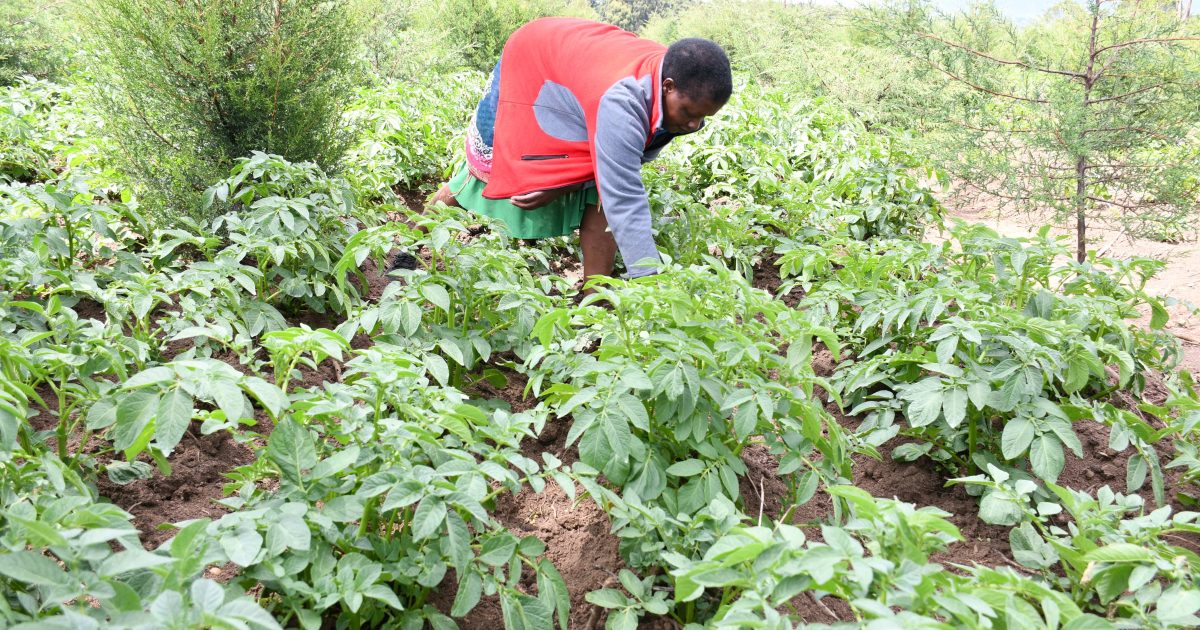
Towards the end of rows upon rows of pine trees at the Naru Moru forest station, where River Nairobi starts to be visible as it flows from the Mount Kenya forest is where we find a potato plantation right in the heart of the woods.
The patches of land stretch for quite a distance. Each of them measures half an acre and is separated by young saplings.
On the first plot is where we meet Patriciah Waihuni tending to her potatoes.In six weeks-time, she will be harvesting her second batch of the Shangi variety of potatoes .
“I am hoping for a bumper harvest and an even better market this time around, “she says.
Ms Waihuni is one of the 200,000 members of Community Forest Associations(CFAs) across the country who are working to establish forest plantation areas.
Data from the Kenya Forest Service shows that there are 233 registered CFAs in Kenya participating in Plantation Establishment and Livelihood Improvement Scheme (PELIS).
As at February this year 6,636 hectares of forest land were under PELIS in the country North Rift, Western Central Highlands, Mau and Coast regions.
The system allows farmers like Ms Waihuni to grow low cover crops such as the potatoes, kales, beans, peas and carrots for their own use on one hand. On the other hand, they are expected to grow fast-maturing exotic trees for timber production which upon maturity are sold to lumberjacks licensed by the Kenya Forest Service.
According to Nyeri Chief Conservator of Forests, Esther Mugo, this arrangement ensures tree seedlings are tended for between three to four years while allowing the farmers to attend to their crops to maturity.
In her assessment PELIS has improved tree seedling survival rates by between 75-80 per cent compared to 40 per cent for areas where re-aforestation has taken place.
“Each and every plot must record over 75 per cent survival of the 300 tree seedlings that they are required to plant. If that one does not happen, the plot is taken back by KFS and issued to another person who is ready to comply with the terms. They are also supposed to do the planting themselves and if the weather conditions are not very favourable, the same farmers are supposed to beat-up especially on the spots where seedlings have dried up,”said Ms Mugo.
Before PELIS was re-introduced in 2007 the country had struggled with practical solutions of how to reverse the rampant deforestation. By the time of its reintroduction, the country was nearly bare with an approximated closed canopy cover of about 3 per cent having lost most of the trees to indiscriminate logging.
Previously, the Shamba System had been introduced to offer Kenyans living near timber plantations with small plots of land for cultivation.
In exchange, the expectation was that these farmers would plant tree seedlings alongside the food crops and after trees had reached maturity, they would vacate the farms.
However, this entire system was riddled with different forms of corruption especially during the allocation process.
James Muriuki, a member of Kabura-ini CFA narrates how farmers intending to secure a plot would be forced to part with bribes, locking out many deserving families from the programme.
In other instances, the officials would illegally allocate plots of land in areas restricted by the Government and this meant that one would lose their land if KFS found them out .
“Normally, a cultivation license goes for Sh 290 but the officials manning the exercise would demand bribes of up to Sh 30,000 for a plot of land and that is how many farmers lost out on opportunity to improve their livelihoods,”he said.
There were also allegations that some farmers would illegally extend their stay on the plantation farms long after their contract had expired.
Close to two decades down the line, reforms in the implementation of PELIS slowly writing off the wrongs of the shamba system.
The program, which is largely supervised by KFS, provides a vital framework where community members, the local CFA and the forest service work together to reduce damage to the timber plantation and better manage newly planted trees.
Ms Mugo says that no area is placed under PELIS without authority from the Chief Conservator of Forests.
And before granting authority to open new farming sites, the respective county forest conservators must submit a report on the status of PELIS at the forest station confirming that previously open areas had recorded a 75 per cent survival rate.
According to Ms Mugo, under this system, anyone wishing to take part in plantation cultivation must be a registered member of a Community Forest Association that is adjacent to the particular forest.
Secondly, allocation is done strictly through balloting sloley supervised by KFS.
This is to ensure that only the prescribed amount of land is allocated to eligible members of CFAs.
The arrangement similarly ensures the farmers adhere to the agreed terms of the agreement.
“The process is guided by the Forest Conservation and Management Act 2016.Section 52 of the subsidiary Regulations for instance spells out where plots may not be allocated which include important water catchment areas or a source of a spring, on a slope exceeding 30 per cent inclination, within 30 metres of either side of a river course or wetland, spring or other water source or in a fire break, road reserve , natural grid, natural forest area and an area under mature plantation,” she explained.
“Section 53 of the regulations categorically affirms the allocation process must be through balloting and spells out that a person must be issued with a cultivation permit. And this ensures there is fairness in the process. Those who do not manage to get a plot are encouraged to try their luck when we announce availability of land once the mature trees are harvested from other areas,” she continued.
For many CFA members PELIS is more than just access to land.
Many view it as a pathway to economic empowerment. One aspect that is rarely talked about is that during allocation,consideration is given to the vulnerable groups including the impoverished and People With Disability(PWD).
Those who have previously benefited from PELIS agree that the system creates a dual benefit of income generation and environmental conservation.
Charles Thuo, a one-time official of the Naru Moru CFA and a PWD compares securing a parcel of land under PELIS to winning a jackpot.
He describes the land as virgin with a potential to yield up to 40 bags of 90 kilogram of potatoes which he says can give an average income of between Sh 30,000 to Sh 50,000 per planting season.
“With one making this kind of money every four months, it is possible to pay school fees for your children and for someone like me who is living with disability, I can use the money for my rehabilitation and medical care,” said Thuo.
He is not alone,Sarah Wanjira, 38, says this is not the first time she has benefited from PELIS, noting that previous opportunities enabled her to acquire home assets and educate her children.
“My house and the dairy cow were all acquired through proceeds from PELIS,”she told KNA.
She expressed hope that the renewed opportunity will help her improve her family’s livelihood and raise school fees for her three children, including one who is set to sit for her final Secondary School exams this year.
by Wangari Mwangi and Samuel Maina