Parents of children living with Down syndrome are calling on the national and county governments in the Coast region to establish more specialized schools to support early intervention through therapy and education.
They say the limited number of institutions offering such services leaves many children without proper care or learning opportunities.
Down syndrome is a genetic disorder that occurs when a child is born with three copies of chromosome 21 instead of the usual two.
According to Dr Kathrene Oyieke, a Paediatric Neurologist at Aga Khan University Hospital in Nairobi, a normal baby is born with 46 chromosomes (23 pairs), but babies with Down syndrome have 47. The extra chromosome affects how the baby’s body and brain develop, causing both mental and physical challenges.
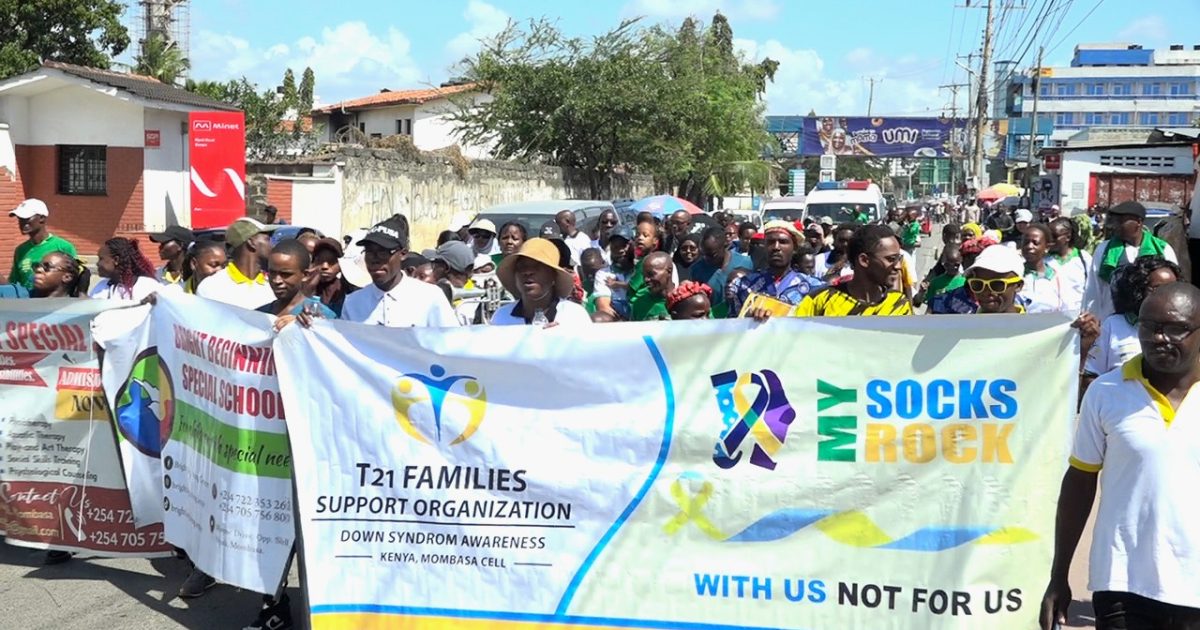
Parents of children living with Down syndrome braved the scorching sun during an awareness campaign that began with a procession at the Kengeleni area in Nyali Sub-County and culminated in a colorful event at the Kongowea dispensary.
Samuel Wambugu, a parent of a child with Down syndrome, urged fellow parents not to hide their children but to seek help and support.
“This is a lifelong condition. A child can live a normal life, though there may be stunted growth. With proper care, they can develop like other children,” he said.
Wambugu called for the establishment of more schools for children with autism and down syndrome, noting that there are only three such institutions in the entire region. He also appealed for the training of more teachers to handle children with special needs.
Mgeni Mwachiro, another parent, shared how she was initially terrified after doctors informed her that her child had down syndrome, but later accepted the condition after receiving counselling from her cousin.
“I want to tell parents not to hide their children. They should come out, meet others, and let their children interact. Keeping them indoors only slows their development,” she said.
Mwachiro also appealed to the County Government to subsidize treatment costs, saying therapy sessions are expensive and conducted weekly.
“Most of the schools that cater for these children are private. The government should build more affordable ones for our families,” she added.
Another parent, Priscilla Chebocho, disclosed that her daughter was born with health complications and had to undergo heart surgery in India shortly after birth.
“It would be better if our local hospitals could perform such surgeries at an affordable rate. Many children die as parents struggle to raise funds for overseas treatment, and even local hospitals charge too much,” she lamented, noting that therapy should be a priority before education.
“Education comes later. First, the child needs to be able to walk, communicate, and be self-sufficient. Therapy is crucial, and we would like every dispensary to have an occupational therapist,” she said.
Jonathan Metet, Head of Disability Mainstreaming at the Technical University of Mombasa, urged parents to dispel myths and misconceptions about children with disabilities, encouraging them to provide love and care instead of neglect.
Linda Okusimba, an Occupational Therapist at Bright Beginning Centre in Nyali, advised pregnant women to attend antenatal clinics regularly for early intervention before giving birth.
Fredrick Muhando, a Special Needs Teacher, emphasized that children with Down syndrome have potential just like other children and should be given equal opportunities to learn and thrive.
by Sadik Hassan