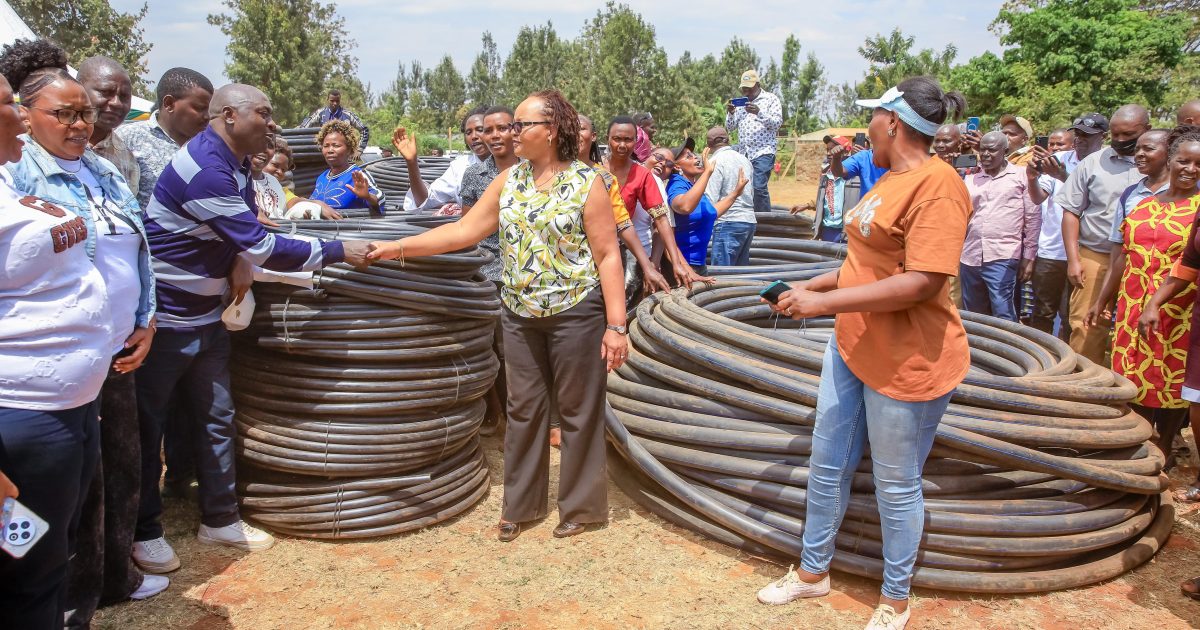
The County Government of Kirinyaga has set aside Sh100 million for the expansion of the bulk water supply system that will benefit more than 30,000 households in Mwea Sub-County.
The allocation will finance the first phase of the extension of the Kutus–Kimbimbi bulk water main pipeline and feeder lines, aimed at supplying clean and safe domestic water to residents of Gathigiriri, Tebere, and Thiba wards.
Governor Anne Waiguru said the project marks a major milestone in her administration’s efforts to ensure that every household in the county has access to reliable piped water. She noted that the expansion will significantly reduce dependence on unsafe water sources and ease the burden of women and children who travel long distances in search of water.
Speaking during the State of the County Address (SOCA) at the Kirinyaga County Assembly, Waiguru said the county had made great strides in water infrastructure development, with Mwea now set to receive priority attention due to its low coverage compared to other sub-counties.
“Compared to other sub-counties, Mwea was lagging behind in water coverage, both for domestic and irrigation use. This is why we are investing significant resources to ensure piped water reaches all the residents,” said the Governor.
Waiguru explained that the ongoing expansion will be undertaken in phases, with Mutithi and Wamumu wards being supplied through the extension of the Kandongu–Mutithi bulk water pipeline. The rehabilitation of the Nyamindi intake will serve residents of Nyangati and parts of Gathigiriri and Tebere, while Kangai ward will benefit from the extension of existing lines to areas such as Kombuini, Kangai, and Karii.
She said that the residents of Murinduko ward are set to receive clean water upon the completion of the Mugaro Water Project, which is currently under construction.
Governor Waiguru further noted that the county has prioritized investment in smaller water projects across various wards to complement the larger bulk systems. She said a total of 33 projects involving the drilling of boreholes, construction of intakes, and installation of water fittings are ongoing at a cost of Sh44.8 million. The projects are expected to increase the number of residents with access to clean water to 78 percent across the county.
The Governor added that since 2017, her administration has undertaken over 200 new water projects through direct government funding and community partnerships, raising the total number of active projects from 170 to 370. These interventions have extended safe and reliable water to more than 100,000 households across the county.
“The above investment in water projects has collectively increased household connections from 67,790 in 2017 to the current 139,596. This has eased the burden of fetching water from distant or unsafe sources, improved hygiene, reduced waterborne diseases, and enhanced productivity,” said Waiguru.
She explained that access to water has also boosted small-scale irrigation, livestock rearing, construction activities, and the growth of cottage industries such as car wash stations and hospitality enterprises. Reliable water supply, she said, is also reducing conflicts over scarce water resources and promoting peaceful coexistence among communities.
To ensure sustainability of the water systems, Waiguru said the county has embarked on reforms to curb water losses and enhance efficiency at the Kirinyaga County Water and Sanitation Company (KICOWASCO).
Through these reforms, non-revenue water (NRW) has been reduced from 59 percent to 47 percent, and the county targets to bring this down to below 35 percent by next year.
She attributed the progress to improved monitoring mechanisms, including the installation of a master meter at the Muratiri Water Treatment Plant, which now allows for accurate tracking of water production against consumption.
Further, the county is installing 27 electro-magnetic zonal meters and District Metering Area (DMA) systems to strengthen flow management and billing accuracy across different service zones. These systems are designed to ensure that every drop of water is accounted for and that losses from leakages, bursts, and illegal connections are minimized.
“This reform has enhanced accountability, improved operational efficiency, and positioned the utility to serve our growing population better. We target to reduce water losses to below 35 percent by next year,” Waiguru stated.
The Governor noted that challenges such as old and dilapidated infrastructure, illegal connections, and unmetered community water projects had in the past contributed to high levels of water loss. She reaffirmed her administration’s commitment to addressing these issues through modernization and tighter oversight.
The County Government’s overall water strategy seeks to achieve universal access to safe and clean water by 2030, aligning with both the national development agenda and Sustainable Development Goal (SDG) 6 on clean water and sanitation.
Waiguru said her administration remains committed to ensuring that every household, especially in rural areas, has access to affordable and sustainable water supply, describing the initiative as a cornerstone of Kirinyaga’s economic transformation.
By David Wandeto