The world faces unprecedented environmental challenges, from climate change to resource depletion and escalating waste, and Kenya is no exception.
Principal Secretary of the State Department for Environment and Climate Change Dr. Eng. Festus Ng’eno, said on Thursday (today) that with rapid urbanization and a growing population, the volume of waste generated is immense.
Speaking during the two-day 10th Kenya Private Sector Alliance (KEPSA) Circular Economy Conference, the PS said that currently, each citizen produces about 0.5 kilograms of waste daily, accumulating to approximately 27,500 tons across the country every single day.
“A staggering 60 percent of this waste is not properly managed, resulting in widespread environmental degradation,” he added.
Eng. Ng’eno noted that the proliferation of plastic pollution and the complex challenge of e-waste are particularly alarming, as they pose significant threats to human health and the rich biodiversity that is crucial to our national heritage.
The PS explained that a circular economy is therefore foundational to the government’s national development goals, about redefining growth and focusing on positive, system-wide benefits by minimizing waste and pollution by design, keeping products and materials in use for as long as possible and regenerating natural systems.
He announced that the ministry is prioritizing the development of a comprehensive circular economy strategy this financial year to transform value chains and foster green job creation.
“This strategy will go far beyond traditional waste management by transforming our entire value chains. It will promote waste prevention, reuse, recycling, and resource efficiency, directly reducing the environmental harm caused by unmanaged waste,” Eng. Ng’eno said.
KEPSA CEO Carole Kariuki said that over the decades, circularity has moved from
theory to practice, from pilots to programmes, from Nairobi to counties, and from waste management to full systems redesign.
“The circular economy is not just an environmental agenda but an economic strategy that drives innovation and strengthens manufacturing,” she said.
The Project Director of Sustainable Inclusive Business Kenya (SIB-K) Ms. Karin Boomsma challenged delegates to adopt a regenerative mindset, rooted in indigenous wisdom.
Ms. Anja Berretta of Konrad Adenauer Stiftung emphasized that policy dialogue and systems thinking are essential, and therefore, by strengthening institutions and sharing knowledge, we create the enabling environment for circular innovations to thrive”.
Ms. Kamilla Heden Henningsen from the Embassy of Denmark in Kenya noted that “Practical cooperation skills, design, and enterprise support turn policy into livelihoods. Denmark remains a committed partner in delivering hands-on circular solutions”.
The 10th Annual Circular Economy Conference and No Waste Festival opened today, marking a decade of accelerating Kenya’s transition to a regenerative circular economy.
Today, the official launch of the Textile Tool Kit: WearTheGreenFuture aimed at promoting redesign, slow fashion, and circular social opportunities within the textile industry was announced.
Day II (Friday) will be dedicated to the Kenya Plastics Pact (KPP) Summit, focusing on accelerating the transition to a circular economy for plastics.
The summit will feature the official launch of the No Single-Use Plastics Elimination Manual, a landmark initiative designed to accelerate the phase-out of problematic single-use plastics, starting with Kenya’s hospitality and tourism sectors.
The manual promotes the adoption of the 5Rs: Refuse, Reduce, Replace, Reuse, and Refill.
Delegates will also focus on the KPP’s ambitious roadmap to 2030, which includes targets for the elimination of problematic plastics, achieving 100 percent reusable or recyclable plastic packaging, and integrating 15 percent recycled content across all plastic packaging.
Co-hosted by Sustainable Inclusive Business Kenya (SIB-K) in partnership with the Kenya Plastics Pact (KPP), the Ministry of Environment, Climate Change and Forestry, and the National Environment Management Authority (NEMA) Kenya, the conference is powered by Konrad-Adenauer-Stiftung Kenya and supported by a coalition of strategic partners.
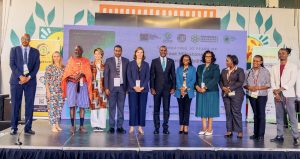
The event is running under the theme “Reimagine: Looking Back into the Future” and convened 300+ delegates, including policymakers, industry leaders, innovators, and youth, for a day focused on “Circularity in Action.”
By Wangari Ndirangu