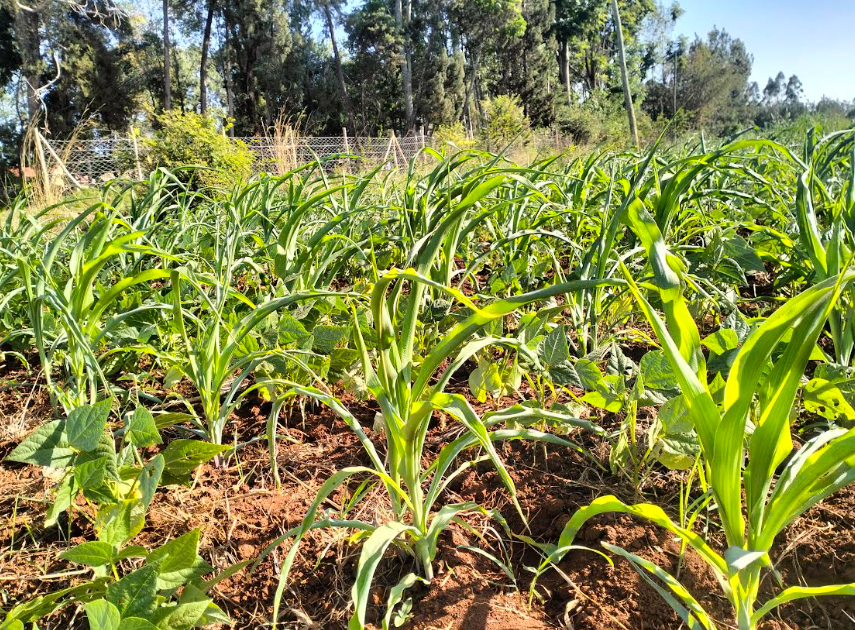
Farmers in Murang’a County have expressed concerns over the poor rainfall this season, which now threatens to ruin crops just as they begin to thrive
In Kamahuha, an area highly productive with maize and beans, crops look emaciated and weak at knee length due to depressed rainfall.
Many farmers reported that they had invested heavily in seed, fertilizers, and labor, and added that the sudden drop in precipitation has placed their livelihoods at risk.
I planted my entire farm expecting normal rainfall. If the rains do not return, I may lose everything,” said Jane Wanjiru, another resident.
The Kenya Meteorological Department in October had issued a warning that rainfall levels for the October-December season may be below average.
They noted that depressed rains are likely due to changes in regional weather patterns, affecting Central Kenya and other parts of the country.
Murang’a County Director of Meteorology, Peter Karanja said that the region is experiencing below-average rainfall, noting that such conditions could worsen food insecurity if the pattern persists.
“We are advising farmers to consult agricultural extension officers on suitable crop varieties, water conservation techniques like mulching, and use of moisture-retaining pits.”
The Met department had urged farmers to consider planting fast-maturing and drought-tolerant crops, but many had already planted by the time the rains subsided just two weeks in.
Agricultural experts warn that if the situation persists, both maize and horticultural crops could experience stunted growth, reduced yields, or even complete failure.
“Farmers need to consider water conservation techniques such as mulching and rainwater harvesting. However, large scale farmers may find it difficult to implement these measures effectively,” said agronomist Lawrence Njuguna.
Farmers are now hoping that the rains will resume in the coming weeks to allow them to sustain the crops.
“I had even weeded and I was expecting a good harvest this season, but all my maize crop looks like onions yet i had spent over Sh20,000 for land preparation, seeds and farm inputs” lamented Agnes Mwangi.
Reduced harvests will not only threaten food security but may also push up food prices, further straining household budgets.
John Kamau, a small-scale farmer from Makuyu, says he had also planted maize and beans on his two-acre piece of land and was expecting a bumper harvest which is his sole source of livelihood.
“The crops germinated and sprouted well, I knew my labour was not in vain but after a few days the rains disappeared and the young plants are almost drying up now.”
“We however are hopeful that the rains will return and I can be able to salvage even an eighth of what I had planted,” he said.
Another farmer, Kamande Muiruri invested in tomatoes and capsicum, hoping to take advantage of the early showers. She says the dry spell has frustrated her efforts.
“Tomatoes require consistent watering, and I solely rely on rainfall. I had spent over Sh30,000 on seedlings, fertilizer, and labour, but nearly everything is drying up,” Njeri said, adding that irrigation is too costly for smallholders.
Normally, the short rains between October and December are crucial for most farmers in Murang’a and other central counties, sustaining maize, beans, and horticultural crops before the long rains begin in March.
By Florence Kinyua