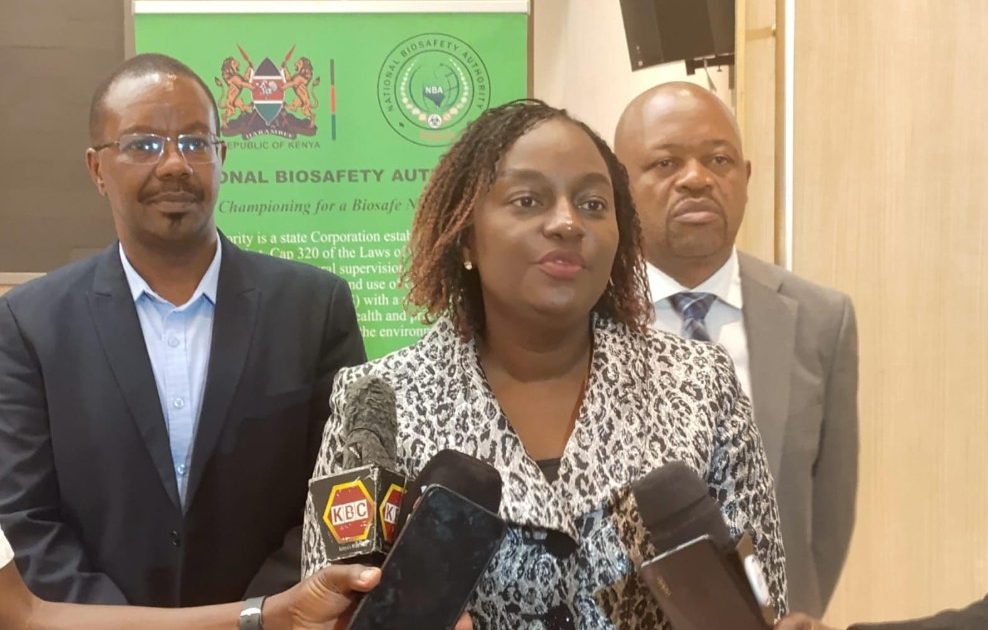
The National Biosafety Authority (NBA) has pledged to streamline the approval of genetically modified (GM) products and harmonise regulatory processes to accelerate the adoption of biotechnology as a tool for addressing food insecurity in Kenya.
NBA Board Chairman David Wamatsi said the Authority would work with other government agencies to ensure that approvals are processed concurrently, reducing delays that have slowed the commercialisation of approved biotechnology products.
Speaking in Nairobi during an engagement with principal investigators and Institutional Biosafety Committees (IBCs), Wamatsi said the Authority had identified lengthy regulatory processes and uncertainty after NBA approval as some of the challenges facing researchers and developers.
“We have agreed to harmonise our approval process so that where other government agencies are involved, it runs concurrently,” he said.
Wamatsi said the move would ensure that once the NBA approves a product, there are no unnecessary delays arising from subsequent regulatory procedures.
He added that the Authority was also working on amendments to the Biosafety Act to align it with emerging technologies, including genome editing.
The engagement brought together principal investigators involved in biotechnology research and IBCs, which Wamatsi described as the first line of regulatory oversight within research institutions.
He said the committees play a critical role in ensuring that biotechnology research complies with established biosafety requirements before applications are submitted to the NBA.
“Our role is to regulate science and biotechnology to ensure that whatever Kenyans consume is safe for them, animals and the environment.”
Wamatsi identified misinformation, propaganda and rumours surrounding GM technology as a major challenge to the uptake of biotechnology in Kenya.
He urged Kenyans to seek information from credible scientific and regulatory sources, saying biotechnology could contribute to addressing the country’s food security challenges when properly regulated.
“This technology is being run by our own sons and daughters. The researchers and scientists are Kenyans,” he said, adding that products developed through approved biotechnology processes undergo regulatory scrutiny to ensure their safety.
NBA Chief Executive Officer Dr Ann Karemi said the engagement was the first of its kind to bring together principal investigators and heads of IBCs to openly discuss challenges affecting biotechnology research and regulation.
She said the Authority wanted to strengthen collaboration with researchers and institutions to improve compliance while making regulation more facilitative and efficient.
“We need to talk to each other, not at each other, ultimately for the benefit of the common mwananchi whose major problem is food and safe food,” said Karemi.
Karemi said researchers had called for faster processing of applications once ongoing court processes are concluded, noting that existing legislation provides specific timelines that the Authority must follow.
She said the Authority would also increase training for IBCs to strengthen their capacity to conduct effective internal oversight and ensure that applications reaching the NBA meet the required standards.
“If we can better train them, they can support us and do a lot of self-regulation by the time they come to our doorsteps,” she said.
Dr Martin Murigi, Director of the Biotechnology Research Institute at the Kenya Agricultural and Livestock Research Organisation (KALRO), welcomed the engagement, saying it would help researchers understand regulatory requirements and identify ways of improving compliance.
He said biotechnology projects were subject to several regulatory requirements and that closer engagement with the NBA would help institutions improve efficiency while ensuring Kenya benefits from the technology.
“We are pleased that the National Biosafety Authority has been able to set up this platform,” said Murigi.
The Authority had previously engaged IBCs and principal investigators separately, but the CEO Karimi said the new approach would provide a platform for stakeholders to address common challenges collectively.
She said the NBA intended to make such engagements regular to strengthen coordination, compliance and the efficient development of approved biotechnology products.
The Authority said viewing modern biotechnology as an investment rather than solely a compliance issue could help Kenya harness the technology to improve food availability while safeguarding public health and the environment.
By Wangari Ndirangu